
Quick Answer: Which Cone Type Should You Choose?
Selecting the right training cones can dramatically alter the quality, safety, and flow of a football training session. There is no single “best” cone for every scenario; rather, the optimal choice depends entirely on the specific drill, the age of the players, and the training environment.
For coaches and players setting up sessions on local pitches or school fields, understanding these differences prevents disrupted drills and unnecessary injuries. Having the wrong gear can lead to constant interruptions or, worse, physical hazards during high-intensity sessions.
Tall cones excel at high-visibility boundary marking and establishing clear target zones from a distance. Disc cones are the industry standard for tight agility work, rapid footwork, and minimizing trip hazards in crowded spaces. Saucer cones serve as a highly versatile middle ground, offering a slightly higher profile than discs for better visual tracking during dribbling drills without the bulk of tall markers.
Products mentioned in this guide
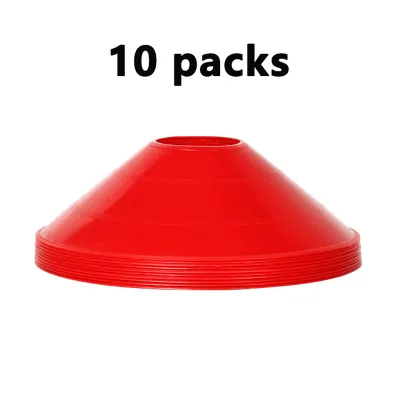
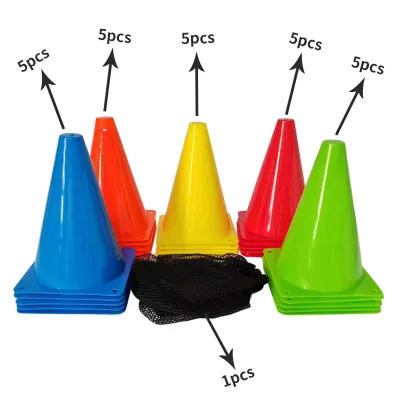
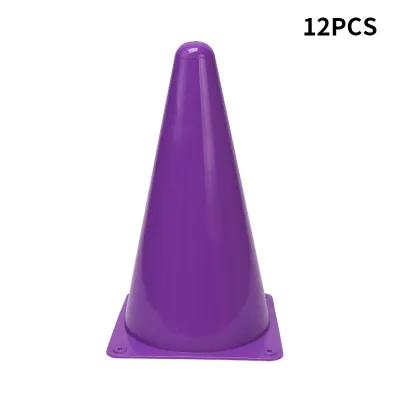
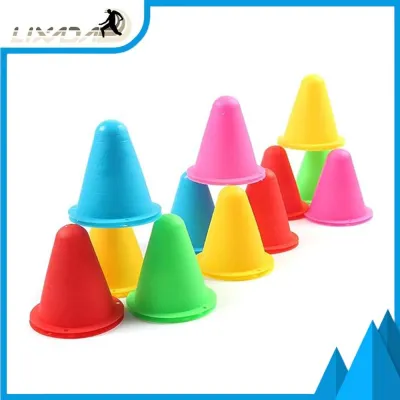
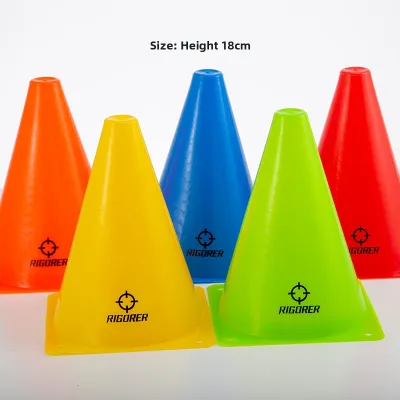
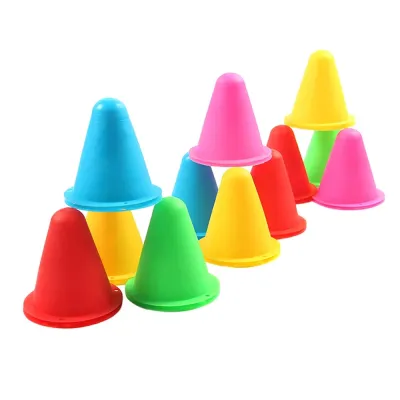
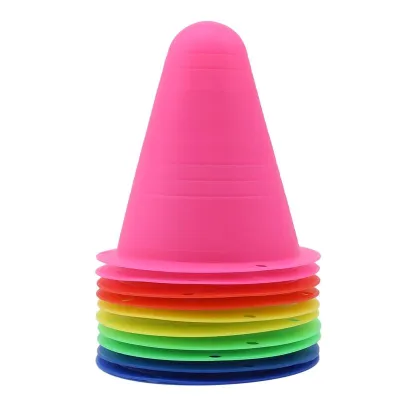
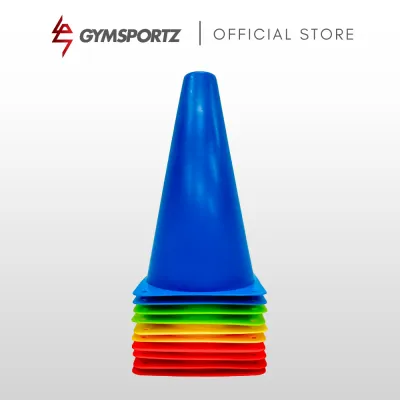
Prices are valid at publication and may change. Please refer to the product page for the latest price.
A well-rounded football training kit rarely relies on a single style. Instead, combining these three types allows you to tailor your setup to various technical, tactical, and physical conditioning drills.
Understanding the Three Main Football Training Cones
To choose the right gear, you must first understand the physical characteristics and structural designs of each cone type.

Tall Cones (Marker Cones)
Tall cones, often referred to as traffic or marker cones, typically stand between 12 to 18 inches (30 to 45 cm) in height. They are constructed from rigid or semi-rigid plastic, such as high-density polyethylene (HDPE) or polyvinyl chloride (PVC). Their primary design goal is maximum vertical visibility, ensuring players can spot them from across the pitch even when their focus is locked on the ball or an opponent.
Because of their height, they often feature a wide, square base to maintain stability on uneven grass surfaces. Many models also include cut-out slots or holes near the top, which can be used to hold training hurdles or boundary poles, adding to their utility.
Disc Cones (Flat Cones)
Disc cones, sometimes called flat cones, feature an ultra-low profile, typically rising only 2 to 3 inches (5 to 7.5 cm) off the ground. They are manufactured from highly flexible, lightweight low-density polyethylene (LDPE) that collapses instantly when stepped on.
This design minimizes the risk of ankle rolls and allows the ball to roll over them with minimal deflection. They are highly stackable, making them exceptionally easy to transport in large quantities inside a standard kit bag. Their low manufacturing cost also makes them the most budget-friendly option for coaches.
Saucer Cones (Shallow Dish Cones)
Saucer cones bridge the gap between tall cones and flat discs, featuring a mid-profile dome shape that stands roughly 3 to 5 inches (7.5 to 12.5 cm) high. They have a wider, curved base than standard disc cones, which provides a more substantial visual target without creating a major physical barrier.
Made from flexible plastic, they retain their shape well after being stepped on, offering a compromise between the high visibility of tall markers and the safety of low-profile discs. They are particularly popular in youth academies where players need clear visual cues but still require a forgiving surface if they trip.
Key Comparison Dimensions for Football Drills
Evaluating training cones requires looking at how they perform under the physical demands of high-intensity football training.
Visibility and Player Awareness
During high-speed sprints or complex tactical drills, a player’s peripheral vision is heavily taxed. Tall cones provide an unmistakable visual cue that can be spotted instantly without forcing the player to look directly down at the ground. This is crucial for maintaining spatial awareness and keeping the head up—a fundamental skill in modern football.
Disc cones, while excellent for close-up work, can easily disappear from a player’s peripheral vision during long-distance drills or when training on long, un-mown natural grass. Saucer cones offer a balanced compromise, standing high enough to remain visible during medium-distance runs while keeping the player’s focus relatively close to the playing surface.
Trip Hazard and Safety
Safety is a paramount concern, especially during high-velocity agility drills involving rapid changes of direction. Disc cones present the lowest risk of injury; their flexible, low-profile design means that if a player plants their foot directly on one, the cone simply flattens under their weight, preventing ankle inversion or slips.
Saucer cones also collapse under pressure, though their slightly higher dome can occasionally cause a minor stumble if clipped at high speed. Tall cones present the highest trip hazard. If a player collides with a rigid tall cone, it can cause a fall, or worse, lead to a rolled ankle if the player attempts to plant their foot on the rigid base. Therefore, tall cones should never be placed in areas where high-speed physical contact or tight footwork is expected.
Ball Interaction and Deflection
The way a football reacts when striking a cone can make or break the flow of a training session. When a ball hits a disc cone, it often rolls right over it with only a minor change in trajectory, allowing the drill to continue uninterrupted.
Saucer cones will cause a moderate bounce or deflection, which can actually be used intentionally to simulate unpredictable ball movements. Tall cones, however, act as solid obstacles. A ball striking a tall cone will stop dead, bounce back, or deflect wildly off-course. While this is useful for simulating defenders or creating passing barriers, it can frustrate players during continuous dribbling or passing sequences if the spacing is tight.
Comparison Table
| Feature | Tall Cones | Disc Cones | Saucer Cones |
|---|---|---|---|
| Height Profile | 12 to 18 inches | 2 to 3 inches | 3 to 5 inches |
| Visibility Distance | High (Excellent from afar) | Low (Best for close-up) | Medium (Good mid-range) |
| Trip Hazard Risk | High (Rigid structure) | Low (Collapsible design) | Medium-Low (Flexible dome) |
| Ball Deflection | High (Stops or redirects ball) | Low (Ball rolls over easily) | Medium (Causes minor bounce) |
| Wind Stability | Low (Prone to tipping over) | High (Aerodynamic profile) | High (Low wind resistance) |
Best Use Cases: Matching Cones to Specific Drills
To maximize the effectiveness of your training sessions, you must match the physical properties of each cone to the specific demands of your drills.
Dribbling and Close Control
For close-control dribbling, slalom runs, and tight weaving drills, disc cones and saucer cones are the superior choices. These drills require players to manipulate the ball within inches of the markers. Using low-profile disc cones allows players to focus entirely on their touch and footwork without worrying about tripping or damaging the equipment.
If a player makes a mistake and clips a disc cone, the drill can continue smoothly. Saucer cones are also highly effective here, particularly for younger players who need a slightly more prominent visual target to guide their path through a slalom course.
Agility, Speed, and Change of Direction
Agility drills, such as shuttle runs, T-tests, and Illinois agility runs, require players to sprint to a marker, plant their foot, and change direction instantly. Here, the choice of cone involves a trade-off between visibility and safety.
Disc cones are ideal for the actual turning points because players can plant their feet directly next to—or even on—the cone without losing their footing. However, to ensure players can see the turning points clearly while sprinting at maximum speed, placing a saucer cone at the key pivot points offers the perfect balance of visibility and safety.
Boundary Marking and Target Zones
When setting up the boundaries for small-sided games, passing grids, or tactical shape drills, tall cones are indispensable. Players need to be able to identify the limits of the playing area instantly from 20 to 30 yards away.
Disc cones can easily be obscured by other players or the texture of the turf, leading to frequent arguments about whether the ball went out of bounds. Tall cones provide clear, vertical sightlines that eliminate any ambiguity. Additionally, tall cones are excellent for creating physical targets, such as “goals” for passing drills or obstacles that players must loft the ball over to reach a teammate.
Surface and Weather Considerations
The environment in which you train plays a massive role in how your cones perform and how long they last.
Grass vs. Artificial Turf vs. Indoor Courts
On natural grass pitches, the uneven surface can cause lightweight disc cones to shift or blow away easily, while tall cones with wide bases can sit unevenly. Some tall cones feature holes in the base for ground pegs, which secure them firmly to natural grass.
On artificial turf—which is highly prevalent in Singapore—pegs cannot be used. On these synthetic surfaces, weighted disc cones or saucer cones with textured bases are ideal as they grip the synthetic fibers. For indoor sports halls or futsal courts with parquet or synthetic rubber flooring, standard lightweight plastic cones can slide easily when stepped on, creating a slipping hazard. In these indoor settings, look for cones made from thermoplastic rubber (TPR) or those with non-slip rubberized bases to ensure they stay firmly in place.
Wind Resistance
Wind can be a major disruptor during outdoor training sessions, especially on open fields or coastal pitches. Tall cones have a high surface area, making them highly susceptible to catching the wind and blowing over.
If you must use tall cones in windy conditions, look for models with weighted bases or hollow designs that allow wind to pass through. Disc cones and saucer cones, with their low, aerodynamic dome shapes, are virtually unaffected by strong winds, making them the most reliable choice for stormy or windy days.
Wet Conditions and Heavy Rain
Singapore’s tropical climate means training sessions are frequently subjected to sudden, heavy downpours. In wet conditions, standing water on the pitch can submerge ultra-flat disc cones, rendering them invisible. Saucer cones and tall cones are far better suited for wet weather due to their height.
When selecting cones for wet conditions, look for models with built-in drainage holes or slots. These holes prevent water from pooling inside the cone, which can add weight and cause them to sink into muddy grass. Additionally, choose bright, high-contrast colors like neon orange, pink, or electric yellow, which remain highly visible against dark, wet turf and under overcast skies.
Final Decision Framework: Building Your Training Kit
To build the ultimate training kit, you should evaluate your specific coaching needs, player age groups, and typical training environments.
- Choose Disc Cones if your training sessions focus heavily on rapid footwork, close-control dribbling, agility ladders, and high-speed turning drills where minimizing trip hazards and maximizing player safety are your top priorities.
- Choose Tall Cones if you regularly run tactical sessions, small-sided games, or long-distance passing drills where marking clear, highly visible boundaries and target zones is essential.
- Choose Saucer Cones if you need a highly versatile, all-purpose marker that offers a compromise between the visibility of tall cones and the safety of flat discs for general training.
- Verify first if the cones are constructed from high-quality, UV-resistant, and impact-resistant materials. Check the manufacturer's labels to ensure the plastic is rated for flexibility in both high-heat and cold-weather conditions to prevent cracking and fading over time.
For a comprehensive training setup, we recommend a mixed-kit approach. A highly effective baseline ratio for a squad of 12 to 15 players consists of approximately 40 to 50 disc cones (split into two or three contrasting colors for different drills), 10 to 12 saucer cones for transitional drills, and 4 to 6 tall cones for marking boundaries and goals. This combination ensures you have the right tool for every phase of your training session, from the initial warm-up to the final tactical game.
Frequently Asked Questions (FAQ)
How many training cones do I need for a basic football kit?
For individual practice or parent-child training sessions, a pack of 10 to 20 disc cones is usually sufficient to set up basic dribbling slaloms and agility grids. For team coaches managing a squad of 15 or more players, a minimum of 50 disc cones is recommended. Having a larger quantity in multiple colors allows you to set up multiple drill stations simultaneously, reducing player idle time and keeping the session moving at a high tempo.
Do training cones damage artificial turf or indoor courts?
Standard flexible plastic disc and saucer cones are completely safe for all playing surfaces, including artificial turf and indoor courts, as they do not have sharp edges or heavy metal components. However, you should avoid using tall cones that require metal ground pegs on artificial turf, as these pegs can puncture the backing material of the turf. For indoor courts, ensure your cones do not have hard plastic spikes on the bottom, which can scratch parquet floors; instead, opt for flat-bottomed rubberized cones.
Community discussion
Share your experience or ask a question. Comments are reviewed before publication.