
Investing in a tennis ball machine is one of the most effective ways to accelerate your development as a beginner. Instead of coordinating schedules with a practice partner or chasing erratic hits, a dedicated machine delivers consistent, repeatable shots that allow you to focus entirely on your stroke mechanics. However, navigating the technical specifications of these machines can be overwhelming, and it is easy to overspend on advanced features that offer little value to an early-stage player. Prioritizing portability, basic feed adjustments, and reliable power compatibility will give you the exact tools you need to build a solid foundation on the court.
Core Performance Specs: Speed, Spin, and Feed Rate
When evaluating a tennis ball machine, the core performance specifications dictate how closely the machine can replicate real-court scenarios. For a beginner, the goal is not to face professional-level serves, but rather to establish a comfortable, repeatable rhythm.
Speed range is the first metric to analyze. Many entry-level machines offer adjustable speeds starting from a gentle toss and reaching up to moderate baseline rally speeds. As a beginner, you should look for a machine that can deliver balls at slow to medium speeds. This range provides ample reaction time, allowing you to prepare your racket, set your feet, and execute a clean follow-through without feeling rushed. High-speed capabilities are unnecessary during your initial training phases.
Products mentioned in this guide
![SG [In Stock]PUSUN PT-Smart Tennis Ball Machine - 100% Genuine Automatic Launcher with 3-Year Warranty & Lifelong Maintenance Portable for Tennis Training & Games](https://img.lazcdn.com/g/p/557070a72ae4a08c2e49867d05145ff3.jpg_400x400q80.jpg_.webp)
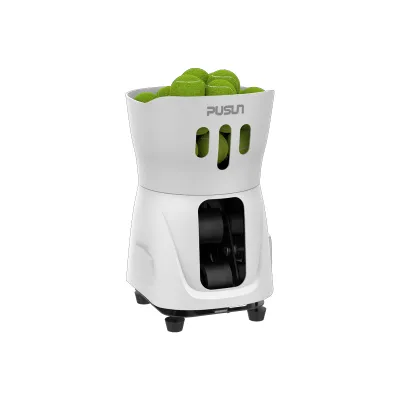
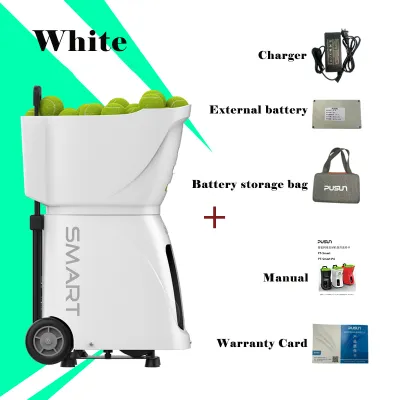
Prices are valid at publication and may change. Please refer to the product page for the latest price.
Spin capabilities are another critical factor in your development. While advanced players require complex side-spin variations to simulate match play, beginners only need to focus on the fundamentals: topspin and backspin (underspin). Topspin helps you understand how to clear the net and keep the ball inside the baseline, while backspin teaches you how to handle low-bouncing defensive shots. Ensure the machine you select allows you to manually adjust these two basic spin types.
Finally, the feed rate—the interval of time between each ball thrown—must be adjustable. A machine that feeds a ball every two to ten seconds is ideal. When you are first learning a stroke, you need a longer interval to reset your stance and analyze your previous shot. As your muscle memory improves, you can gradually decrease the interval to build physical endurance and quicker footwork.
Portability and Power: Matching the Machine to Your Court Routine
A tennis ball machine is only useful if you can easily transport it to your local court. Because most players do not store their equipment directly at the court, physical handling and power requirements should heavily influence your purchase decision.

Weight and transport design are paramount. Look for a machine equipped with heavy-duty, oversized wheels and an ergonomic, extendable towing handle. A machine that weighs between 15 and 25 kilograms is generally manageable for a single person to lift in and out of a car trunk. If you must navigate stairs or uneven paths to reach your local court, a compact, lightweight design is far more valuable than a high-capacity hopper.
Power configuration is another critical logistical detail. You must choose between a battery-powered unit and an AC-powered machine. In Singapore, many public and condominium courts do not have accessible electrical outlets near the baseline. Consequently, a battery-powered machine is highly recommended for maximum flexibility. Verify the battery runtime specifications; a machine that offers two to four hours of continuous play on a single charge is usually sufficient for multiple practice sessions.
Ball capacity directly impacts the flow of your practice. A hopper that holds 70 to 150 balls strikes the perfect balance. It provides enough continuous hitting time to get into a groove without making the machine excessively bulky or heavy when fully loaded. Gathering 100 balls also serves as a natural break point to rest and hydrate.
Advanced Features You Can Safely Skip
Manufacturers often highlight premium features to justify higher price points, but many of these additions are unnecessary for beginners and can actually hinder early skill development.
Multi-axis oscillation is a prime example of an expensive feature to skip. This function sweeps the ball randomly across both the horizontal and vertical planes of the court, forcing you to run constantly. While excellent for advanced cardio and match simulation, random oscillation is counterproductive when you are trying to master basic stroke mechanics. At this stage, you need the ball to land in the exact same spot repeatedly so you can isolate and correct errors in your swing.
Smart app connectivity and complex remote controls are also luxury additions that add cost without much practical benefit. While adjusting settings from your phone sounds convenient, simple manual dials on the back of the machine are often more durable and easier to operate in bright sunlight. A basic, single-button remote control to start and stop the feed is all you need to prevent balls from firing while you walk to the other side of the net.
Similarly, programmable drill sequences—which simulate specific play patterns like a deep baseline drive followed by a short volley—are unnecessary for beginners. Fixed-interval feeding to a single spot is the gold standard for building fundamental muscle memory. Save your budget by opting for a simpler control panel.
Building Your Beginner Shortlist
To finalize your decision, create a structured checklist that filters available models based on your practical needs and local environment.
First, establish a realistic budget boundary. Basic, reliable machines generally range from S$1,000 to S$2,000. By skipping multi-axis oscillation and smart app integration, you can easily find a high-quality, durable machine at the lower end of this spectrum.
Second, verify local power compatibility. If you choose a battery-powered model, ensure the charger is compatible with Singapore’s 230V electrical supply and uses a standard Type G plug. Importing a machine from a region with different voltage standards can lead to charging issues or require bulky, expensive transformers.
Finally, check the warranty terms and the local availability of replacement parts. Over time, the rubber throwing wheels inside the machine will wear down, and batteries will eventually lose their capacity to hold a charge. Purchasing from a distributor that stocks replacement wheels, batteries, and offers local servicing will ensure your investment remains functional for years to come.
Frequently Asked Questions (FAQ)
Do I need a tennis ball machine with oscillation as a beginner?
No, horizontal and vertical oscillation is not necessary for beginners. When you are first learning the game, your primary goal is to develop consistent stroke mechanics and clean ball contact. This is best achieved by hitting from a fixed position where the ball is delivered to the exact same spot repeatedly. Basic horizontal oscillation can be a useful feature to grow into later for light footwork drills, but advanced multi-axis oscillation is an unnecessary expense.
Can I use any tennis balls in a ball machine?
While you can physically load standard tennis balls into a machine, using dedicated pressureless tennis balls is highly recommended. Standard pressurized balls lose their bounce quickly when repeatedly compressed by a machine’s throwing wheels, leading to inconsistent launches. Pressureless balls maintain their bounce indefinitely and feature thicker felt, which withstands the heavy friction of the machine. Always ensure your balls are completely dry before loading them to prevent internal jams.
Community discussion
Share your experience or ask a question. Comments are reviewed before publication.