
Choosing the right travel yoga mat thickness depends on finding your personal balance between carrying convenience and joint cushioning. While an ultra-thin 2mm mat offers unmatched packability and easily fits into a backpack or carry-on bag, it provides very little protection against hard floors. Conversely, a plush 6mm mat delivers excellent joint support for sensitive knees and wrists but adds significant bulk and weight to your luggage. A 4mm mat serves as a versatile middle ground, offering moderate cushioning while remaining relatively easy to transport. To make the right choice, you must evaluate your typical travel style, the surfaces where you plan to practice, and your body’s specific comfort requirements.
Understanding the Trade-Off: Portability vs. Joint Support
When preparing for a trip, every centimeter of luggage space and every gram of weight matters. If you are traveling with carry-on baggage only, your packing constraints are highly restrictive. Airlines operating out of major hubs often enforce strict weight limits for cabin bags, sometimes restricting passengers to a total of seven kilograms. In these scenarios, a heavy or bulky mat can quickly consume your allowance, forcing you to choose between your practice gear and other travel essentials. For those checking their bags or embarking on road trips, weight limits are more generous, allowing for more substantial gear.
Beyond luggage constraints, your physical environment during travel dictates your equipment needs. Hotel rooms, holiday rentals, and outdoor spaces present highly unpredictable flooring. A carpeted hotel room offers natural, built-in cushioning, which makes a thinner mat perfectly acceptable. However, if your accommodation features polished concrete, hardwood, or ceramic tiles, a thin barrier will do little to protect your joints during weight-bearing poses. Outdoor practices on grass or sand provide some natural shock absorption but introduce uneven terrain that requires a stable, non-slip foundation.
Products mentioned in this guide
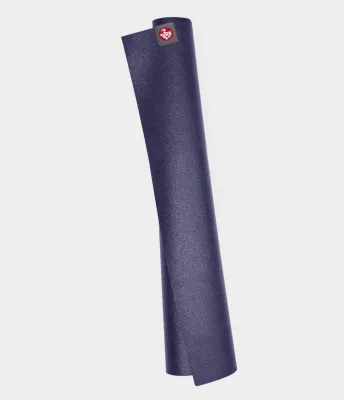
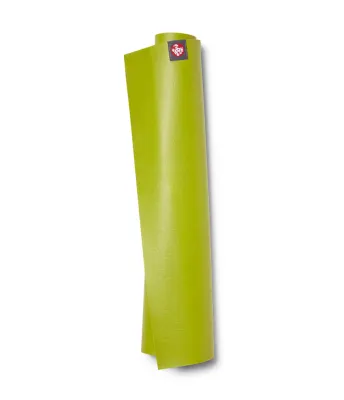
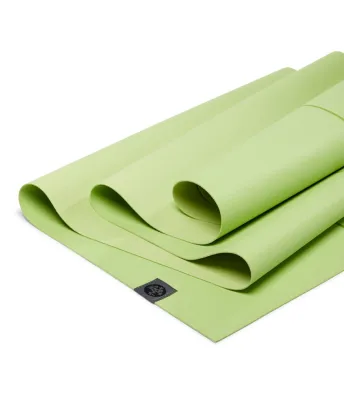
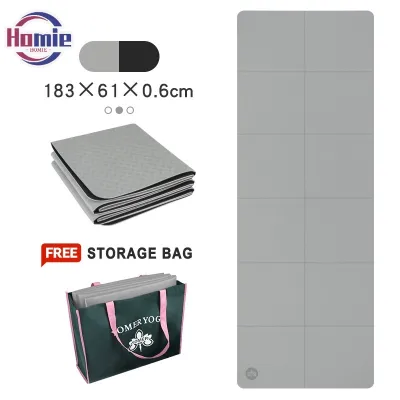
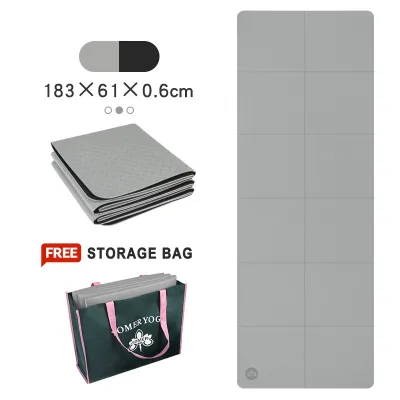
![[SG Seller]TPE folding mat yoga mat lunch Travel Fitness Pads Thickened Lightweight Travel Easy Carry](https://img.lazcdn.com/g/p/3387b2a02c7e3489489b05d56973c4f2.jpg_400x400q80.jpg_.webp)
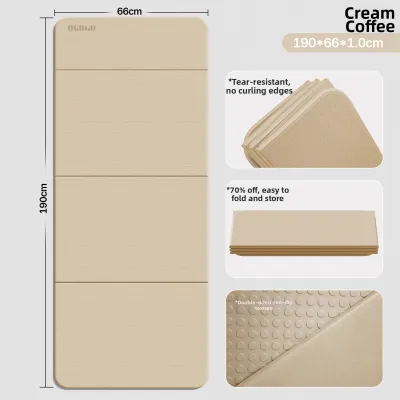
Prices are valid at publication and may change. Please refer to the product page for the latest price.
Your personal physical condition is the final, and perhaps most critical, element of this trade-off. Yoga practitioners with sensitive wrists, knees, or ankles require sufficient impact absorption to practice safely and comfortably. Without adequate cushioning, poses like low lunge or tabletop can cause discomfort or strain, detracting from the benefits of your practice. Conversely, highly experienced practitioners or those without joint sensitivities may prioritize ground feedback and stability over plush cushioning.
Before purchasing any travel mat, it is essential to verify the manufacturer’s exact specifications. Do not rely solely on product photos, which can make mats appear more compact than they are in reality. Check the listed weight, rolled diameter, and whether the mat is designed to be folded flat. Foldable mats are particularly advantageous for packing, as they can lay flat at the bottom of a suitcase or slide into a laptop compartment, whereas rolled mats must be strapped to the exterior of a bag or placed vertically inside.
2mm Travel Mats: Maximum Portability for Minimalist Packagers
The 2mm travel yoga mat represents the pinnacle of minimalist design, engineered specifically for travelers who prioritize space-saving efficiency above all else. These ultra-thin mats are highly favored by backpackers, frequent flyers, and commuters who need to transition seamlessly from transit to practice. Because they are so thin, many 2mm models are designed to be folded into a neat square rather than rolled. This unique structural feature allows you to pack the mat flat against the back panel of a travel pack, taking up no more space than a pair of folded trousers.

In terms of practice performance, a 2mm mat excels in standing and balancing sequences. Because your feet are positioned extremely close to the solid ground, you will experience minimal wobble or instability compared to practicing on a thick, squishy surface. This direct connection to the floor provides excellent tactile feedback, allowing you to engage your core and stabilize your ankles effectively during challenging poses like tree pose or warrior III. For active, flow-based styles where standing postures dominate, this level of stability is highly beneficial.
However, the primary limitation of a 2mm mat is its near-total lack of impact absorption. When placed directly on a hard surface, such as tile or hardwood, a 2mm layer of material offers virtually no cushioning for sensitive bony prominences. Poses that place direct pressure on the knees, elbows, or wrists can quickly become uncomfortable. If you frequently experience joint discomfort during your home practice, relying solely on a 2mm mat on a hard floor may lead to frustration or a modified, less satisfying session.
To make the most of an ultra-thin mat, you must carefully inspect its material density and surface texture before buying. Since there is very little material thickness to prevent slipping, the quality of the grip is paramount. Look for mats made from high-density natural rubber or specialized polyurethane surfaces that maintain traction even when damp. A high-density material ensures that the mat does not compress completely to zero under your weight, providing a tiny but crucial buffer between your body and the floor. Additionally, verify that the underside of the mat has a reliable non-slip pattern to prevent the entire mat from sliding across smooth hotel floors.
4mm Travel Mats: The Middle Ground for Versatile Travelers
For many yogis, the 4mm travel yoga mat represents the ideal compromise, balancing the portability of thinner models with the comfort of standard studio mats. This thickness is highly versatile, making it suitable for a wide range of yoga styles, from dynamic vinyasa flows to slower, restorative yin sessions. If your travel itinerary involves a mix of different accommodations and practice environments, a 4mm mat provides a reliable, predictable surface that can handle almost any floor type without causing joint strain.
The primary advantage of a 4mm mat is its ability to offer genuine joint protection while remaining relatively lightweight. The extra two millimeters of material compared to minimalist mats make a substantial difference when performing poses like low lunge or camel pose. The material absorbs a moderate amount of pressure, reducing the need to double-fold your mat or place extra towels under your knees. This makes your practice smoother and more continuous, as you do not have to constantly adjust your setup to stay comfortable.
Despite these benefits, a 4mm mat does introduce some transport challenges that you must consider. Unlike their 2mm counterparts, 4mm mats are rarely designed to be folded flat; attempting to fold them can crease and permanently damage the internal structure of the material. Consequently, you must roll them, which results in a cylinder that is significantly bulkier than a folded mat. This rolled shape may not fit easily inside a standard backpack, meaning you will likely need to carry it externally using a dedicated yoga strap, a specialized mat bag, or by securing it to the compression straps of your luggage.
Before choosing a 4mm mat for your travels, it is crucial to verify its rolled dimensions against your luggage limits. Measure the length of the rolled mat to ensure it fits within the width of your suitcase if you plan to pack it inside. If you intend to carry it as a personal item on a flight, check that the rolled diameter does not exceed the airline’s overhead compartment or under-seat dimensions. Additionally, pay close attention to the weight of the mat, as some high-density 4mm rubber mats can weigh over two kilograms, which can quickly become burdensome during long walks through transit terminals.
6mm Travel Mats: Prioritizing Comfort on the Road
A 6mm yoga mat is generally considered the standard thickness for home and studio use, but it can also serve as a travel mat under specific circumstances. If your travel plans involve road trips, train journeys, or checked luggage where space and weight are not tightly restricted, prioritizing a 6mm mat can ensure your practice remains as comfortable as it is at home. This thickness is particularly well-suited for individuals who practice gentle, restorative, or therapeutic yoga, where long-held poses require maximum cushioning and support.
The outstanding benefit of a 6mm mat is its superior comfort and joint protection. The thick layer of material completely isolates your body from the cold, hard surfaces beneath you, allowing you to sink into poses without any distracting pressure points. This is especially valuable if you are recovering from an injury or if you have chronic joint sensitivity in your knees, hips, or wrists. The generous cushioning also provides excellent thermal insulation, which is highly beneficial if you are practicing on cold tile floors in air-conditioned rooms or outdoors on cool ground.
However, the trade-offs of traveling with a 6mm mat are substantial. These mats are inherently bulky and heavy, making them highly impractical for minimalist travel or long-distance backpacking. A rolled 6mm mat creates a large, thick cylinder that will occupy a significant portion of a standard suitcase, leaving little room for clothing and other essentials. Furthermore, carrying a heavy mat through airports, train stations, or city streets can quickly lead to shoulder strain, defeating the wellness benefits of your travel practice.
To determine if a 6mm mat is viable for your travels, you must carefully verify its core material. The material composition directly dictates both the weight and the durability of the mat. For example, a 6mm mat made from natural rubber will be exceptionally heavy, often weighing three kilograms or more, making it highly unsuitable for air travel. On the other hand, a 6mm mat made from lightweight thermoplastic elastomer (TPE) or high-quality closed-cell foam will be significantly lighter, though still bulky. Confirming these material specifications allows you to balance the physical weight of your gear against your carrying capacity.
Quick Comparison: Matching Thickness to Your Travel Profile
To help you make an efficient decision, the table below compares the key characteristics of each thickness option based on typical travel and practice requirements.
| Thickness | Packing Style | Average Weight Range | Joint Support Level | Best Practice Types |
|---|---|---|---|---|
| 2mm | Foldable or ultra-compact roll | 0.8 kg – 1.2 kg | Minimal | Ashtanga, Vinyasa, balancing-heavy styles |
| 4mm | Standard roll only | 1.5 kg – 2.2 kg | Moderate | Hatha, Vinyasa, general fitness |
| 6mm | Bulky roll only | 2.0 kg – 3.5 kg | High | Yin, Restorative, therapeutic practices |
To finalize your choice, apply these straightforward decision rules to your travel profile:
- Choose a 2mm mat if you travel exclusively with a carry-on bag or backpack, prioritize saving space, and have healthy joints that do not require extra cushioning on hard floors.
- Choose a 4mm mat if you want a versatile, all-purpose mat for various yoga styles, have moderate joint support needs, and do not mind carrying a rolled mat externally or packing it in a medium-to-large suitcase.
- Choose a 6mm mat if you are traveling by car, checking large luggage, practicing restorative yoga, or require maximum joint protection due to physical sensitivities.
Please note that certain boundary conditions apply to these recommendations. Neither of these standard travel options may fit your needs if you have severe joint conditions, chronic pain, or are recovering from recent surgery that requires specialized orthopedic support; in such cases, consult a medical professional before practicing on temporary travel surfaces. Additionally, always verify first if your chosen airline has specific restrictions regarding the dimensions of personal items, as a rolled 4mm or 6mm mat may exceed the allowable length for cabin storage on smaller regional aircraft.
Frequently Asked Questions (FAQ)
Can I bring a 6mm yoga mat as a carry-on item on most airlines?
Yes, you can generally bring a 6mm yoga mat as a carry-on item, but its suitability depends heavily on the airline’s specific cabin baggage dimensions and enforcement policies. Most airlines allow passengers one cabin bag and one smaller personal item, such as a laptop bag or handbag. A rolled 6mm mat is often too long to fit within the standard dimensions of a personal item, meaning it will likely count as your primary cabin bag. If you are traveling on budget carriers with strict size limits, a gate agent may require you to check the mat if it cannot fit inside your approved luggage.
To minimize the rolled diameter of a 6mm mat and make it more flight-friendly, consider using adjustable compression straps or a tight-fitting travel sleeve. These accessories help compress the material as much as possible, preventing the roll from expanding during transit. Always check your airline’s baggage policy before heading to the airport, especially if you are flying on smaller regional flights where overhead bin space is highly restricted.
Should I use a yoga towel with a thin travel mat?
Using a yoga towel with a thin travel mat, particularly a 2mm or 4mm model, is an excellent way to enhance both grip and hygiene while away from home. Thin mats often have less surface texture to keep weight down, which can lead to slipping if your hands or feet become sweaty. A specialized microfiber yoga towel with silicone grips on the underside can be placed directly over your mat to provide a reliable, sweat-absorbing surface. This combination is especially useful when practicing in warm, humid climates or during high-intensity sessions.
Before packing a towel, verify its compatibility and sizing with your travel mat. The towel should match the dimensions of your mat as closely as possible; an oversized towel can bunch up and create a tripping hazard, while an undersized towel may slide around during transitions. Additionally, using a towel adds a layer of hygiene when you are practicing on shared studio mats or carpeted hotel floors, as the towel can be easily washed and dried along with your regular travel laundry.

Community discussion
Share your experience or ask a question. Comments are reviewed before publication.