
Selecting your first tennis racket can feel overwhelming when confronted with technical jargon and numbers printed along the frame. For a beginner, understanding what the specifications of the Friday Aura Pro mean is the key to avoiding early fatigue, preventing injury, and developing clean stroke mechanics. By analyzing how its weight, balance, head size, and grip dimensions interact, you can make an informed decision on whether this specific model supports your entry into the sport or if you need to look for alternative configurations.
Locating and Prioritizing Core Specs on the Friday Aura Pro
Before analyzing how a racket performs on the court, you must locate its official technical specifications. Manufacturers typically print these metrics directly on the inside of the racket throat or shaft, though they can also be verified on the official product packaging or the brand’s online spec sheet. When examining the Friday Aura Pro, prioritize the foundational physical dimensions—specifically weight, balance, head size, and grip size—rather than marketing terms describing proprietary frame materials.
It is critical to distinguish between strung and unstrung measurements when reading these specifications. Most manufacturers publish unstrung specifications as their baseline. A bare frame might feel exceptionally light in your hand, but once strings, a vibration dampener, and an overgrip are installed, the total weight will increase by approximately 15 to 20 grams. Always verify which state the published numbers represent so you do not accidentally purchase a racket that is heavier than your physical conditioning can comfortably handle.
Products mentioned in this guide
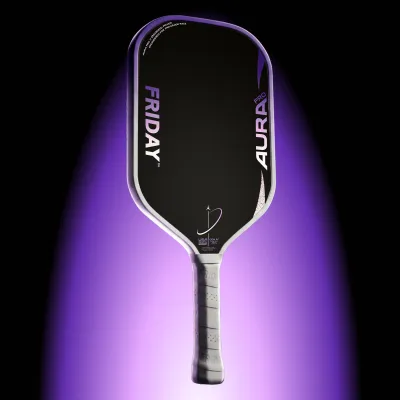
Prices are valid at publication and may change. Please refer to the product page for the latest price.
How Weight and Balance Impact Your Swing Mechanics
The static weight of a tennis racket dictates how much effort is required to swing it and how stable it feels when making contact with the ball. For beginner players, a lighter unstrung weight—typically between 270 and 290 grams—is generally recommended. Lighter frames allow you to swing quickly, react to fast balls, and practice for longer periods without shoulder or wrist fatigue. Conversely, heavier frames (over 300 grams) offer superior stability and shock absorption against hard-hitting opponents, but they require established muscle memory and clean technique to swing safely.

Balance is equally important and refers to how the weight is distributed along the length of the racket. A head-light (HL) racket concentrates its mass toward the handle, making the frame feel nimble and easy to maneuver, especially when playing quick volleys at the net. A head-heavy (HH) racket places more mass in the hoop, which helps beginners generate natural depth and power on groundstrokes even with slower, shorter swings. An even-balance (EB) setup splits the difference, offering a neutral feel.
To evaluate how these factors affect your personal swing mechanics, perform a simple physical check. Hold the racket with your standard grip and execute several slow shadow swings. If your wrist feels strained at the end of the follow-through, or if the racket head feels like it is dragging behind your hand, the swing weight may be too high for your current strength level.
Understanding Head Size and String Pattern for Better Forgiveness
The head size of a racket directly determines the size of the sweet spot, which is the optimal hitting area on the string bed. Rackets generally fall into three categories: mid-size (under 97 square inches), mid-plus (98 to 102 square inches), and oversize (103 square inches and above). For those starting out, a mid-plus or oversize head is highly advantageous. A larger hitting surface provides greater forgiveness on off-center hits, helping you keep the ball in play while your hand-eye coordination and footwork develop.
The string pattern—expressed as the number of main (vertical) strings by cross (horizontal) strings—also influences how the racket behaves. An open string pattern, such as 16×19, features wider spacing between the strings. This design allows the strings to deflect more upon impact, naturally generating more power and spin potential, though it can cause strings to wear out faster. A dense string pattern, such as 18×20, keeps the strings closer together, prioritizing directional control and durability at the expense of easy depth.
As a beginner, balancing immediate forgiveness with long-term control is essential. While an oversized head with an open string pattern makes learning the game much easier and more enjoyable, you should ensure the specifications do not prevent you from developing controlled, full swings as your stroke mechanics naturally improve over time.
Assessing Grip Size and Frame Stiffness for Arm Comfort
Choosing the correct grip size is a fundamental step in preventing chronic injuries like tennis elbow. Standard grip sizes range from size 1 (4 1/8 inches) to size 5 (4 5/8 inches). In warm, humid climates like Singapore, players sweat heavily, making a secure grip even more critical to prevent the racket from twisting during contact. You can verify your grip size using the classic finger-test method: hold the racket in your dominant hand using an Eastern forehand grip, and attempt to slide the index finger of your opposite hand into the space between your ring finger and palm. If the space is too tight to fit your finger, the grip is too small; if there is a large gap, the grip is too large.
Frame stiffness, often measured by an RA rating, dictates how much the racket bends during a stroke. Stiffer frames (higher RA ratings) bend very little, transferring more energy back into the ball for easy power, but they also transmit more harsh vibrations directly into your arm. Flexible frames (lower RA ratings) bend more to absorb shock, offering a softer feel and better comfort, but they require faster swing speeds to generate depth.
When evaluating the Friday Aura Pro, look for moderate stiffness ratings or check the manufacturer’s specifications for integrated vibration-dampening technologies in the handle or frame. These features help mitigate the impact of off-center hits, protecting your joints as you refine your contact point.
Final Checklist: Matching the Racket to Your Current Skill Level
To determine if the Friday Aura Pro is the right fit for your current physical profile, cross-reference its verified specifications against standard beginner benchmarks. Use this structured checklist to guide your decision:
- Weight Check: Is the unstrung weight between 270g and 295g? (If it exceeds 300g, it may cause early fatigue).
- Head Size Check: Is the head size at least 100 square inches? (Smaller head sizes require highly precise timing).
- Grip Size Check: Does the handle size pass the finger-test, allowing a secure hold without excessive squeezing?
- Balance Check: Is the balance point even or slightly head-heavy to assist with your power generation?
Be alert to potential red flags. If the specifications indicate a heavy, highly stiff frame designed for advanced players with fast swing speeds, using it as a beginner can lead to immediate arm strain and poor habits, such as shortening your swing to compensate for the weight. If you are uncertain about how these metrics feel in practice, pause your purchase and consult a certified tennis coach or a professional stringer at a local pro shop to get a personalized recommendation.
Frequently Asked Questions (FAQ)
Does factory stringing alter the published specs of the racket?
Yes, factory stringing significantly alters the static weight and balance of a racket compared to its published unstrung specifications. Pre-installed strings typically add about 15 grams of weight and shift the balance point slightly toward the head of the racket. When purchasing, always check whether the retailer’s listed specifications represent the strung or unstrung state. If you find the factory strings feel too stiff or lack control, you can visit a local pro shop to have the racket restrung with a softer multifilament string at a lower tension, which increases comfort and sweet spot forgiveness.
How often should a beginner re-evaluate their racket specifications?
A beginner should generally re-evaluate their racket specifications after 12 to 18 months of regular play, or once they achieve consistent stroke mechanics. Key milestones that signal it is time for an upgrade include a naturally faster swing speed, the ability to consistently hit the sweet spot, and a desire for more directional control over raw power. When you reach the point where your shots are regularly flying long despite using proper technique, scheduling an equipment check-in with a certified coach can help you determine if transitioning to a heavier, more control-oriented frame is appropriate for your development.
Community discussion
Share your experience or ask a question. Comments are reviewed before publication.