
Finding the correct goggles swimming degree is essential for seeing the pool wall clearly and preventing the headaches and eye strain that come with incorrect lenses. In Singapore, where swimming is a popular year-round activity in both outdoor condo pools and public ActiveSG facilities, choosing the right corrective eyewear ensures you can navigate lanes safely. Off-the-shelf prescription goggles offer a convenient and cost-effective solution, but they do not work exactly like your daily spectacles. Understanding how these numbers translate from your optical prescription to the water is the first step toward a comfortable swim.
What Do the Degree (Diopter) Numbers Actually Mean?
When you look at the packaging of prescription swimming goggles, the numbers displayed (such as -3.00 or -4.50) represent the optical power of the lenses. In optometry, the standard unit of measurement for this refractive power is called a diopter (D). These numbers indicate how much the lens must bend light to focus it correctly on your retina.
The mathematical sign preceding the number tells you the type of vision correction the lens provides. A minus sign (-) indicates correction for myopia, commonly known as nearsightedness, which is the most frequent reason swimmers seek prescription lenses. Conversely, a plus sign (+) represents correction for hyperopia, or farsightedness.
Products mentioned in this guide
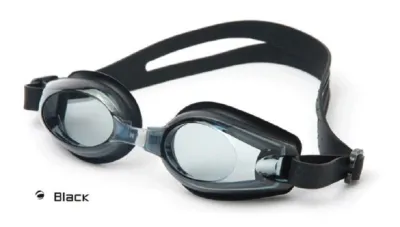
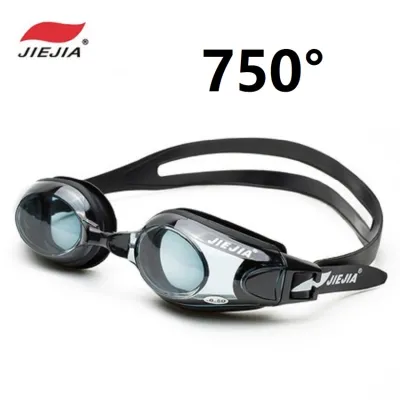
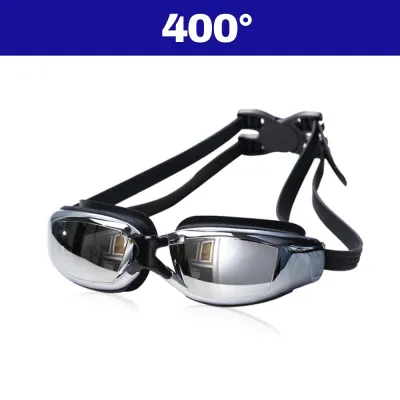
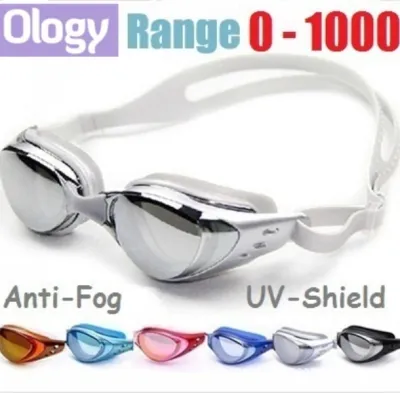
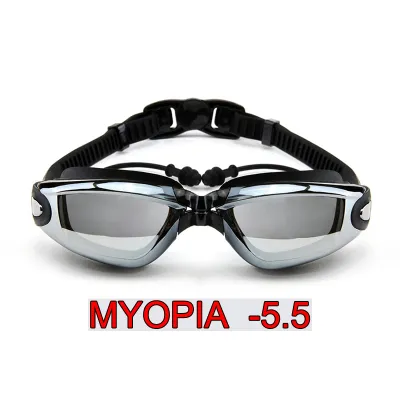
![[SG SELLER] ORIGINAL 361° BRAND Adult Swimming goggles high-definition myiopia degree waterproof anti-fog lenses swimming goggles](https://img.lazcdn.com/g/p/9d19d99f2ac96bcf991b22599e9a33b9.jpg_400x400q80.jpg_.webp)
Prices are valid at publication and may change. Please refer to the product page for the latest price.
A higher absolute number simply means a stronger correction is required to achieve clear vision. For instance, a -6.00D lens is significantly stronger than a -2.00D lens, but this is merely a physical measurement of your eye’s shape, not an inherent measurement of your eye health.
Unlike your everyday spectacles, which are custom-crafted to your exact decimal prescription (such as -3.25 or -3.75), mass-produced prescription swimming goggles are generally sold in fixed 0.50-diopter steps. This means you will typically choose between options like -2.00, -2.50, and -3.00.
How Underwater Refraction Changes Your Vision Needs
Seeing clearly underwater involves a unique set of physical principles because light behaves differently when traveling through water compared to air. When you wear swimming goggles, a small pocket of air is trapped directly in front of your eyes. As light passes from the pool water, through the flat plastic lens of the goggle, and into this air pocket, it bends—a process known as refraction.

This optical transition creates a natural magnification effect. To the human eye, objects viewed underwater through a flat lens appear approximately 25% closer and 33% larger than they actually are. Because of this natural magnification, your eyes do not have to work as hard to focus on nearby objects.
Because water naturally assists with magnification, wearing your exact land-based prescription underwater can actually cause over-correction. For swimmers with myopia, eye care professionals generally recommend stepping down your prescription by about 0.50 diopters. Choosing a slightly weaker lens prevents the eye strain, headaches, and mild dizziness that often occur when your eyes are forced to accommodate an overly strong prescription in a magnified environment.
However, this general rule of thumb is best suited for standard, uncomplicated myopia. If you have severe vision impairment, complex eye conditions, or if you participate in open-water swimming where navigating distant landmarks requires precise distance vision, you should consult an optometrist before making any adjustments to your prescription.
Managing Astigmatism with Standard Swimming Goggles
Astigmatism is a common refractive error caused by an irregularly shaped cornea or lens, which prevents light from focusing evenly on the retina. In a standard optical prescription, astigmatism is indicated by the “cylinder” (CYL) value, along with an “axis” value that shows the orientation of the irregularity.
Most off-the-shelf prescription swimming goggles do not correct for astigmatism. Due to manufacturing constraints and the high cost of creating molds for every possible combination of sphere, cylinder, and axis, mass-produced goggles only feature spherical lenses. They are designed primarily to address simple nearsightedness or farsightedness.
To compensate for this, opticians use a mathematical calculation known as the “Spherical Equivalent.” This formula helps translate a prescription with astigmatism into a single spherical number that can be matched to standard goggle steps. To find your spherical equivalent, you take your sphere value and add half of your cylinder value to it.
For example, if your prescription has a Sphere (SPH) of -3.00D and a Cylinder (CYL) of -1.00D, you would divide the cylinder value by two, resulting in -0.50D. Adding this to your sphere value (-3.00D + -0.50D) gives you a Spherical Equivalent of -3.50D.
Keep in mind that the Spherical Equivalent is an optical compromise. Swimmers with mild astigmatism (typically under 1.00D) usually adapt to this compromise very well. However, if your cylinder value is higher than 1.00D or 1.50D, you may still experience mild blurriness or distortion while wearing standard goggles, meaning a custom-made alternative may be necessary.
A Step-by-Step Framework for Choosing Your Goggle Degree
Selecting the correct goggles swimming degree does not have to be a guessing game. By following a structured approach, you can narrow down the options to find a pair that offers comfortable, clear vision.
Step 1: Gather Your Recent Prescription Ensure you have a recent optical prescription from a qualified optometrist in Singapore. This prescription must clearly display your Sphere (SPH) and Cylinder (CYL) values for both eyes, as your left and right eyes may require different levels of correction.
Step 2: Calculate the Spherical Equivalent If your prescription contains a cylinder value for astigmatism, apply the spherical equivalent formula: Sphere + (Cylinder / 2). If you do not have astigmatism, use your sphere value as your baseline.
Step 3: Adjust for Underwater Refraction For myopia (minus prescriptions), subtract 0.50D from your baseline number to account for the natural magnification of water. For example, if your baseline is -4.00D, adjusting it down brings you to -3.50D. If you have a very mild prescription (under -1.50D), you may not need to step down, as the natural magnification might already provide sufficient clarity.
Step 4: Round to the Nearest 0.50D Step Because off-the-shelf goggles are sold in 0.50D increments, you must round your calculated number to the nearest available step. The golden rule here is to always round down to the lower power (closer to zero) if your calculation falls exactly between two steps. For instance, if your calculation yields -3.75D, choose a -3.50D goggle rather than a -4.00D goggle. Over-correcting is much more likely to cause eye strain and headaches than under-correcting.
Step 5: Verify the Retailer’s Return Policy Before finalizing your purchase, check the return or exchange policy of the retailer or optical shop. In Singapore, physical sports stores and online marketplaces have varying policies regarding corrective eyewear. Ensuring you can exchange the goggles if they cause discomfort during your first few swims provides valuable peace of mind.
When to Upgrade to Custom Prescription Goggles
While off-the-shelf prescription swimming goggles are highly convenient and affordable—typically ranging from S$20 to S$60—they are not a perfect fit for everyone. Certain optical profiles require a higher level of customization to ensure safe and comfortable vision in the water.
You should consider upgrading to custom prescription goggles if you have a high degree of astigmatism (greater than 1.50D), a significant difference in prescription between your left and right eyes (a condition known as anisometropia), or if you require progressive or bifocal lenses. Additionally, standard goggles assume a uniform distance between your pupils, which may not align with your actual facial structure.
The primary trade-offs of custom goggles are cost and time. Custom pairs can range from S$100 to over S$300, and they must be ordered through specialized optical shops, resulting in longer lead times. However, the benefits are substantial: you receive lenses ground to your exact prescription, precise optical center alignment, and a frame tailored to your pupillary distance (PD).
To explore this option, visit a specialized sports optometrist or a local optical shop in Singapore that offers custom sports eyewear. They can take precise measurements of your face and pupillary distance, ensuring your custom goggles provide the same optical clarity as your daily spectacles.
Frequently Asked Questions (FAQ)
Can I just wear my daily contact lenses under regular swimming goggles?
While wearing daily contact lenses under standard, non-prescription goggles is a common workaround for many swimmers, eye care professionals strongly advise against it. Swimming pool water, even when chlorinated, contains microscopic pathogens and bacteria, such as Acanthamoeba. If water leaks into your goggles, these microorganisms can easily become trapped behind your contact lens, creating a warm, moist environment where infections can rapidly develop, potentially leading to corneal ulcers or permanent vision loss.
If you absolutely must wear contact lenses while swimming, you should strictly use daily disposables. Ensure your goggles have a highly secure, watertight seal to minimize any contact with pool water, and discard the lenses immediately after your swim.
Why do my new prescription goggles make me feel dizzy?
Feeling dizzy or disoriented when you first put on prescription swimming goggles is a relatively common issue that usually points to a few specific optical causes. The most frequent culprit is over-correction, which occurs if you selected a goggle degree that is too strong for underwater use. Alternatively, if you have moderate to high astigmatism that is uncorrected by the spherical lenses, the resulting distortion can cause mild nausea or spatial disorientation.
Another common issue is a mismatch in pupillary distance (PD). If the optical centers of the mass-produced lenses do not align properly with your pupils, it creates a prism effect that forces your brain to work harder to merge the images. If you experience persistent dizziness, headaches, or eye strain after a few brief swimming sessions, stop using the goggles immediately. Take them along with your current optical prescription to a local optometrist to verify the lens power and check for proper alignment.
Community discussion
Share your experience or ask a question. Comments are reviewed before publication.