
Setting up a strength training space in a Housing & Development Board (HDB) flat requires a masterclass in spatial geometry. While a standard straight barbell is a staple for home workouts, the safety squat bar is highly coveted for its ability to reduce shoulder, elbow, and wrist strain during heavy lifts. However, its unique three-dimensional shape—featuring a padded yoke, a pronounced camber, and forward-pointing handles—presents distinct spatial challenges in a typical Singaporean home. Yes, you can absolutely use a safety squat bar in an HDB flat, but doing so successfully requires careful planning of your layout, precise clearance calculations, and specialized storage strategies to keep your living space functional.
Checking Safety Squat Bar Dimensions Against HDB Layouts
To determine if a safety squat bar will fit in your HDB flat, you must first understand its physical dimensions. A standard safety squat bar is typically 2.2 metres (approximately 7.2 feet) long, which is identical to a standard Olympic barbell. However, unlike a straight bar, an SSB is not a simple two-dimensional cylinder. The padded yoke that rests on your neck and the two handles that extend forward create a bulky, three-dimensional footprint that cannot be easily tucked away.
Before purchasing, you must map out the logistics of getting the bar into your flat. HDB main doors, narrow corridors, and bedroom door frames can be incredibly tight, especially in newer Build-To-Order (BTO) flats where hallways are optimized for space. A rigid 2.2-metre steel bar cannot bend around tight corners. You must measure the turning radius of your entryway and any corridors leading to your designated workout room. If your bedroom door frame is the standard 80 to 90 centimetres wide, you will need to maneuver the bar vertically or at a steep angle to get it inside, which requires checking that your ceiling is clear of light fixtures and fans during transit.
Products mentioned in this guide
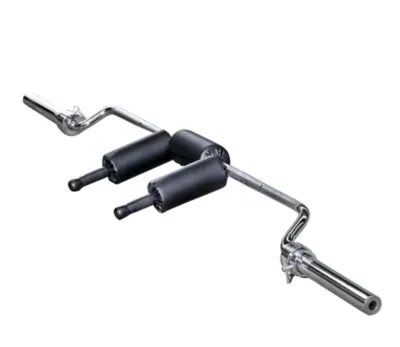
Prices are valid at publication and may change. Please refer to the product page for the latest price.
Once inside the room, you must assess the available floor space. A typical HDB spare bedroom measures roughly 3 metres by 3 metres (9 square metres). Since the bar itself is 2.2 metres long, placing it horizontally in the center of the room leaves only about 40 centimetres of clearance on either side. This is where the “loading zone” becomes critical. To slide Olympic weight plates onto the sleeves, you need at least 50 to 60 centimetres of open space on each side of the bar. Without this buffer, you will find yourself constantly hitting the walls, wardrobe doors, or windows with heavy plates, making your workouts frustrating and hazardous.
Calculating Operational Space and Ceiling Clearance for Safe Lifting
Lifting safely in a confined space requires calculating your operational clearance, starting with your ceiling height. Most HDB flats have a ceiling height of approximately 2.6 metres to 2.8 metres. While this is generally sufficient for standard squats, the safety squat bar sits higher on your upper back than a traditional low-bar or high-bar setup due to the thick padded yoke. If you are a taller lifter (e.g., 1.8 metres or taller), the top of the bar’s yoke and handles will come close to the ceiling at the peak of your squat. You must ensure your workout area is completely clear of low-hanging ceiling fans, light fixtures, or air conditioning units that could be struck during a lift.

Next, consider the “swing zone” and walk-out distance. When you unrack a safety squat bar, the cambered design shifts the weight distribution forward, which naturally alters your center of gravity. This requires a highly controlled walk-out. If you lose balance or experience horizontal bar drift, the protruding handles can swing outward. To prevent the handles or the ends of the bar from smashing into walls or nearby furniture, you should maintain a clear, unobstructed zone of at least 1.5 metres behind the squat rack’s uprights.
The footprint of your squat rack also dictates your operational space. A standard half-rack or squat stand typically occupies a footprint of 1.2 metres in width and 1.0 to 1.2 metres in depth. However, you must also account for safety spotter arms, which extend an additional 50 to 60 centimetres forward. When positioning your rack in an HDB room, place it in a way that maximizes the remaining floor space, ensuring you have enough room to step back, perform your squat, and safely re-rack the bar without your elbows or the bar’s handles clipping any obstacles.
Practical Storage Solutions for Limited Home Gym Space
Storing a safety squat bar in a compact HDB flat requires a departure from traditional barbell storage methods. Straight barbells are easily stored horizontally on wall-mounted gun racks or flat on the floor against a wall. An SSB, however, cannot be stored flat. Because of the protruding handles and the heavy padded yoke, the bar will rest at an awkward angle, balancing precariously on the handles. This not only creates a massive tripping hazard in a small room but can also bend the handles or permanently compress the foam padding over time under the bar’s own weight.
Vertical storage is the most practical and space-saving solution for an HDB home gym. There are two primary ways to store your bar vertically:
- Wall-Mounted Vertical Holders: These hangers secure the bar by its sleeve, keeping it flush against the wall. However, before drilling, you must verify the load-bearing capacity of your HDB walls. Newer HDB flats often use lightweight concrete blocks or drywall partitions for internal bedroom walls, which may not safely support a 20kg to 25kg safety squat bar over time. Always mount heavy vertical holders into structural concrete walls (such as the household shelter wall or external-facing walls) using heavy-duty metal sleeve anchors, or bolt the holder directly to your squat rack's steel frame.
- Freestanding Vertical Floor Stands: A heavy steel vertical barbell holder (often a single-tube or multi-tube base) can be placed in a corner. This allows you to slide the sleeve of the SSB into the tube, keeping the bar perfectly upright. Ensure the stand has a wide, heavy base to prevent the top-heavy SSB from tipping over.
To maximize your layout, utilize “dead space” such as the tight corner behind a bedroom door or the gap between a wardrobe and the wall. If your squat rack design permits, look for attachments that allow you to store the bar vertically directly on the rack’s rear stabilizers. This consolidates your equipment into a single footprint, saving precious floor space.
Managing Floor Impact and Neighbourly Noise in an HDB Flat
Operating a heavy strength training setup in a high-density HDB block requires a high level of consideration for your neighbors and the structural integrity of your home. HDB floor tiles (typically homogeneous, ceramic, or vinyl) are highly susceptible to cracking under the localized pressure of a heavy squat rack loaded with hundreds of kilograms. To protect your flooring, you must install high-density rubber gym tiles (at least 15mm to 25mm thick). For maximum protection, consider laying a 12mm to 18mm plywood subfloor beneath the rubber mats to distribute the weight evenly across the concrete slab.
Vibration and noise travel easily through the reinforced concrete structure of HDB blocks. While the safety squat bar is excellent for maintaining an upright posture, failing a lift or dropping the bar onto metal safety arms will create a massive, low-frequency impact noise that will disturb your neighbors downstairs and next door. To mitigate this, always use rubber-lined J-cups and safety spotter arms. Better yet, opt for nylon strap safeties, which catch the bar silently compared to steel spotter arms. Always maintain a controlled lowering phase on every repetition and never drop the bar.
Additionally, keep HDB floor load limits in mind. The standard structural design load for HDB residential floors is 150 kg/m² (1.5 kN/m²). While this is a distributed load limit and can easily handle a standard home gym setup, you should avoid stacking massive amounts of weight plates in one single corner. Distribute your weight plates evenly on a weight tree or rack storage pegs, and position your heavy equipment close to load-bearing walls rather than the center of the room.
Common Space and Rack Compatibility Mistakes to Avoid
Avoiding common spatial and compatibility mistakes can save you significant time, money, and frustration when setting up your safety squat bar. The most frequent error is ignoring J-cup and upright compatibility. Because the camber of an SSB curves downward and forward before transitioning into the sleeves, the bar requires a specific rack width. If your squat rack has exceptionally wide uprights (such as 75mm x 75mm) or bulky, wide J-cups, the curved portion of the bar or the handles may clash with the rack before the sleeves can settle securely. Always measure the “collar-to-collar” distance of the SSB and compare it to the outer width of your rack (which should typically be 120 cm or less) to ensure a seamless fit.
Another common mistake is underestimating the vertical clearance required for transport and storage. While your ceiling might be 2.6 metres high, lifting a 2.2-metre bar out of a vertical floor stand requires you to lift the bar straight up by at least 15 to 20 centimetres. This leaves almost zero margin for error. If you are not careful, you will puncture your plaster ceiling or smash a light fixture. Always measure the total height of the bar when placed in its vertical stand and ensure you have the physical clearance to lift it out safely.
Finally, avoid the temptation to buy an oversized commercial power cage. These massive cages are designed for spacious commercial gyms and will completely overwhelm a standard HDB bedroom, leaving you with no room to walk around or load plates. Instead, opt for a compact, heavy-duty half-rack, a squat stand with robust safety spotters, or a wall-mounted folding rack that can be tucked away when not in use.
Frequently Asked Questions (FAQ)
Will a safety squat bar fit on a standard home squat rack?
Most safety squat bars are designed to fit standard Olympic-width squat racks, which typically feature an outer width of 120 cm to 123 cm. However, the unique camber and forward-pointing handles of an SSB can easily interfere with wide uprights or bulky J-cup designs. Before purchasing, verify the bar’s collar-to-collar distance (the straight portion of the shaft) against your rack’s outer width. You may need to use slim-profile, rubber-lined J-cups to ensure the bar rests securely without the handles or camber clashing with the rack frame.
Can I store a safety squat bar horizontally on the floor?
Storing a safety squat bar horizontally on the floor is highly impractical and discouraged. Because of the protruding handles and the thick padded yoke, the bar cannot lie flat. It will rest at an awkward, tilted angle, balancing on its handles. Over time, the heavy weight of the bar can bend the handles or permanently deform the foam padding. Furthermore, a 2.2-metre bar resting unevenly on the floor creates a severe tripping hazard in a compact HDB room. Vertical storage using a dedicated floor stand or a rack-mounted holder is the safest and most space-efficient solution.
Community discussion
Share your experience or ask a question. Comments are reviewed before publication.