
Choosing the right exercise ball size is essential for maintaining proper spinal alignment, engaging your core muscles, and preventing joint strain during workouts or active sitting. The correct size depends primarily on your height, but because different manufacturers use varying materials and inflation specifications, a standard chart is only your starting point. To find the perfect fit, you must combine height guidelines with a physical posture check to ensure your body remains in a biomechanically sound position.
Understanding Exercise Ball Diameters and Height Charts
Exercise balls, also known as stability or fitness balls, are categorized by their diameter, typically measured in centimeters. Common industry sizes generally range from small (often around 55 centimeters) to extra-large (75 centimeters or more). However, these categories are not universal across all brands. Material elasticity, wall thickness, and manufacturing tolerances mean that two balls labeled with the same nominal diameter might sit differently when fully inflated.
Because of these variations, you should always treat general height-to-diameter charts as a preliminary baseline rather than an absolute rule. Before making a purchase, check the specific sizing recommendations printed on the product packaging or the manufacturer’s official product page. These specifications account for the unique stretch and density of that particular brand’s PVC material, helping you avoid selecting a ball that is too small or too large for your frame.
Products mentioned in this guide
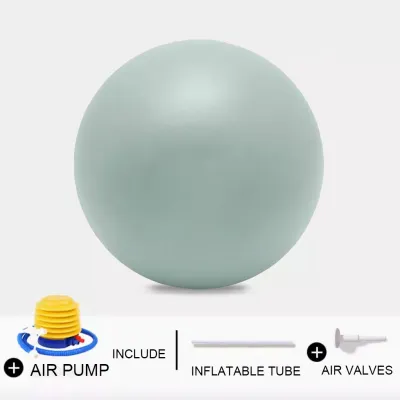
![⭐[Sg Seller] 45cm55CM 65CM 75CM 85CM Burst Resistance Yoga Ball Gym Fitness Iron Shake Weight](https://img.lazcdn.com/g/p/e23e6d3db4b1f7e42ef3d0a86e2e6e3f.jpg_400x400q80.jpg_.webp)
![[SG Seller]Small Exercise Ball Mini Yoga Ball 22cm Anti-Burst Yoga Ball Mini Exercise Ball for Core Strength & Body Sculpting](https://img.lazcdn.com/g/p/5f4bac5ad65f0dd86cf9b4ec46f00b83.jpg_400x400q80.jpg_.webp)
Prices are valid at publication and may change. Please refer to the product page for the latest price.
The 90-Degree Rule: How to Test Your Fit
Once you have selected a ball based on your height, the most reliable way to verify the fit is by performing a physical posture test. Sit comfortably on the center of the inflated ball with your feet flat on the floor, keeping your weight evenly distributed. In this position, observe the angles of your lower joints.

The target posture is known as the 90-degree rule: your hips and knees should be bent at approximately a right angle, with your thighs parallel to the floor or your hips positioned slightly higher than your knees. This alignment keeps your pelvis neutral and allows your core muscles to engage naturally without placing excessive pressure on your lower back.
If your knees are positioned higher than your hips, the ball is either too small or under-inflated, which can strain your hip flexors and cause your lower back to round. Conversely, if your feet cannot rest flat on the floor or your hips are significantly higher than your knees, the ball is too large, making it difficult to maintain stability and balance. Always check that you can easily maintain a neutral spine and an upright posture while seated.
Adjusting for Exercise Type and Desk Use
Your intended activity can influence whether you should stick strictly to standard height recommendations or adjust your size selection. If you plan to use the exercise ball as an active desk chair, you must coordinate its height with your desk surface. In some cases, a slightly larger ball is necessary to ensure your arms can rest comfortably on the desk at a natural typing angle without forcing you to slouch.
For traditional fitness applications, such as core stability routines, yoga, or floor-based physical therapy, sticking to your standard height-matched size is generally optimal. A correctly sized ball allows for a full range of motion and proper support during back extensions, planks, and leg lifts.
You can also fine-tune the effective size and difficulty of your exercises by adjusting the inflation level. Inflating the ball to its maximum recommended diameter makes the surface firmer and less stable, which increases the challenge to your core muscles. Keeping it slightly under-inflated creates a larger contact patch with the floor, offering more stability and making it easier to maintain your balance.
Inflation and Maintenance for Consistent Sizing
Achieving the true advertised diameter of your exercise ball requires proper inflation techniques, as the material needs time to stretch and settle. Most manufacturers recommend a two-step inflation process. First, inflate the ball to approximately 80% of its target size and let it rest for 24 hours, allowing the material to expand and lose its packaging creases. After this resting period, finish inflating the ball to its full specified diameter.
To verify the size accurately, do not rely solely on how firm the ball feels to the touch. Instead, use a measuring tape to check the actual physical diameter. You can do this by placing the ball against a wall, marking the target height on the wall, and inflating the ball until the top of the ball aligns with your mark.
Regular maintenance checks are essential for safety and performance. Inspect the surface periodically for visible bulging, deep scratches, or material degradation, especially if you use the ball on rough surfaces. If the ball fails to hold its target size or shows signs of uneven stretching, stop using it immediately and replace it to prevent sudden deflation during an exercise.
Frequently Asked Questions (FAQ)
Can I use a larger exercise ball if I am between sizes?
Yes, if your height falls directly between two standard size categories on a manufacturer’s chart, it is generally best to choose the larger size. You can inflate the larger ball slightly below its maximum capacity to achieve the correct 90-degree joint angle at your hips and knees. Choosing the smaller ball often forces your knees too high, which compromises your posture and reduces exercise effectiveness.
Does the weight capacity of the exercise ball affect its size?
No, physical diameter and weight capacity are independent specifications. The diameter is determined by your height to ensure proper joint alignment, while the weight capacity and burst resistance are determined by the thickness and quality of the material. Always check both specifications separately to ensure the ball matches your height and safely supports your body weight during dynamic movements.
Community discussion
Share your experience or ask a question. Comments are reviewed before publication.