
Selecting the right knee guard bauerfeind model depends on your sport’s movement patterns and the specific level of joint support your knees require. For linear sports like running or cycling, the standard GenuTrain provides optimal compression and flexibility. High-impact sports with frequent jumping require the targeted patellar guidance of the GenuTrain A3. Court and field sports involving rapid lateral cuts demand the structural side stays and strap system of the GenuTrain S.
Using the wrong model can lead to inadequate joint stabilization or unnecessary movement restrictions. By matching the brace design to your athletic demands, you ensure proper joint protection without compromising your performance. This guide breaks down the physical mechanisms of each model to help you make an informed decision.
Decoding Bauerfeind's Core Support Technologies
Understanding the foundational design elements common across these supports helps clarify how they assist your joints during physical activity. Every model in the lineup relies on a combination of proprietary materials and anatomical shaping to deliver medical-grade compression and stability.
Products mentioned in this guide
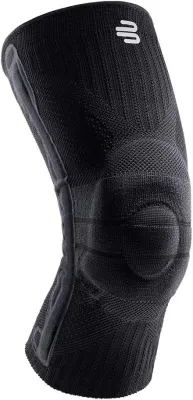
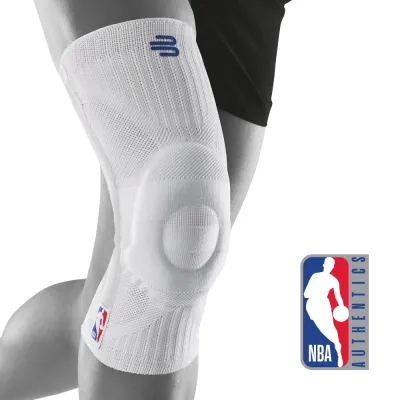
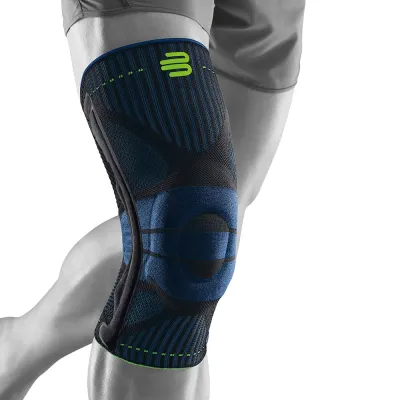
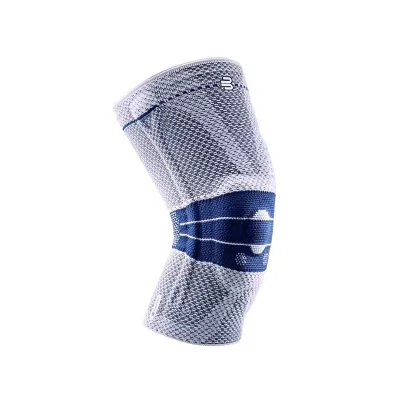
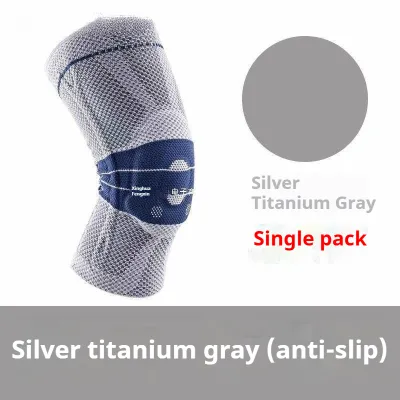
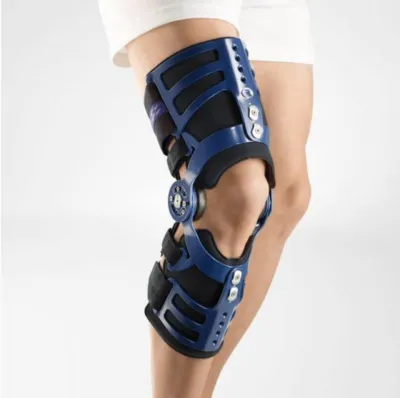
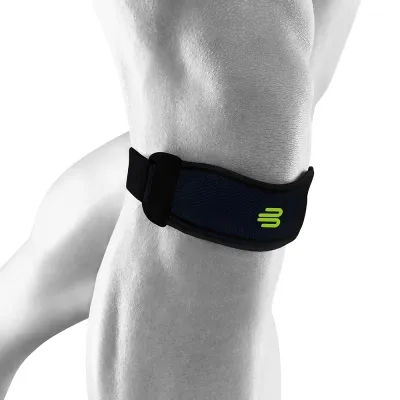
Prices are valid at publication and may change. Please refer to the product page for the latest price.
3D Breathable Knit Fabric The core of each guard is the three-dimensional active knit. Unlike flat-knit neoprene sleeves that trap heat and sweat, this fabric is engineered to provide gradient compression. It is tighter at the boundaries to promote blood circulation and highly elastic over the kneecap to allow a full range of motion. For athletes training in Singapore’s humid climate, the moisture-wicking properties of this knit are crucial for preventing skin irritation and keeping the support securely in place during long training sessions.
Anatomically Shaped Silicone Pads At the center of the support is a specialized viscoelastic insert, often referred to as the Omega pad. Rather than simply covering the kneecap, this pad surrounds it to distribute pressure away from the patella to the surrounding soft tissues. As your knee moves, the pad dynamically massages the joint capsule. This action stimulates local blood flow, accelerates the absorption of swelling, and provides sensory feedback that helps guide proper patellar tracking.
Flexible Side Stays To keep the fabric taut and prevent it from bunching behind the knee, flexible spring bars are integrated into the sides of the guard. These stays feature pull-on loops at the top to make the guard easier to slip on. While they do not lock the joint, they provide mild lateral guidance and ensure the support maintains its structural integrity throughout complex movements.
Synergistic Action These components work in unison to improve proprioception—your brain’s awareness of the joint’s position. While the basic technology remains consistent, the specific shape of the silicone inserts, the rigidity of the side stays, and the addition of strap systems vary across models to address different athletic demands.
Which Bauerfeind Model Matches Your Sport?
Different sports place unique stresses on the knee joint. Selecting a model tailored to your specific activity ensures you receive the correct balance of mobility, compression, and mechanical stabilization.

GenuTrain: Everyday Compression for Running and Fitness
Target Audience & Sports The standard GenuTrain is designed for athletes participating in linear, repetitive sports such as road running, cycling, rowing, and general gym fitness. It is highly suitable for individuals experiencing mild knee fatigue, minor swelling, or general joint instability after long workouts. If you run along the East Coast Park or cycle the Round Island Route, this model offers the ideal balance of lightweight comfort and joint reassurance.
Key Features This model features the classic Omega+ pad, which incorporates specialized massage nubs that target the Hoffa’s fat pad and the base of the meniscus. The gradient compression of the knit stimulates the surrounding muscles, helping to stabilize the joint actively. It provides excellent sensory feedback, allowing your body to naturally correct minor alignment issues during repetitive strides.
Limitations Because the GenuTrain relies entirely on flexible side stays and compression knit, it does not provide rigid mechanical stabilization. It lacks the structural support required to protect the knee against heavy side-to-side pivoting or rotational forces. Consequently, it is not recommended for athletes recovering from major ligament tears (such as the ACL or MCL) or those playing high-contact sports.
Decision Check Choose the standard GenuTrain if your primary goal is to manage mild joint soreness, reduce minor post-exercise swelling, and improve joint awareness during predictable, straight-line movements.
GenuTrain A3: Targeted Relief for Jumping and High-Impact Sports
Target Audience & Sports The GenuTrain A3 (Anti-Arthrosis-Alleviation) is engineered specifically for athletes dealing with anterior knee pain, patellar tracking issues, or degenerative joint irritation. It is highly effective for high-impact court sports like basketball, volleyball, tennis, and badminton, where explosive jumping, landing, and rapid changes of direction place immense stress on the kneecap.
Key Features The A3 features a complex, asymmetrical star-shaped silicone pad that directly addresses patellar misalignment. It includes friction nubs that target the vastus medialis obliquus (VMO) muscle on the inner thigh, stimulating it to pull the kneecap back into its proper tracking groove. Additionally, an integrated corrective guide prevents the kneecap from drifting outward during high-impact loading.
Limitations This model is highly specialized for anterior knee pain and patellar tracking correction. It does not offer the heavy lateral ligament stabilization provided by models with rigid joints or cross-straps. If your primary joint vulnerability is lateral buckling rather than patellar pain, the A3 may not provide the specific support you need.
Decision Check Select the GenuTrain A3 if you suffer from localized pain directly around or behind the kneecap, or if you have been diagnosed with runner’s knee or patellar tendinopathy, and need to protect your joint during high-impact jumping and landing.
GenuTrain S: Lateral Stability for Court and Field Sports
Target Audience & Sports The GenuTrain S (Splints) is designed for sports that demand aggressive lateral pivoting, sudden deceleration, and physical contact, such as soccer, rugby, basketball, and martial arts. It is also the preferred choice for athletes returning to sport after mild-to-moderate collateral ligament sprains (MCL or LCL) or those dealing with chronic joint laxity.
Key Features This model upgrades your protection by incorporating anatomically contoured side joints made of lightweight, rigid plastic. These joint splints are secured to the knee using an inelastic, adjustable cross-strap system that wraps around the thigh and calf. This combination provides direct mechanical reinforcement, restricting harmful lateral movement and rotational twisting while allowing the knee to bend and straighten naturally.
Limitations Due to the inclusion of rigid side joints and straps, the GenuTrain S has a bulkier profile than the standard knit sleeves. It may feel slightly restrictive under tight athletic compression gear or during activities that require maximum, deep knee flexion, such as deep squatting or certain martial arts transitions.
Decision Check Opt for the GenuTrain S if your sport involves unpredictable lateral cutting and physical contact, or if you require mechanical reassurance against side-to-side knee buckling and rotational instability.
Sizing, Fit, and Safety Boundaries
An improperly fitted knee guard can cause discomfort, slide down during exercise, or fail to provide the intended level of joint stabilization. Taking precise measurements and understanding the physical limits of athletic supports are essential steps for safe and effective use.
Measurement Protocol To find your correct size, you must take two precise circumferential measurements using a flexible measuring tape while your knee is bent at a slight 30-degree angle. First, measure the circumference of your thigh at a point exactly 14 centimeters above the center of your kneecap. Second, measure the circumference of your calf at a point exactly 12 centimeters below the center of your kneecap. Compare these two measurements against the official Bauerfeind size chart for your chosen model, as sizing profiles can vary between the standard, S, and A3 variations.
Fit Verification When you first try on the guard, it should feel snug and provide noticeable, even compression across the entire joint. The silicone pad must completely encircle your kneecap without pinching. Walk and perform a few light bodyweight squats to verify the fit. The guard should not slide down, roll at the edges, or cause any numbness, tingling, or skin discoloration. If you experience these symptoms, the support is too tight and you should size up to prevent circulatory restriction.
Safety and Medical Boundaries While a high-quality knee guard bauerfeind model provides excellent physical support, it is not a medical cure for structural joint damage. If you experience severe pain, sudden joint locking, acute swelling, or suspect a complete ligament tear, stop using the support immediately and consult a qualified physiotherapist or orthopaedic specialist. Equipment cannot replace proper physical conditioning, muscle strengthening, and professional medical diagnosis.
Contraindications If you suffer from peripheral vascular disease, lymphatic drainage disorders, neuropathy, or have a known skin allergy to silicone or synthetic fibers, you must consult your healthcare provider before wearing a compression knee guard. Do not apply the guard over open wounds or active skin infections.
Care and Maintenance for Longevity
Proper maintenance preserves the elasticity of the knit, the grip of the silicone pads, and the hygiene of the guard over prolonged athletic use. Premium supports require careful handling to maintain their therapeutic compression values.
Washing Instructions Wash your knee guard regularly, especially after intense workouts, to remove sweat, salt, and body oils that degrade the elastic fibers. Hand washing in cold water with a mild, liquid detergent is the safest method. If you prefer using a washing machine, place the guard in a mesh laundry bag, select a gentle or delicates cycle at a maximum of 30 degrees Celsius, and use a low spin speed. Never use bleach, fabric softeners, or harsh chemical detergents, as they break down the medical-grade elastane and damage the adhesive holding the silicone pads.
Drying Protocol After washing, gently squeeze out excess water without twisting or wringing the fabric. Lay the guard flat on a clean towel in a shaded, well-ventilated indoor area to air dry. Do not tumble dry, iron, or expose the guard to direct sunlight on an outdoor clothes rack. High heat and UV exposure will warp the silicone inserts, melt the adhesive bonds, and permanently destroy the elasticity of the knit.
Silicone Care Between washes, you can maintain the anti-slip properties of the silicone pads and side grips by wiping them gently with a damp, lint-free microfiber cloth. This simple step removes accumulated skin flakes and oils, ensuring the guard maintains its secure, non-slip grip on your skin during your next workout.
Frequently Asked Questions (FAQ)
Can I wear my Bauerfeind knee guard all day?
Bauerfeind knee guards are designed to be worn during periods of physical activity and daily movement when your muscles are active. You should remove the guard during long periods of rest, such as sitting at a desk for several hours, and always take it off before going to sleep. Prolonged compression during inactivity can restrict blood circulation and prevent your skin from breathing, which may lead to irritation.
Are Bauerfeind knee guards interchangeable for the left and right leg?
Whether a guard is interchangeable depends on the specific model you choose. Symmetrical models like the standard GenuTrain can be worn on either the left or right knee without any loss of function. However, anatomically specialized models like the GenuTrain A3 feature asymmetrical silicone inserts designed to target specific muscle groups on a particular side of the body. For these specialized models, you must select the correct side (left or right) at the time of purchase.
Community discussion
Share your experience or ask a question. Comments are reviewed before publication.