
To find the perfect Butterfly table tennis racket, you must match the equipment’s physical properties to your dominant playing style and your current level of technical consistency. Choosing a racket that is too fast or highly sensitive before you have mastered fundamental strokes will limit your development and lead to unforced errors. By identifying your tactical approach, honestly assessing your skill level, and understanding the structural differences between Butterfly’s pre-assembled and custom setups, you can select a racket that complements your natural instincts on the table.
Identify Your Dominant Playing Style on the Table
Your racket should act as an extension of your arm, working in harmony with your natural instincts rather than forcing you to alter your natural strokes. In table tennis, players generally fall into one of three primary tactical profiles: offensive, defensive, or all-round. Selecting equipment without analyzing these patterns often results in a mismatch that limits your tactical options during a match.
Offensive (Attacker) Signals
Products mentioned in this guide
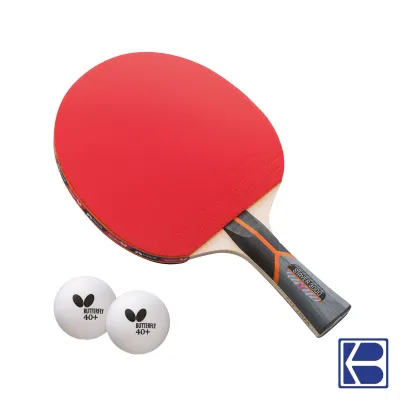
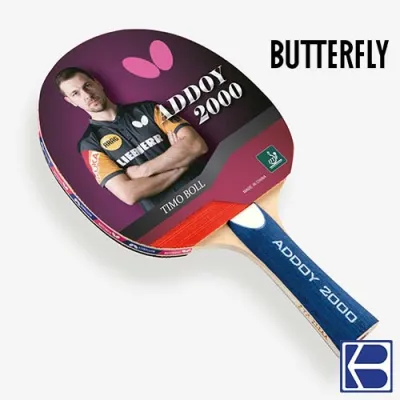
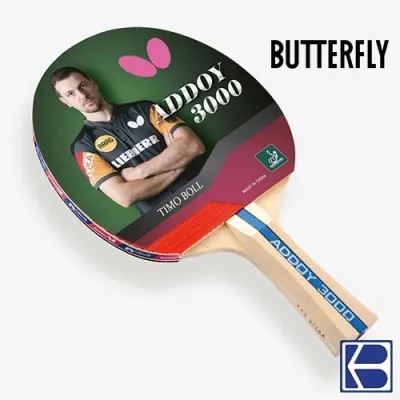
Prices are valid at publication and may change. Please refer to the product page for the latest price.
If you prefer to stay close to the table, initiate attacks at the earliest opportunity, and rely on heavy topspin loops to win points, you have an offensive style. Attackers require equipment that maximizes speed and spin generation. This style benefits from responsive blades—often reinforced with carbon fiber—and springy, high-tension rubbers that can propel the ball with explosive velocity even with a shorter swing.
Defensive (Chopper/Blocker) Signals
If you find yourself naturally stepping back from the table to absorb your opponent’s pace, returning heavy backspin, or relying on precise, passive blocking to force errors, your style is defensive. Defensive players require maximum control and ball feel. This approach demands slower, highly shock-absorbent all-wood blades and rubbers that minimize the incoming ball’s speed, allowing for precise placement and spin manipulation.
All-Round (Versatile) Signals
If you adapt your tactics based on your opponent’s weaknesses—mixing controlled passive blocks with sudden, well-placed attacks—you are an all-round player. Versatile players need balanced equipment that offers a middle ground between speed and control. A setup that is too fast will cause defensive blocks to fly off the table, while a setup that is too slow will make it difficult to finish points when an attacking opportunity arises.
While most players exhibit a mix of these traits depending on the match situation, you should focus on your dominant style. Think about how you win your most critical points under pressure; this primary instinct should dictate whether you look for an offensive, defensive, or balanced racket.
Evaluate Your Skill Level and Technical Consistency
An honest assessment of your technical proficiency is the most critical step in choosing a racket. High-performance, professional-grade equipment is highly sensitive to the angle of the racket and the speed of your swing. If your stroke mechanics are not yet consistent, this sensitivity will work against you, magnifying minor errors and causing your shots to miss the table.

Beginner to Intermediate Players
At this stage, your primary goal is to develop consistent stroke mechanics, proper footwork, and basic ball control. Highly sensitive carbon blades and hard, high-tension rubbers are counterproductive for learning. They reduce the dwell time—the fraction of a second the ball remains in contact with the racket—making it incredibly difficult to feel the ball and adjust your strokes. Beginner and intermediate players should focus on control-oriented, all-wood setups that provide clear vibration feedback and a forgiving sweet spot.
Advanced and Competitive Players
Advanced players possess established stroke mechanics, can generate their own power using their legs and core, and have strong tactical awareness. If you can consistently execute forehand and backhand loops against various spins, you can benefit from highly responsive, specialized equipment. Advanced setups allow you to maximize your swing speed, producing extreme spin and velocity that can penetrate your opponent’s defense.
Self-Check Prompt
To determine your current technical standing, analyze your unforced error rate during competitive rallies. Do you lose more points because your shots miss the table entirely, or because your shots are too slow to trouble your opponent? If keeping the ball in play is your primary challenge, prioritizing control over raw speed is essential. Upgrading to professional-grade gear before mastering basic mechanics often leads to frustration, a defensive mindset, and bad habits like shortening your swing to keep the ball on the table.
Equipment cannot replace training, physical conditioning, and technical dedication. A high-performance racket will only enhance techniques you have already mastered.
Navigate Butterfly’s Racket Categories: Premade vs. Custom
Once you understand your style and skill level, you can navigate Butterfly’s product ecosystem. The brand splits its offerings into pre-assembled (premade) rackets and custom components, which serve different stages of a player’s development.
Pre-Assembled Rackets for Immediate Play
Butterfly offers factory-assembled rackets designed specifically for recreational, beginner, and intermediate players. These rackets are budget-friendly and come ready to use out of the box. They are typically categorized by star ratings or specific series names (such as the Timo Boll or Wakaba series) that indicate their performance balance.
When choosing a premade racket, do not simply buy the model with the highest speed rating. Instead, check the manufacturer’s description on the packaging or official site to ensure the racket’s stated characteristics align with your goals. For example, an “all-round” rated premade racket is far more suitable for an intermediate player focusing on control than an ultra-fast model designed for pure attack.
Custom Blade and Rubber Combinations
As you transition into competitive play, pre-assembled rackets will eventually limit your progress. Advanced players typically build custom rackets by purchasing a blade and two separate rubbers, gluing them together to create a highly personalized tool.
- Blade Selection: The blade is the core of your racket. Its performance depends on ply count (typically 5 or 7 layers) and material composition. Pure wood blades offer excellent feel, high flexibility, and longer dwell time, making them ideal for developing players and defensive strategists. Carbon-composite blades (utilizing materials like Arylate-Carbon or Tamca 5000) introduce synthetic layers that stiffen the blade, expanding the sweet spot and dramatically increasing speed, though they reduce ball feel.
- Rubber Selection: Rubbers dictate the spin and speed of your shots. They consist of a top sheet and an underlying sponge. Key factors to consider include pimple structure (inverted rubbers for spin, short pips for blocking, or long pips for spin reversal) and sponge thickness. Thicker sponges (2.0mm or maximum) provide more speed and spin but offer less control, while thinner sponges (1.5mm to 1.8mm) prioritize control. Sponge hardness also matters: harder sponges require fast, precise swings to activate their performance, while softer sponges are more forgiving.
When building a custom setup, avoid matching an extremely fast carbon blade with ultra-hard, high-speed rubbers unless you are a highly trained competitor. It is often wiser to pair a balanced wood blade with control-oriented rubbers, or a moderately fast blade with highly controllable rubbers. Always consult official Butterfly specification charts or authorized dealers to verify compatibility and performance ratings before purchasing.
Pre-Purchase Checklist: Handle, Weight, and Specification Checks
Before finalizing your purchase, you must verify several physical characteristics of the racket to ensure comfort, usability, and durability.
Handle Shape Selection
Your grip style dictates the handle shape you need. For shakehand players, the most common shapes are Flared (FL), Straight (ST), and Anatomic (AN).
- Flared (FL): Widens at the end, preventing the racket from slipping out of your hand during powerful swings. This is the most popular choice globally.
- Straight (ST): Maintains a uniform width, allowing you to easily adjust your grip angle between forehand and backhand shots.
- Anatomic (AN): Features a wave-like shape that conforms to the palm, offering a secure grip for players with larger hands.
- Penhold: Specialized short handles designed for the traditional penhold grip (either Chinese Penhold or Japanese Penhold).
Weight and Balance Considerations
The total weight of a custom racket (the blade plus two rubbers) significantly impacts your swing speed and physical comfort. A heavy setup (often exceeding 180 grams) provides more stability and power against heavy incoming balls, but it requires superior wrist strength and conditioning. A lighter setup allows for faster acceleration and reduces arm fatigue, but it may feel unstable when blocking fast shots. Verify the weight specifications of the blade before buying, keeping in mind that adding two rubbers will typically add 90 to 100 grams to the total weight.
Verification and Authenticity
Because Butterfly is a highly sought-after brand, counterfeit rackets and rubbers are common on unauthorized online marketplaces. To guarantee you are purchasing genuine products, buy exclusively from authorized sporting goods retailers or the official brand store. Genuine Butterfly blades feature a registered serial number and a high-quality metal emblem on the handle base.
Care and Storage in Humid Climates
Table tennis rubbers degrade quickly when exposed to dust, dirt, and air. In humid environments, such as Singapore’s tropical climate, high relative humidity can cause moisture to build up on the rubber surface, leading to rapid oxidation and a loss of grip. To maintain your racket’s performance, always clean the rubbers with a specialized foam cleaner and a soft sponge immediately after play. Once dry, apply protective film sheets to block out air and store the racket in a padded, airtight case.
Frequently Asked Questions (FAQ)
How do I choose the right handle shape for my Butterfly racket?
Choose your handle shape based on your grip stability preferences. If you prefer a locked-in feel that prevents the racket from slipping during heavy topspin loops, choose a Flared (FL) handle. If you frequently adjust your grip angle or rotate the racket in your hand during play, a Straight (ST) handle is more suitable. If possible, hold different handle shapes at an authorized retail store to see which one fits your hand naturally.
Does a more expensive Butterfly racket automatically improve my game?
No, a more expensive racket will not automatically improve your performance and can actually hinder your progress if it does not match your skill level. High-priced Butterfly models often feature advanced carbon blades and hard, high-tension rubbers designed for professional players who have flawless stroke mechanics. If a beginner or intermediate player uses these setups, the lack of control and reduced dwell time will lead to a high unforced error rate and slower skill development.
Community discussion
Share your experience or ask a question. Comments are reviewed before publication.