
Fitting a Jomo treadmill or elliptical into a Singapore Housing & Development Board (HDB) flat requires balancing the machine’s physical footprint with the layout of your home. To prevent your cardio equipment from dominating your living space, you must choose a model that aligns with your specific room dimensions, storage capabilities, and safety clearance needs. Jomo offers several space-saving designs, including folding treadmills, low-profile walking pads, and compact front-drive ellipticals, which can integrate seamlessly into HDB flats when selected and positioned correctly.
Making the right choice involves evaluating how the equipment transitions between its active state and its stored state. A machine that looks perfectly reasonable on a showroom floor can easily overwhelm a standard bedroom or living room once you account for the necessary safety buffers. By understanding your flat’s physical constraints and matching them to the specific engineering features of Jomo’s lineup, you can maintain an active lifestyle at home without sacrificing your living space.
Understanding HDB Space Constraints for Cardio Equipment
Singapore’s HDB flats, particularly modern Build-To-Order (BTO) units, are highly optimized environments where every square meter counts. A typical 3-room or 4-room flat offers limited open floor area, meaning that any large piece of fitness equipment must share space with existing furniture, walkways, and daily household activities. Introducing a bulky treadmill or elliptical without careful planning can quickly turn a multi-purpose living room or bedroom into an cramped, single-purpose gym.
Products mentioned in this guide
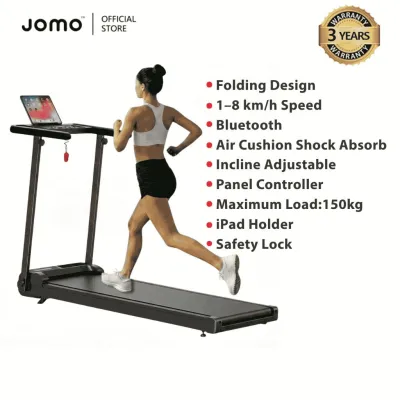
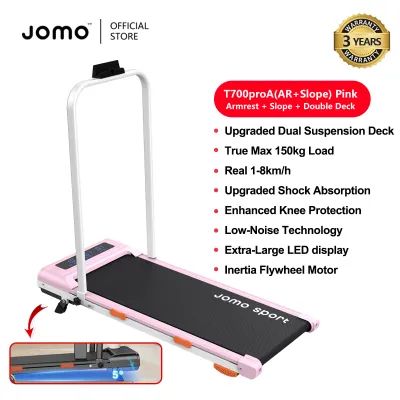
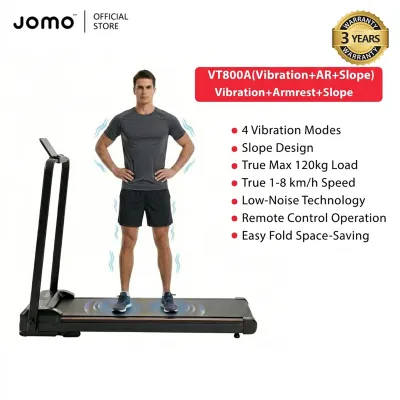
Prices are valid at publication and may change. Please refer to the product page for the latest price.
One of the most immediate physical bottlenecks is the width of standard HDB doors. Main entrance doors and metal gates typically provide a clearance of 80cm to 90cm, while internal bedroom doors are often narrower, sometimes measuring just 75cm to 80cm. If the packaged or fully assembled width of a Jomo cardio machine exceeds these dimensions, you will face significant delivery and installation obstacles. You must verify that the machine can either pass through these openings in its shipping carton or be assembled directly inside the designated room.
Transit logistics within the HDB block itself present additional challenges. Older HDB estates may have smaller elevator cabins or narrow common corridors with tight turning radiuses. If a delivery team cannot safely maneuver a large, non-folding machine around these corners or into the lift, you may face delivery failures or additional handling fees. This makes compact packaging and modular assembly highly desirable features for high-rise residents.
Finally, you must distinguish between a machine’s operational footprint and its stored footprint. The operational footprint is the total floor area required while the machine is in use, which must include safety clearances for mounting, dismounting, and emergency stops. The stored footprint is the space the machine occupies when folded or tucked away. A truly HDB-friendly Jomo machine must satisfy both constraints, allowing you to exercise safely and then reclaim your floor space once the workout is complete.
Key Space-Saving Features in Jomo Treadmills and Ellipticals
Evaluating Jomo’s product lineup requires looking past generic marketing terms and focusing on the specific engineering features that facilitate space management. Different models utilize distinct mechanisms to minimize their physical presence when not in use.

Folding Mechanisms and Stored Footprint
Jomo treadmills generally feature either hydraulic-assisted folding or manual folding mechanisms. Hydraulic-assisted systems, often referred to as soft-drop technology, use gas-charged shocks to help lift the heavy running deck with minimal physical effort. When you want to use the treadmill, the hydraulic system slowly and safely lowers the deck to the floor without requiring you to support its full weight. This is an essential convenience feature if you plan to fold and unfold the machine daily.
Manual folding mechanisms require more physical lifting but often allow the machine to fold flatter. When a treadmill is folded upright, its horizontal floor space is greatly reduced, but its vertical height and depth increase. You must check the folded dimensions carefully; an upright treadmill can stand over 1.5 meters tall, which might block wall-mounted air conditioning units, windows, or decorative shelving. If you intend to store the folded machine in a shallow closet or behind a partition, ensure the folded depth is slim enough to fit without protruding into your primary walkways.
For ellipticals, folding is less common due to the complex linkage of the foot pedals and handlebars. However, Jomo addresses this by offering compact ellipticals designed with a shorter stride length and a front-drive system. Front-drive ellipticals place the flywheel mechanism at the front of the machine, which naturally creates a more vertical, space-efficient footprint compared to traditional rear-drive models. Some specialized compact ellipticals also feature folding pedal arms that reduce the machine’s length by up to 40% when stored.
Transport Wheels and Daily Mobility
Integrated transport wheels are critical for any cardio machine destined for an HDB flat. If a machine is too heavy or awkward to move, you are highly unlikely to store it away after each workout, defeating the purpose of buying a space-saving model. Look for Jomo models equipped with multi-directional or high-durability wheels that allow you to tilt the machine and roll it smoothly across the floor.
However, you must consider the overall weight of the machine in relation to your flooring. Heavy, semi-commercial Jomo models can weigh 70kg or more. Even with transport wheels, moving such a heavy load across common HDB flooring materials—such as vinyl, laminate, or engineered wood—can cause deep scratches, scuffs, or permanent indentations. Always verify the net weight of the equipment and assess whether you can safely maneuver it on your own without damaging your home’s interior finishes.
Matching Equipment Types to HDB Room Layouts
Different rooms within an HDB flat serve different functional and aesthetic purposes. Matching the right Jomo machine to the specific layout of your room ensures that your workouts remain convenient without disrupting the household.
Living Rooms and Open Areas
The living room is typically the largest open space in an HDB flat, making it the most popular location for larger, more robust Jomo treadmills. These models provide the longer running belts and higher motor horsepower needed for high-intensity running or interval training. Because the living room is also a high-traffic social zone, a folding treadmill is ideal here. You can position the machine parallel to a wall or behind a sofa, folding it upright immediately after use to keep the central floor area clear for family activities.
When placing a treadmill in the living room, pay close attention to cable management and power access. Treadmills draw significant electrical current and should ideally be plugged directly into a dedicated wall outlet rather than a multi-plug extension cord, which can overheat. Position the machine close to an outlet to prevent the power cable from stretching across main walkways, creating a dangerous tripping hazard for children or elderly family members.
Bedrooms and Compact Corners
If you prefer to exercise in private or have a dedicated study room, ultra-compact Jomo walking pads, under-desk treadmills, or compact front-drive ellipticals are the most appropriate choices. These low-profile machines are designed specifically for light jogging or walking while working. Their minimal vertical height means they do not block natural light from windows, helping to maintain an open, airy feel in smaller bedrooms.
Low-profile walking pads can easily slide under a standard bed frame or a raised standing desk when you are finished. However, bedroom installations require extra attention to noise and vibration. Because HDB flats share concrete floors, the impact of your feet striking a treadmill deck can easily transmit structural noise to the neighbors living directly below you. To maintain neighborly harmony, choose a Jomo model with advanced internal shock absorption, and always place the machine on a thick, high-density equipment mat to dampen vibrations.
Crucial Clearance and Safety Margins for Safe Use
One of the most common mistakes home gym owners make is squeezing fitness equipment into tight corners without leaving adequate safety clearance. Operating a treadmill or elliptical without proper margins can lead to severe injuries, equipment damage, or voided warranties.
- Rear Clearance for Treadmills: You must maintain a minimum of 1.5 meters of completely unobstructed space behind the treadmill belt. If you lose your balance or trip while running, a moving belt will rapidly eject you backward. If the rear of the treadmill is positioned directly against a wall, window, or heavy furniture, you can become trapped between the spinning belt and the obstacle, resulting in severe friction burns, fractures, or head injuries. Never place the back of a treadmill facing a wall.
- Side Clearance: Leave at least 0.5 meters of open space on both sides of your Jomo treadmill or elliptical. This clearance is necessary to allow you to safely mount and dismount the machine, perform emergency stops, and access the power switch or folding latch without squeezing into a tight gap.
- Ceiling Clearance for Ellipticals: Standard HDB ceilings are approximately 2.6 meters high. While a treadmill user's head height remains relatively constant, an elliptical elevates your body significantly at the peak of its pedal stroke. To prevent hitting your head on the ceiling or wall-mounted fixtures, calculate your required clearance using this formula: Pedal Height at Peak Stride + Your Height + 15 to 20 cm of safety buffer. If this total exceeds your ceiling height, the elliptical is unsafe for your room, especially if you have a ceiling fan installed.
- Ventilation and Heat Dissipation: Cardio equipment motors generate heat during operation. Enclosing a treadmill or elliptical in a tight, unventilated alcove or closet can trap this heat, causing the motor and control boards to overheat. This can lead to sudden motor shutdowns, premature component failure, and may void your manufacturer's warranty. Ensure there is free airflow around the motor shroud at the front of the machine.
How to Measure and Verify Dimensions Before Purchase
To ensure a seamless purchase and delivery experience, follow this step-by-step verification process before committing to a specific Jomo model.
First, use a reliable tape measure to map out your delivery path. Measure the width of your HDB lift door, the width of your main front door, the clearance of your metal gate, and the width of any internal hallway doors the machine must pass through. Keep in mind that door handles, security latches, and shoe racks can reduce the effective clearance width by several centimeters.
Second, consult the official Jomo specification sheet and locate three distinct sets of dimensions:
- Assembled/Operational Dimensions: The length, width, and height of the machine when fully set up for a workout.
- Folded/Stored Dimensions: The physical space the machine occupies when folded upright or collapsed for storage.
- Packaging/Carton Dimensions: The size of the shipping box. This is almost always the largest of the three dimension sets and is the critical measurement for determining if the delivery team can physically bring the machine into your flat.
Third, use painter’s tape to outline the operational footprint of the Jomo machine on your floor, including the mandatory 1.5-meter rear safety clearance and 0.5-meter side clearances. Walk around this taped area to verify that it does not block bedroom doors, wardrobe doors, or primary walking paths. This physical visualization is the most effective way to prevent post-purchase regret.
Finally, prepare your floor surface. Standard HDB concrete floors are incredibly strong, but the concentrated weight of a heavy cardio machine resting on small rubber feet can easily dent vinyl or scratch parquet. Purchase a high-density EVA foam or heavy-duty rubber equipment mat that is slightly larger than the machine’s operational footprint. This mat will protect your flooring, distribute the weight evenly, and significantly reduce the transmission of motor hum and foot-strike noise through the building’s structure.
Frequently Asked Questions (FAQ)
Can I keep a Jomo treadmill folded against the wall permanently?
While Jomo folding treadmills are engineered for vertical storage, leaving them folded upright for months at a time without use is not recommended. Prolonged vertical storage can place uneven pressure on the hydraulic soft-drop pistons, potentially causing them to lose pressure or leak fluid over time. Additionally, the running belt can stretch unevenly or develop a permanent crease if left static in a folded position for too long. To maintain the mechanical health of your treadmill, unfold it at least once a week and run it at a slow speed (around 2 to 3 km/h) for five minutes to keep the belt aligned and ensure the internal lubricants remain evenly distributed.
Do Jomo ellipticals require less ceiling clearance than treadmills?
No, Jomo ellipticals generally require significantly more ceiling clearance than treadmills. When you run on a treadmill, your feet remain close to the low-profile running deck, meaning your head height is only slightly higher than your standing height. On an elliptical, the foot pedals are elevated on a mechanical linkage that lifts your body higher off the ground, particularly at the peak of the elliptical stride. Because of this elevated pedal height, you must carefully calculate your total height plus the peak pedal height against your HDB’s 2.6-meter ceiling to ensure safe operation without hitting ceiling fixtures or fans.
Community discussion
Share your experience or ask a question. Comments are reviewed before publication.