
Selecting the right prince tennis ball as a beginner depends on whether you are stepping onto the court for high-repetition stroke drills or playing a structured match. For casual practice, a highly durable pressureless ball provides the longevity needed for repetitive hitting. For matches, a pressurized championship ball offers the authentic bounce and crisp feel required to develop proper timing. Matching the ball’s felt type to the abrasive hard courts dominant in Singapore is equally critical to prevent premature wear.
Understanding the distinct categories of tennis balls helps you make an informed decision. By selecting the correct ball type, you can optimize your budget, protect your racket arm, and ensure your practice sessions translate directly to improved performance on game day.
Understanding Tennis Ball Types to Guide Your Prince Selection
Tennis balls are broadly categorized into pressurized and pressureless designs, each serving a distinct purpose on the court. Pressurized balls are filled with compressed air or nitrogen, which gives them a lively, responsive bounce and a lightweight feel upon impact. However, because the gas slowly permeates through the rubber core over time, pressurized balls gradually lose their bounce, even when left unused in an opened can.
Products mentioned in this guide
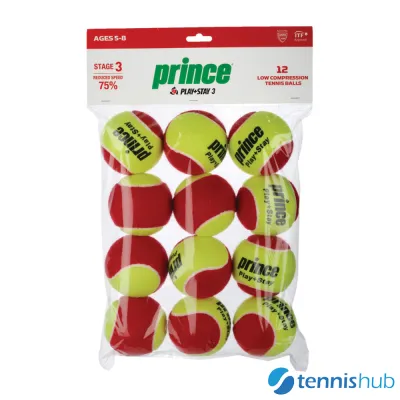
Prices are valid at publication and may change. Please refer to the product page for the latest price.
Pressureless balls, on the other hand, rely on a thicker, more elastic rubber core to generate their bounce. They do not lose pressure over time and actually become slightly bouncier as the outer felt wears down. While highly durable, pressureless balls feel noticeably heavier and stiffer when struck, which can sometimes lead to arm fatigue for beginners who have not yet developed clean contact mechanics.
When evaluating a prince tennis ball, you must also distinguish between practice-grade and match-grade felt. Practice-grade options often utilize a higher percentage of synthetic fibers, which resist wear but offer less aerodynamic control. Match-grade balls feature premium woven felt with a higher wool content, providing a more consistent flight path and better grip on the racket strings. To identify these categories, look closely at the packaging labels; Prince typically categorizes its lineup using terms like “Championship” or “Tournament” for match-grade pressurized balls, and “Coach” or “Pressureless” for training variants.
Choosing Prince Tennis Balls for Casual Practice and Drills
Repetitive training and drills require a ball that can withstand hours of abrasive contact without losing its physical integrity. If you are practicing your serve, working with a ball machine, or participating in multi-ball feeding drills with a coach, your primary needs are high durability and cost-efficiency. Using premium match balls for these scenarios is financially impractical, as they will lose their internal pressure long before the felt wears out.

For these high-volume training sessions, Prince pressureless or practice-grade balls are highly effective. Because these balls do not rely on internal gas pressure, they can be stored loose in a basket or hopper for months without going flat. This consistent bounce profile allows beginners to focus entirely on perfecting their swing path, footwork, and contact point without the frustration of erratic bounces.
When purchasing balls for practice, look for packaging explicitly labeled for training, coaching, or pressureless use. These are often sold in larger quantities, such as mesh bags or buckets, which offer a much lower cost per ball than standard three-ball cans. Additionally, verify the recommended court surface printed on the packaging to ensure the felt is designed to handle the specific friction of your local training environment.
Selecting Prince Match Balls for Competitive Play and Fixtures
When you transition from solo practice to competitive matches, friendly fixtures, or structured sparring sessions, the requirements change entirely. Match play demands absolute consistency in bounce, speed, and flight. A ball that bounces too low or flies unpredictably makes it difficult to execute strategy, keep score accurately, or build confidence in your competitive strokes.
For these scenarios, beginners should select Prince match-grade or championship pressurized balls. These balls provide the standard speed and responsive feel that tennis governing bodies mandate for official play. The lively response of a fresh pressurized ball allows you to generate depth and spin with less physical effort, encouraging relaxed, fluid stroke mechanics rather than stiff, forced swings.
To maximize the value of these premium balls, reserve them strictly for match play or high-intensity rally sessions. Once you break the metal seal on a pressurized can, the balls will begin to lose pressure. It is best to buy these in smaller, manageable quantities, such as individual three-ball or four-ball cans, rather than bulk cases. Opening a fresh can right before your match ensures that both players enjoy a fair, high-quality playing experience.
Matching Your Prince Tennis Ball to the Court Surface
Court surfaces exert varying degrees of friction on a tennis ball, which is why manufacturers produce different felt configurations. The two primary categories you will encounter are “Regular Duty” and “Extra Duty” felt. Regular Duty balls are designed for softer, less abrasive surfaces such as clay, grass, or indoor carpet courts. Their felt is thinner and more tightly woven to prevent the ball from absorbing excess moisture or fluffing up too much, which would slow the ball down excessively on these already slow surfaces.
Conversely, Extra Duty balls are engineered specifically for hard courts. The felt on an Extra Duty ball is thicker, heavier, and woven with a higher proportion of synthetic fibers like nylon. This construction is designed to resist the intense shearing forces and high friction generated by abrasive acrylic hard court surfaces.
In Singapore, the vast majority of public courts, condominium facilities, and private clubs feature outdoor hard courts. Because these courts are exposed to tropical heat and rain, their textured surfaces act like sandpaper on a tennis ball. Beginners playing in Singapore should look for “Extra Duty” or “All Court” clearly printed on the Prince can. Using a Regular Duty ball on these courts will cause the felt to bald prematurely, ruining the ball’s aerodynamics and bounce within a single session.
Cross-Scenario Compatibility: Can One Prince Ball Do It All?
Many beginners wonder if they can simplify their gear by purchasing a single type of prince tennis ball for both practice and matches. While attempting a “one-ball-fits-all” approach is common, it introduces significant trade-offs that can hinder your development and strain your budget. Using premium pressurized match balls for daily serve practice will quickly drain your wallet, as a typical can costing S$8 to S$12 will lose its optimal bounce within a couple of weeks, even if rarely struck. Conversely, using stiff, heavy pressureless balls for competitive matches can frustrate your opponents and fail to prepare you for the speed of standard play.
A more practical approach is to adopt a dual-ball strategy. Invest in a bulk set of Prince pressureless or practice balls for your solo drills, serve practice, and ball machine sessions. These balls will remain usable for months, allowing you to build muscle memory without financial worry. Then, keep a few sealed cans of Prince Extra Duty pressurized championship balls in your bag, opening a fresh can only when you play a competitive set or a high-level practice match.
This strategy offers the best of both worlds. It keeps your ongoing equipment costs low while ensuring that when you do play a match, you are competing with a ball that behaves exactly as intended. Over time, this separation of gear will help you transition smoothly from technical drills to real-game situations.
Frequently Asked Questions (FAQ)
How long do pressurized Prince tennis balls last once opened?
Once the pressurized can is opened, the balls begin losing pressure immediately due to gas permeation through the rubber shell. For optimal match play, a pressurized ball is best used within one to three active hitting sessions, or within one to two weeks of opening the can. Even if left unused in your bag, opened pressurized balls will lose their lively bounce and feel flat within a few weeks.
Can beginners use pressureless Prince balls for actual matches?
While highly durable, pressureless balls are generally not recommended for competitive matches. They have a heavier, stiffer feel on impact and bounce differently than standard pressurized balls. Using them in a match can make it difficult to gauge depth and pace accurately, and the stiffer impact can place unnecessary strain on a beginner’s elbow and wrist.
How should I store my Prince tennis balls in Singapore's humid climate?
To preserve ball quality in Singapore’s tropical climate, store unopened cans in a cool, dry place away from direct sunlight and extreme heat, such as inside a closet rather than a hot car trunk. High temperatures can cause the air inside pressurized cans to expand and escape faster. For opened balls, ensure they are kept in a dry compartment of your sports bag, as excess moisture can waterlog the felt and ruin the ball’s flight characteristics.
Community discussion
Share your experience or ask a question. Comments are reviewed before publication.