
Finding the right pull-up bar for a Housing & Development Board (HDB) flat requires balancing fitness goals with the unique structural and spatial realities of Singapore public housing. Standard HDB layouts—ranging from compact 2-room Flexi flats to larger 5-room and Executive apartments—present specific constraints regarding wall composition, door frame durability, and floor space. Choosing the wrong equipment can lead to structural damage, lease violations, or serious physical injury.
To make an informed decision, you must evaluate how different pull-up bar designs interact with your home’s architecture. Doorway, wall-mounted, and freestanding bars each offer distinct advantages and drawbacks depending on whether you rent or own, your available floor area, and the materials used in your flat’s construction. By understanding these factors, you can establish a safe, effective home workout space without compromising your living environment.
Understanding HDB Flat Constraints and Installation Rules
Before purchasing any home fitness equipment, you must understand the structural rules governing HDB flats. HDB renovation guidelines strictly regulate drilling and structural modifications to maintain the building’s integrity. Structural walls, columns, and household shelters (bomb shelters) are made of high-strength, reinforced precast concrete. While these structures are incredibly durable and capable of supporting heavy loads, drilling into them requires a high-powered rotary hammer drill and specialized masonry drill bits. Standard impact drills will struggle to penetrate these surfaces, often resulting in damaged tools or incomplete installations.
Products mentioned in this guide
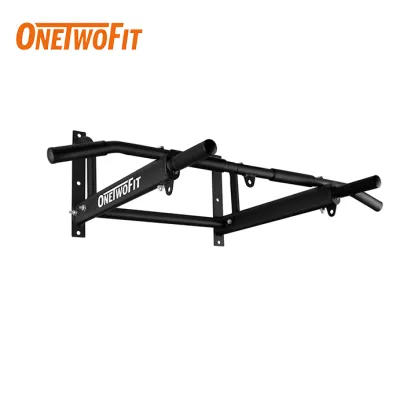
![[Ready Stock] UltimateSup Wall Mounted Pull Up Bars Portable Home Chin Up Fitness Equipment Pull Up Bar No Drilling Load Bearing](https://img.lazcdn.com/g/p/9e3a5040799705b35dace88921b6ab7b.png_400x400q80.png_.webp)
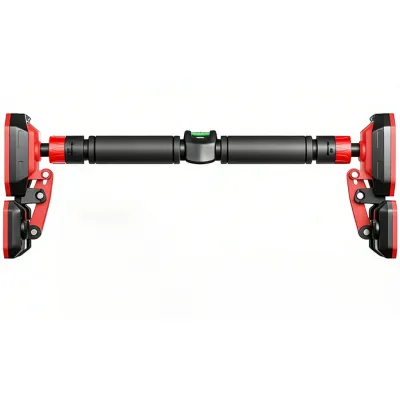
![🇸🇬 [READY STOCK] No Drill Pull Up Bar Easy Install Total Upper Body Workout](https://img.lazcdn.com/g/p/e78ced9e624a1071457309ad97dd1eac.jpg_400x400q80.jpg_.webp)
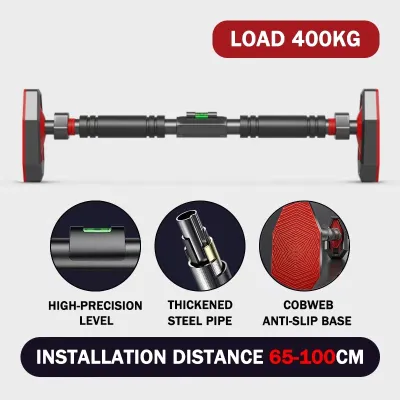
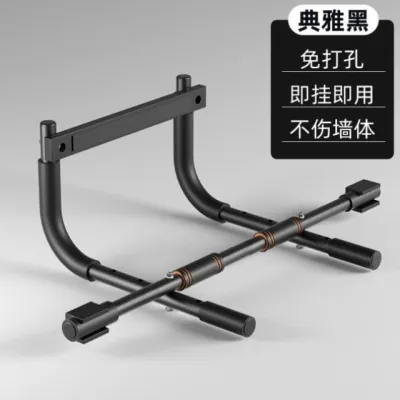
Prices are valid at publication and may change. Please refer to the product page for the latest price.
Conversely, non-structural partition walls—typically used to divide bedrooms or enclose kitchens—are made of lightweight concrete blocks, gypsum boards, or drywall. These materials lack the density and structural strength to support the dynamic, downward force exerted during a pull-up. Attempting to mount a heavy steel bar to a partition wall can cause the anchors to pull out, leading to severe wall damage and potential injury.
Tenancy agreements introduce another layer of complexity. If you are renting an HDB flat, your tenancy agreement almost certainly contains clauses prohibiting permanent alterations, including drilling holes into walls or door frames. For renters, non-invasive installation methods are not just a preference; they are a legal necessity to avoid losing your security deposit.
Finally, physical space constraints must be factored into your decision. Standard HDB ceiling heights typically range from 2.6 to 2.8 meters. When you perform a pull-up, your head must clear the bar by at least 20 to 30 centimeters. If you install a bar too high, you risk striking your head against the ceiling. Floor space is also limited, especially in bedrooms where wardrobes, queen-sized beds, and desks leave little room for bulky equipment.
Doorway Pull-Up Bars: Best for Compact Rooms and Renters
Doorway pull-up bars are the most popular choice for compact HDB flats and rental units because they require no drilling and can be set up or removed in seconds. However, their safety and viability depend heavily on the material and construction of your door frames.

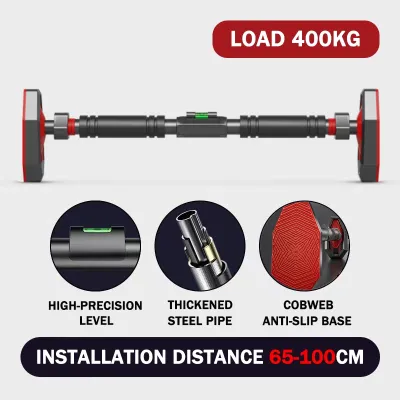
Modern HDB flats often feature door frames made of hollow-core wood, aluminum, or thin sheet metal. Tension-mounted bars, which extend outward against the inner sides of the frame, rely entirely on friction and pressure. If applied to a hollow-core wooden frame, this intense outward pressure can easily warp, crack, or split the wood. On smooth metal frames, tension bars are prone to slipping unless they feature high-quality, slip-resistant rubber pads. Solid wood door frames, commonly found in older HDB estates, are the most reliable option for tension bars as they can withstand the compressive forces without structural failure.
Lever-action or over-the-door pull-up bars work differently. Instead of pushing outward, they use a cantilever design that hooks onto the trim (architrave) above the door frame on one side, while resting against the front of the frame on the other. This design distributes your body weight more evenly, but it requires a sturdy, protruding wooden trim that is securely nailed to the wall. If your HDB flat has flush door frames with no protruding trim, or if the trim is made of flimsy plastic or thin MDF, a lever-action bar cannot be safely installed.
You must also measure the clearance around the doorway. Ensure there is sufficient headroom between the top of the bar and the ceiling, and check that the doorway is wide enough to accommodate the bar’s dimensions. Keep in mind that doorway bars restrict the width of your grip to the width of the door frame, which may limit your ability to perform wide-grip pull-ups.
Wall-Mounted Pull-Up Bars: Best for Dedicated Workout Corners
For homeowners who want a permanent, highly stable setup and have a dedicated workout corner, wall-mounted pull-up bars are the gold standard. These bars are bolted directly into the wall, offering unmatched stability and allowing for dynamic movements like chin-ups, wide-grip pull-ups, and hanging leg raises.
The critical factor for a wall-mounted installation is identifying a structural concrete wall. In HDB flats, structural walls are typically the thick, solid concrete walls that form the perimeter of the flat or separate different units. You can identify these by tapping on the wall; a solid, high-pitched thud indicates concrete, while a hollow, echoing sound indicates a partition wall or drywall. Never attempt to mount a pull-up bar to a partition wall, as the plaster and lightweight blocks will crumble under the shear and tension forces of your workouts.
When planning your installation, calculate the required clearance from the wall. A good wall-mounted bar should project at least 30 to 50 centimeters from the wall surface. This clearance is essential to prevent your knees, shins, or chest from scraping against the wall during your exercises. Additionally, ensure there is at least 50 centimeters of clear space above the bar to prevent your head from hitting the ceiling at the peak of your movement.
Wall-mounted bars often feature multi-grip configurations, including wide, narrow, neutral, and angled handles. This variety allows you to target different muscle groups, such as the latissimus dorsi, biceps, and upper back. However, because this is a permanent fixture, you must choose a location that does not obstruct daily foot traffic or interfere with opening doors and wardrobe panels.
Freestanding Pull-Up Bars: Best for Flexible Layouts and Open Spaces
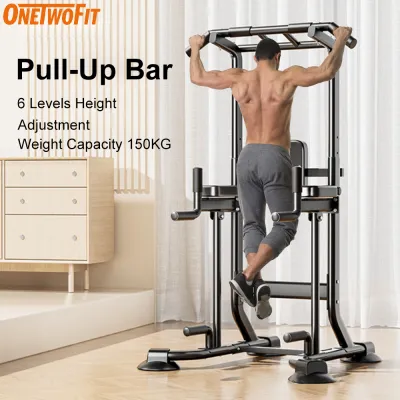
If you have a larger HDB layout, such as a 5-room flat, an Executive apartment, or a spacious living room, a freestanding pull-up bar—often called a power tower—is an excellent alternative. These units require no installation, drilling, or structural modifications, making them highly versatile.
The primary consideration for a freestanding tower is its physical footprint. These units typically require a flat, level floor space of approximately 1 to 1.5 square meters. Because they stand on the floor, they must have a wide, heavy base to ensure stability and prevent tipping during use. If you plan to perform dynamic movements or weighted pull-ups, look for a model with an extended base and rubberized feet that grip the floor securely.
Ceiling height is another critical factor. Most freestanding power towers stand between 2.0 and 2.3 meters tall. You must measure your ceiling height to ensure that when you stand the tower upright, there is still enough clearance for your head at the top of the exercise. If your flat has false ceilings or low-hanging light fixtures, a freestanding tower may not fit safely.
On the positive side, freestanding bars offer excellent versatility. Many models include additional features such as dip bars, push-up handles, and padded backrests for leg raises, turning a single piece of equipment into a complete home gym. Some models are designed to be semi-portable or foldable, allowing you to store them in a household shelter or utility room when not in use. However, they are heavy and bulky, so moving them frequently can be physically demanding.
Comparison Matrix: Matching Bar Types to Your Space
To help you choose the right pull-up bar for your specific HDB flat layout, use the following comparison matrix to match your space constraints and installation preferences.
| Bar Type | Space Footprint | Installation Method | HDB Suitability | Ideal Room Type |
|---|---|---|---|---|
| Doorway (Tension) | Minimal (fits inside door frame) | Friction/Pressure (No drilling) | High (requires solid wood frame) | Small bedrooms, rental units |
| Doorway (Lever) | Small (hangs over door frame) | Cantilever hook (No drilling) | Medium (requires protruding trim) | Standard bedrooms, rental units |
| Wall-Mounted | Medium (projects from wall) | Heavy-duty bolts (Drilling required) | High (must use structural concrete) | Dedicated gym corners, balconies |
| Freestanding | Large (requires floor space) | None (Floor-standing) | High (requires level floor & high ceiling) | Living rooms, spacious study rooms |
Use these conditional decision paths to guide your final choice:
- Choose a doorway tension bar if you are renting, have solid wood door frames, and need a completely non-invasive option that can be stored away easily.
- Choose a wall-mounted bar if you own your HDB flat, have a dedicated workout space with a solid concrete wall, and want the most stable, multi-grip training experience.
- Choose a freestanding power tower if you have ample floor space, want to avoid drilling entirely, and desire a multi-functional workout station that includes dips and leg raises.
- Avoid standard options if your flat features only hollow-core door frames, thin partition walls, and extremely low false ceilings. In such cases, a freestanding tower with an adjustable, lower height setting may be your only viable option.
How to Verify Safety and Structural Limits Before Buying
Ensuring your safety and protecting your HDB flat from structural damage requires careful verification before you make a purchase. Equipment failure can result in severe falls, joint injuries, or costly repairs to your home’s walls and door frames.
First, always check the manufacturer’s stated weight capacity and safety certifications on the product label. Keep in mind that your body weight is static, but when you perform a pull-up, you exert dynamic force. This dynamic load can be significantly higher than your static weight, especially if you drop down quickly or use explosive movements. Choose a bar with a weight capacity that comfortably exceeds your body weight to ensure a safe margin of error.
Second, perform a thorough visual and physical inspection of your proposed installation site. For doorway bars, check that the door frame is perfectly square, free of rot or cracks, and securely anchored to the wall. For wall-mounted bars, use a stud finder or tap test to confirm the wall is solid concrete. If you encounter plaster dust or a hollow sound while drilling, stop immediately; this indicates you have hit a partition wall or plaster rendering that cannot support the load.
Finally, establish clear stopping conditions. If you observe any bowing of the door frame, cracking of the wall plaster, or loosening of the mounting bolts during your first few workouts, cease using the equipment immediately. Do not attempt to force an unstable installation. If you are unsure about the structural integrity of your walls or door frames, consult a qualified contractor or the equipment manufacturer before proceeding.
Frequently Asked Questions (FAQ)
Can I install a wall-mounted pull-up bar on HDB partition walls?
No, you should never install a wall-mounted pull-up bar on HDB partition walls. These walls are typically constructed from lightweight concrete blocks, gypsum boards, or drywall, which do not possess the structural density required to hold heavy expansion bolts under dynamic loads. Attempting to do so will likely cause the anchors to pull out, severely damaging the wall and risking serious injury. Always anchor wall-mounted bars into solid concrete structural walls or columns. If you are unsure of your wall type, consult a licensed contractor or check your flat’s original floor plan.
Will a doorway pull-up bar damage my HDB door frame?
A doorway pull-up bar can damage your HDB door frame if the frame is made of hollow-core wood or thin metal, or if the bar is installed incorrectly. Tension bars exert high outward pressure that can warp or crack hollow wood frames. Lever-action bars can dent or scratch the decorative trim above the door. To minimize the risk of damage, use protective rubber pads or wrap the contact points of the bar in soft microfiber cloths. Regularly check for any shifts in the frame or loose trim, and tighten or adjust the bar before every workout session.
Are ceiling-mounted pull-up bars safe for HDB flats?
Ceiling-mounted pull-up bars can be safe, but they carry significant risks in HDB flats. Drilling into concrete ceiling slabs is highly challenging and carries the risk of striking concealed electrical conduits, water pipes, or structural rebar. Additionally, HDB guidelines restrict unauthorized drilling into ceiling slabs to prevent water leakage issues, especially in kitchens and bathrooms. If you cannot verify the exact path of utility lines within your ceiling, it is highly recommended to opt for a wall-mounted bar or a freestanding power tower instead.
Community discussion
Share your experience or ask a question. Comments are reviewed before publication.