
Selecting the right badminton equipment is essential for improving your game, and few decisions have as immediate an impact on your play as the shuttlecock you choose. Among badminton players worldwide, RSL is recognized as one of the most prominent brands, offering a diverse lineup of shuttlecocks designed for various skill levels and playing environments. However, selecting the wrong model can lead to unnecessary expenses or a highly frustrating experience on the court.
To make an informed purchase, you must evaluate your current skill level, playing frequency, and court conditions. While beginners require maximum durability to withstand frequent mistimed hits, advanced competitive players demand absolute consistency in flight trajectory and speed. This guide analyzes the RSL shuttlecock lineup to help you identify the ideal model for your specific playing needs, ensuring you balance performance with overall cost-effectiveness.
Quick Guide: Matching Your Skill Level to RSL Models
Before exploring the technical differences between individual models, it is helpful to understand where you fit within the player spectrum. The badminton community generally categorizes players into beginner, intermediate, and advanced levels, each with distinct equipment requirements. Selecting a shuttlecock that aligns with your proficiency ensures that you do not overspend on premium models that you might accidentally damage, nor limit your skill development with models that lack precision.
Products mentioned in this guide
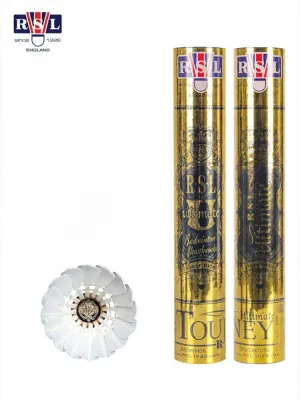
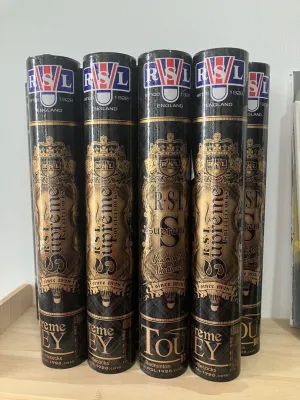
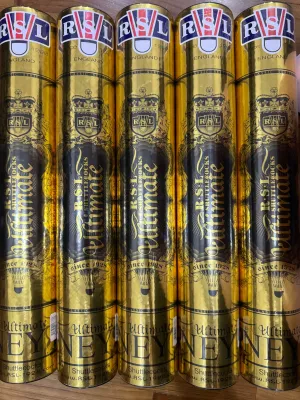
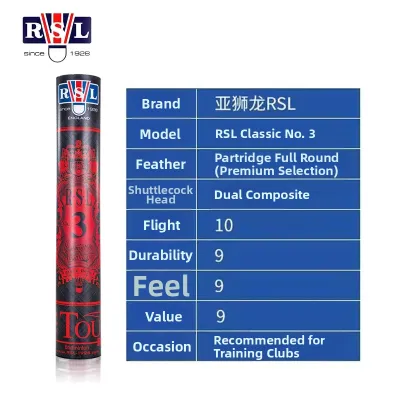
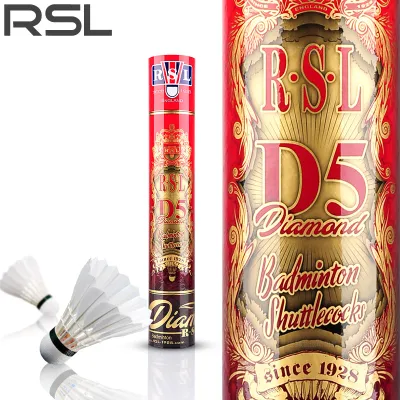
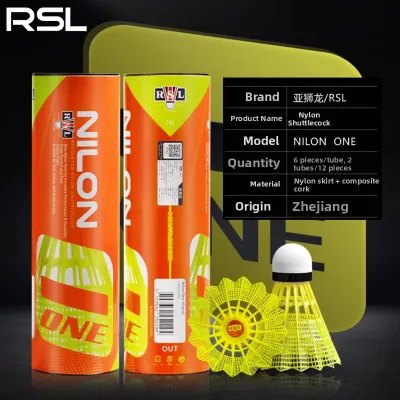
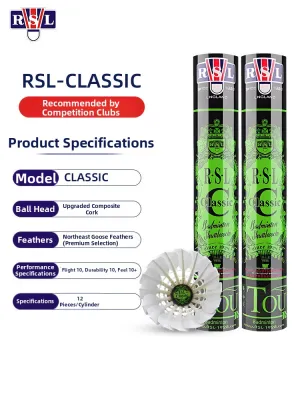
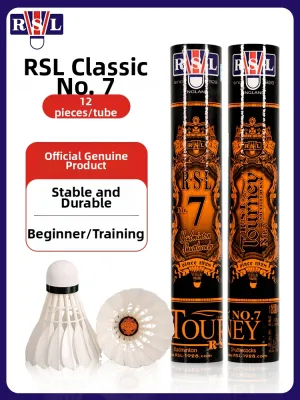
Prices are valid at publication and may change. Please refer to the product page for the latest price.
The following decision matrix summarizes how different player profiles map to the recommended RSL shuttlecock tiers, focusing on material composition, primary performance priorities, and suitable playing environments:
| Player Level | Recommended RSL Model | Primary Material | Key Priority | Ideal Playing Venue |
|---|---|---|---|---|
| Beginner / Casual | RSL Nylon Series (e.g., Nylon 10) | Synthetic Nylon | Maximum Durability & Low Cost | Outdoor parks, non-AC community halls |
| Intermediate / Club | RSL Classic, RSL Supreme, RSL No. 2 Tourney | Mid-grade Duck or Goose Feather | Balanced Flight & Moderate Lifespan | Indoor sports halls (AC or non-AC) |
| Advanced / Competitive | RSL Tourney No. 1, RSL Super | Premium Goose Feather | Precise Trajectory & Speed Consistency | Indoor tournament courts (AC) |
Choosing the correct shuttlecock is ultimately a balancing act between performance expectations and replacement costs. Beginners who attempt to use premium feather shuttlecocks often find themselves shredding multiple expensive units per session due to frame hits, which quickly becomes financially unsustainable. Conversely, advanced players using synthetic nylon models will struggle to execute precise net play or deceptive slices, as synthetic materials do not react to the racket strings with the same level of responsiveness as natural feathers.
Feather vs. Nylon: The Foundation of Your Choice
The primary decision you must make when purchasing rsl shuttlecocks is choosing between natural feather and synthetic nylon construction. This fundamental material difference dictates how the shuttlecock behaves in the air, how long it lasts under repeated impacts, and how much it will cost you over time. Understanding these physical properties is essential for selecting a model that supports your playing style.

Flight Trajectory and Feel
Natural feather shuttlecocks possess unique aerodynamic characteristics that synthetic alternatives have struggled to replicate perfectly. Due to the natural overlap of the feathers, a feather shuttlecock experiences high drag, causing it to decelerate sharply at the end of its flight path. This steep, parabolic trajectory allows for precise baseline-to-baseline clears and sharp, downward smashes. The tactile feedback off the racket strings is also highly distinct, offering a crisp feel that allows players to gauge the power and angle of their shots with extreme accuracy.
In contrast, synthetic nylon shuttlecocks feature a continuous plastic skirt that behaves differently in the air. Nylon models tend to follow a flatter, more consistent trajectory and do not decelerate as abruptly as feathers. This means that shots hit with a nylon shuttlecock often travel further and faster near the end of their flight, requiring players to adjust their timing and swing power. While synthetic designs have improved significantly, they still lack the delicate responsiveness required for advanced spin serves and tight net play.
Durability and Cost-Effectiveness
Durability is the primary advantage of synthetic nylon shuttlecocks. The flexible plastic skirt can bend and absorb high-impact forces without breaking, making nylon highly resilient against mistimed hits, frame strikes, and aggressive smashes. A single nylon shuttlecock can often survive multiple intense sessions or weeks of casual play without experiencing a significant degradation in flight quality, making it an exceptionally cost-effective option for recreational players.
Natural feather shuttlecocks are inherently fragile. Each shuttlecock is constructed from 16 individual feathers inserted into a cork base and secured with thread and glue. If a player strikes the feathers directly with the racket frame—a common occurrence during fast rallies or when learning new strokes—the delicate feather shafts can easily snap. Once a feather is broken or severely bent, the shuttlecock loses its aerodynamic balance, causing it to wobble, veer off course, or slow down dramatically, requiring immediate replacement.
Environmental Factors and Court Suitability
Natural materials are highly sensitive to environmental conditions, particularly temperature and humidity. Dry air deprives natural feathers of their moisture, making them brittle and prone to snapping within a few rallies. High humidity, on the other hand, can make the feathers heavier, altering their flight speed and distance. Because of this sensitivity, feather shuttlecocks are designed almost exclusively for indoor use, where air currents are minimized and temperature can be relatively controlled.
Synthetic nylon shuttlecocks are virtually unaffected by changes in humidity or temperature. Their plastic construction maintains its structural integrity and flexibility whether you are playing in a chilly, air-conditioned indoor hall or in a warm outdoor park. Furthermore, nylon models are heavy enough to withstand mild outdoor breezes, making them the default choice for outdoor recreational play, backyard games, and casual sessions on non-standard court surfaces.
Recommended RSL Shuttlecocks by Playing Level
RSL has developed a comprehensive product portfolio that caters directly to different segments of the badminton community. By categorizing their models based on material quality, manufacturing tolerances, and durability, RSL ensures that every player can find a shuttlecock that matches their specific proficiency. Below is a detailed breakdown of the recommended RSL models for each playing level, outlining their target audiences, advantages, and limitations.
Beginners and Casual Players: Prioritizing Durability
For those who are new to badminton or play primarily for casual recreation, the primary focus should be on durability and economic viability. Beginners are still developing their hand-eye coordination and stroke mechanics, which naturally leads to frequent off-center hits and frame strikes. Using delicate feather shuttlecocks at this stage is highly impractical and expensive, as a single mistimed hit can ruin a premium feather unit instantly.
The RSL Nylon series, particularly models like the RSL Nylon 10, is specifically designed to meet the needs of casual and entry-level players. These synthetic shuttlecocks feature a highly resilient nylon skirt mounted on a synthetic or compressed cork base. They are engineered to mimic the flight of a feather shuttlecock as closely as possible while offering a level of durability that natural feathers cannot match.
- Target Audience: Beginners, school students, casual weekend players, and those who play outdoors or in non-air-conditioned community spaces.
- Why They Fit: The primary benefit of the RSL Nylon series is its exceptional lifespan. A single nylon shuttlecock can withstand hundreds of hard smashes and frame hits without losing its shape or tearing. This high durability translates to a very low cost per hour of play, allowing beginners to focus on practicing their clears, drives, and serves without the constant distraction of replacing damaged shuttlecocks. Additionally, their consistent flight path under outdoor conditions makes them highly versatile.
- Limitations: While highly durable, nylon shuttlecocks do not offer the refined tactile feedback or advanced spin control of natural feathers. They tend to feel slightly heavier and stiffer upon contact with the racket, which can contribute to wrist fatigue during extended playing sessions. The lack of rapid deceleration also means that advanced defensive techniques and tight net play are much harder to execute effectively.
Intermediate Club Players: Balancing Feel and Cost
Intermediate players, regular club members, and those undergoing structured training have typically developed consistent stroke mechanics and rarely hit the shuttlecock with the racket frame. At this level, players begin to incorporate advanced tactical shots into their games, such as slice drops, net tumbles, and precise cross-court clears. To execute these shots successfully, transitioning to natural feather shuttlecocks is highly recommended, as the synthetic skirt of a nylon model cannot provide the necessary aerodynamic responsiveness.
For this large segment of the badminton community, RSL offers mid-tier feather models like the RSL Classic, RSL Supreme, and the RSL Tourney No. 2 or No. 3. These models are constructed using carefully selected duck feathers or mid-grade goose feathers, combined with dual-tier natural cork bases. They are designed to deliver the authentic flight characteristics and touch of premium feathers while maintaining a level of structural resilience that keeps them economically viable for frequent club sessions.
- Target Audience: Intermediate club players, weekly social group participants, and players practicing specific drills (such as repetitive smashing or net-play exercises) multiple times a week.
- Why They Fit: These mid-tier models offer an excellent balance between performance and durability. By utilizing slightly thicker and more robust feather selections, RSL ensures that these shuttlecocks can withstand multiple hard smashes before the feathers begin to fray or weaken. They provide the classic crisp feel and sharp deceleration of natural feathers, allowing intermediate players to refine their touch at the net and develop better control over their shot depth.
- Limitations: Because these models are positioned as mid-tier options, they do not undergo the same level of ultra-strict weight and balance sorting as tournament-grade shuttlecocks. While highly reliable for club play, players may occasionally notice minor variations in speed or flight consistency between different tubes or batches. Additionally, while more durable than premium options, they will still degrade quickly if subjected to repeated frame hits.
Advanced and Competitive Players: Maximizing Performance
Advanced players, league competitors, and tournament athletes operate in a high-intensity environment where every millimeter counts. At this elite level, rallies are incredibly fast, and players rely on absolute precision to force errors from their opponents. A shuttlecock that wobbles slightly in mid-air, deviates from its trajectory, or exhibits inconsistent speed can ruin a competitive match. Consequently, performance consistency takes absolute priority over durability and cost.
To meet these demanding standards, RSL produces its premium flagship lines, including the RSL Tourney No. 1, RSL Super, and RSL Gold. These top-tier shuttlecocks are manufactured using only the finest, hand-selected goose feathers and premium solid natural cork bases. Each unit undergoes rigorous testing for weight distribution, aerodynamic balance, and flight speed consistency, ensuring that every single shuttlecock in a tube performs identically to the next.
- Target Audience: Advanced club players, competitive league participants, tournament organizers, and elite athletes who train in regulated indoor environments.
- Why They Fit: The primary advantage of RSL's premium models is their flawless aerodynamic stability and predictable flight path. Whether executing a powerful smash or a delicate, spinning net shot, the player receives immediate, precise feedback from the shuttlecock. The premium goose feathers provide exceptional structural strength under clean impacts, allowing the shuttlecock to maintain its speed and trajectory even during high-velocity rallies.
- Limitations and Care: Premium feather shuttlecocks are highly sensitive and expensive. Because they are designed for maximum performance, any clean frame hit or off-center strike can instantly snap a feather shaft, rendering the unit unusable for competitive play. To maintain their elite performance, these shuttlecocks require careful handling, proper storage, and controlled humidification to prevent the natural feathers from drying out and becoming brittle.
Crucial Pre-Purchase Checks for Players in Singapore
Playing badminton in Singapore presents unique environmental challenges that directly affect shuttlecock performance and durability. The country’s tropical climate, characterized by high temperatures and high relative humidity, interacts closely with the physical properties of natural feathers and cork. To protect your investment and ensure optimal performance on the court, there are several crucial pre-purchase checks and maintenance practices you should follow.
Understanding Speed Grades
Shuttlecocks are manufactured in different speed grades, typically indicated by numbers such as 76, 77, or 78 printed on the tube cap. These numbers correspond to the weight and flight distance of the shuttlecock under specific atmospheric conditions. Air density is heavily influenced by temperature and altitude: warm air is less dense, which reduces drag and causes shuttlecocks to fly faster and further. Conversely, cool air is denser, increasing drag and slowing the shuttlecock down.
In Singapore, where the ambient outdoor temperature averages around 30°C to 32°C, air density is relatively low. Therefore, slower speed grades such as speed 76 or 77 are generally preferred for non-air-conditioned sports halls to prevent the shuttlecocks from constantly flying out of bounds. However, if you regularly play in modern, fully air-conditioned sports complexes where the indoor temperature is kept significantly cooler (around 21°C to 24°C), the air becomes denser. In these cooler environments, a speed grade of 77 or 78 is typically required to achieve a standard flight distance without requiring excessive physical effort from the players.
Climate and Storage Practices
While Singapore’s natural outdoor humidity is high, the way players store their equipment can inadvertently damage feather shuttlecocks. Storing your badminton gear in air-conditioned rooms at home or leaving them in the trunk of a hot car dries out the natural oils within the feathers. This dehydration makes the feather shafts extremely brittle, causing them to snap easily during your first few rallies on the court.
To maximize the lifespan of your RSL feather shuttlecocks, store them in a cool, dark place at room temperature, away from direct sunlight and active air-conditioning vents. Many experienced players in Singapore utilize specialized humidification techniques to restore moisture to the feathers before play. This can be achieved by using a dedicated shuttlecock steamer or by carefully placing a damp sponge near the feather end of the tube (ensuring it does not touch the cork base directly) a few days before a session. This simple step restores elasticity to the feathers, allowing them to bend rather than snap upon impact.
Authenticity Verification
Due to the immense popularity of RSL shuttlecocks in Singapore, counterfeit products are a persistent issue in the market. Counterfeit shuttlecocks often look nearly identical to genuine RSL products on the outside, but they are constructed using low-grade feathers, inferior glue, and synthetic cork substitutes. These fake products exhibit terrible flight stability, inconsistent speeds, and often fall apart after just a few hits, representing a complete waste of money.
When purchasing RSL shuttlecocks, always inspect the packaging for official security features. Genuine RSL tubes feature high-quality holographic labels with unique verification codes that can be checked on the manufacturer’s official website. Be highly suspicious of prices that seem unusually low compared to established retail standards. To guarantee authenticity, it is always safest to purchase your shuttlecocks from authorized local sports retailers, official brand stores, or well-known badminton specialty shops in Singapore rather than unverified sellers on online marketplaces.
Frequently Asked Questions (FAQ)
How long does a feather shuttlecock last compared to a nylon one?
The lifespan of a shuttlecock depends heavily on player technique, hitting accuracy, and game intensity. A high-quality nylon shuttlecock is exceptionally durable and can easily last for multiple full sessions or several weeks of casual play before the plastic skirt warps or tears. In contrast, a natural feather shuttlecock is fragile; a single intense match can easily consume two to three feather units, and a single clean frame hit can break a feather shaft instantly, requiring immediate replacement.
Can I use RSL feather shuttlecocks for outdoor badminton?
Using natural feather shuttlecocks for outdoor play is strongly discouraged. Because feathers are extremely lightweight and aerodynamically sensitive, even a minor outdoor breeze will severely disrupt their flight path, making controlled rallies virtually impossible. Furthermore, rough outdoor surfaces like concrete, asphalt, or grass will rapidly shred the delicate natural feathers upon impact. For outdoor badminton, always opt for synthetic nylon shuttlecocks, which are designed to withstand outdoor wind and abrasive surfaces.
What should I do if my new feather shuttlecocks feel too fast or too slow?
If your shuttlecocks feel off-speed, first verify that you have purchased the correct speed grade (typically speed 76 or 77 for warm, non-air-conditioned halls in Singapore, and speed 77 or 78 for cooler, air-conditioned venues). If the speed grade is correct but they still feel too fast, the feathers may have dried out during storage, making them lighter and stiffer; proper humidification can help restore their natural moisture and correct their flight speed. If they feel too slow, ensure they have not been over-humidified or exposed to excessive moisture, which adds weight to the feathers.
Community discussion
Share your experience or ask a question. Comments are reviewed before publication.