
Finding the right yoga ball size is the most critical step to ensure your home workouts or active sitting routines are safe and effective. To determine the correct diameter, you must match the ball to your height so your body maintains proper alignment. When sitting upright on a fully inflated ball, your feet should rest flat on the floor with your knees bent at a 90-degree angle, keeping your hips level with or slightly higher than your knees.
While standard height-to-diameter charts provide a helpful starting point, they do not account for individual leg lengths or specific exercise goals. Choosing a ball that is too small or too large can compromise your posture, leading to muscle strain and reduced core engagement. By understanding how to measure your body proportions and verify the fit, you can select a yoga ball that supports your fitness journey.
The Core Rule: Matching Yoga Ball Size to Your Posture
The fundamental rule of yoga ball sizing centers on joint angles and pelvic alignment. When you sit on the ball, your thighs should be parallel to the ground or angled slightly downward toward your knees. This position ensures that your pelvis remains neutral, which naturally aligns your spine and reduces pressure on your lower back.
Products mentioned in this guide
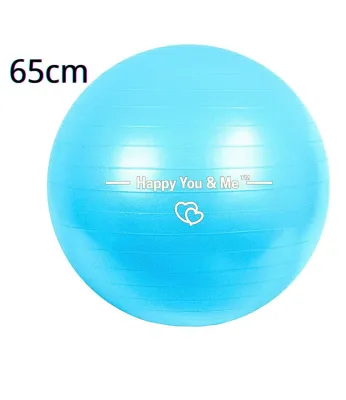
![🇸🇬 [READY STOCK] Anti-Burst and Slip Swiss Ball Yoga Ball Fitness Ball Birthing Ball with Quick Pump](https://img.lazcdn.com/g/p/7185f59d3c18814d079973d3aa24ae62.jpg_400x400q80.jpg_.webp)
![⭐[Sg Seller] 45cm55CM 65CM 75CM 85CM Burst Resistance Yoga Ball Gym Fitness Iron Shake Weight](https://img.lazcdn.com/g/p/e23e6d3db4b1f7e42ef3d0a86e2e6e3f.jpg_400x400q80.jpg_.webp)
Prices are valid at publication and may change. Please refer to the product page for the latest price.
Standard sizing charts typically categorize ball diameters by user height ranges: a 55 cm ball for heights under 165 cm, a 65 cm ball for heights between 165 cm and 180 cm, and a 75 cm ball for heights above 180 cm. However, these ranges are only approximations that assume average body proportions.
If you have relatively long legs compared to your torso, a standard chart might direct you to a ball that is too small. Sitting on an undersized ball forces your knees higher than your hips, tilting your pelvis backward and rounding your lumbar spine. This poor posture increases lower back strain and prevents your core muscles from engaging properly during exercises.
Conversely, using a ball that is too large forces you to balance on your toes to keep your feet in contact with the ground. This instability strains your hip flexors and calves while making it difficult to perform exercises with controlled form. To avoid these issues, always prioritize your seated posture over generic height recommendations.
How to Test and Verify Your Fit Before Committing
To ensure your selected yoga ball is the correct size, verify its fit under proper inflation. An under-inflated ball sinks excessively when you sit on it, artificially lowering your seating height and reducing the stability benefits of the equipment.

Before purchasing, you can simulate the correct ball height using a simple wall-sit or chair-test method. Stand with your back against a wall and lower yourself into a comfortable squat until your thighs are parallel to the floor, mimicking a proper seated position. Measure the distance from the floor to the crease of your hip. This measurement represents the minimum inflated height your yoga ball should have.
If you already have the ball, inflate it according to the manufacturer’s instructions and sit directly in the center. Check your foot placement first; both feet must rest flat on the floor, spaced about shoulder-width apart. Your knees should align directly over your ankles rather than bowing outward or collapsing inward.
Finally, observe your pelvic tilt. Your hips should feel supported without sliding forward or backward. If you feel like you are constantly rolling off the ball or if your knees are pointing upward, the ball is either under-inflated or the wrong diameter for your frame.
Adjusting for Body Proportions and Exercise Types
Your physical proportions and intended use should influence your final size selection. If your height falls on the boundary between two sizes, consider your leg length. Individuals with long legs should size up to keep their knees from rising above their hips, while those with shorter legs benefit from sizing down to maintain flat foot contact with the floor.
The primary activity also dictates the ideal diameter. If you intend to use the yoga ball as an active desk chair, you will likely need to size up. Standard office desks in Singapore typically stand between 70 cm and 75 cm high. A standard 55 cm ball may leave you sitting too low, forcing you to reach upward to type and straining your shoulders. Sizing up to a 65 cm or 75 cm ball and inflating it firmly helps maintain an ergonomic arm angle.
For floor-based workouts, core training, and physical therapy, prioritizing a standard fit is essential. Exercises like ball bridges, planks, and abdominal crunches require a high level of control. A ball that is too large can make these movements awkward and difficult to control, increasing the risk of muscle strain. For dedicated fitness routines, stick to the size that perfectly matches your 90-degree seated posture.
Decoding Secondary Specs: What Matters Beyond Size
While diameter is critical for ergonomics, secondary specifications determine safety, durability, and usability. Understanding these features helps you select a reliable product.
The most important safety specification is an anti-burst rating. This feature ensures that if the ball is punctured, it deflates slowly and safely rather than popping suddenly like a balloon, preventing sudden falls during workouts.
Weight capacity is another essential metric to verify. Yoga balls are rated for both static weight (stationary) and dynamic weight (active movement). Ensure the dynamic weight limit comfortably exceeds your body weight plus any hand weights or dumbbells you plan to use.
Surface texture also plays a role in stability and comfort. Many balls feature a ribbed or textured surface, which provides excellent grip against smooth flooring materials like tile, vinyl, or polished wood. A textured surface prevents the ball from slipping out from under you during dynamic movements, though it does not alter the physical size or height requirements of the ball.
Frequently Asked Questions (FAQ)
Can I use the same yoga ball size for both desk work and workouts?
Using a single yoga ball for both purposes is possible but requires adjustment. Desk work demands a larger or more firmly inflated ball to align your arms with standard desk heights. For workouts, a slightly softer ball or smaller diameter is preferred to ensure proper joint angles. You can adjust the inflation level slightly to transition between tasks, though dedicated balls for each activity offer the best ergonomic support.
How do I know if my yoga ball is fully inflated to its correct size?
To verify proper inflation, measure the ball’s physical height rather than relying on feel. Inflate the ball until mostly full, then let the PVC material stretch for 24 hours before adding the final air. Measure the distance from the floor to the top of the ball. The vertical height must match the manufacturer’s specified diameter (such as 65 cm) to ensure optimal performance and support.
Community discussion
Share your experience or ask a question. Comments are reviewed before publication.