
When choosing between two of the most popular 0.65mm badminton strings, the decision ultimately comes down to your tolerance for restringing frequency versus your demand for specific tactile feedback. The Yonex Exbolt 65 is engineered to address the traditional fragility of thin gauges, offering enhanced durability and a harder, quicker repulsion suited for fast-paced flat exchanges. In contrast, the BG66 Ultimax remains a benchmark for high repulsion and a softer, more responsive feel, though it typically requires more frequent maintenance. Choose the Exbolt 65 if you want a resilient thin string that maintains tension well for aggressive play; choose the BG66 Ultimax if maximum shuttle feedback and touch are your top priorities and you do not mind restringing more often.
Core Specifications and Material Design
To understand the performance differences between these two popular strings, we must first look at their physical dimensions and material construction. Both the Yonex Exbolt 65 and the Yonex BG66 Ultimax feature an ultra-thin gauge of 0.65mm. In badminton, a thinner gauge reduces aerodynamic drag during high-speed swings and allows the string to bite into the shuttle’s cork more effectively, granting superior control and spin. However, this thinness historically comes with a major trade-off: a significantly higher risk of premature breakage and rapid tension loss.
The key differentiator lies in the advanced material technologies used to construct each string. The Exbolt 65 introduces Yonex’s proprietary “Forged Fiber” technology. This material undergoes a specialized manufacturing process that aligns the molecular chains more tightly, dramatically increasing the intermolecular strength and heat resistance of the outer wrap. During intense rallies, the friction generated between intersecting main and cross strings can melt standard nylon, leading to snapping. The Forged Fiber construction is specifically engineered to withstand this friction and shear stress, offering a level of durability previously unseen in 0.65mm strings.
Products mentioned in this guide
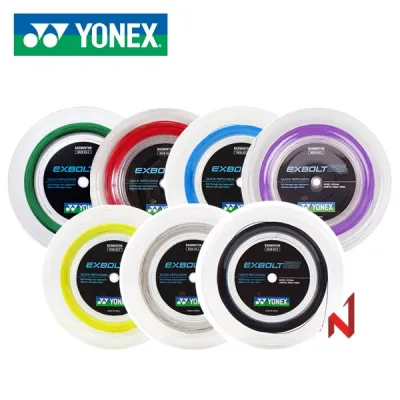
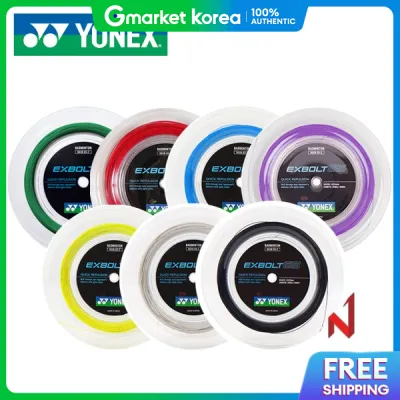
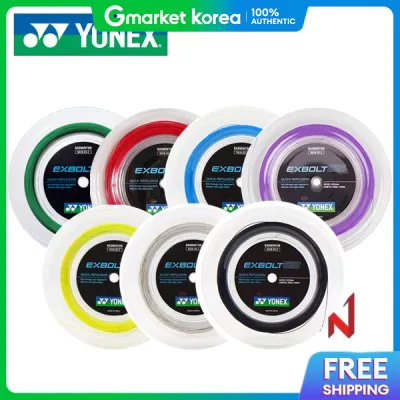
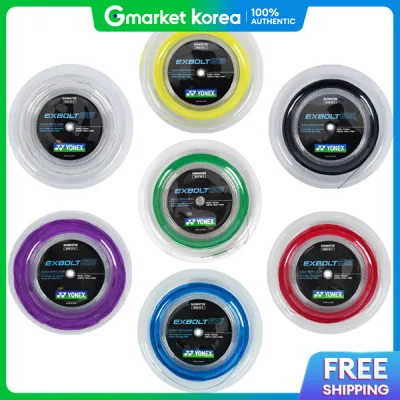
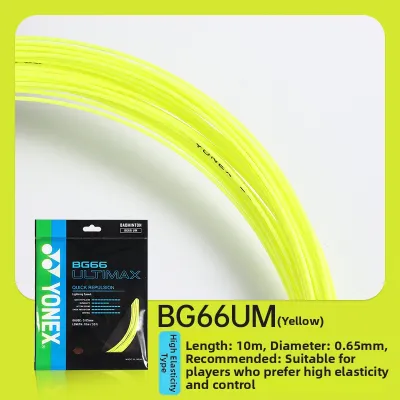
Prices are valid at publication and may change. Please refer to the product page for the latest price.
On the other hand, the BG66 Ultimax relies on a high-intensity nylon multifilament core wrapped with a braided high-polymer nylon outer fiber. This classic construction is optimized for maximum elasticity and energy transfer. The high-intensity nylon core acts like a highly responsive spring, stretching deeply upon impact and snapping back with immense speed. While this design delivers exceptional repulsion power, the standard nylon fibers are more susceptible to wear, abrasion, and structural fatigue over time, making the BG66 Ultimax a much more delicate string compared to its modern counterpart.
Repulsion, Power, and Shuttle Feel
Repulsion and power delivery are critical factors for players looking to optimize their swing mechanics. While both strings excel in generating shuttle speed due to their thin 0.65mm profile, they deliver this power in distinct ways. The BG66 Ultimax is renowned for its highly elastic, spring-like repulsion. When executing deep clears or powerful smashes, the stringbed stretches and cushions the shuttle before launching it forward. This characteristic provides effortless power generation, making it highly beneficial for players who rely on a whip-like swing technique or those who need extra assistance in clearing the shuttle from baseline to baseline.

In contrast, the Exbolt 65 offers a much quicker, more direct repulsion. The stiffer Forged Fiber material minimizes the dwell time—the duration the shuttle remains in contact with the stringbed. Upon impact, the shuttle is repelled almost instantly with a crisp, solid feel. This rapid response is highly advantageous for fast-paced flat exchanges, defensive blocks, and quick drives, where every millisecond counts. Players who already possess strong wrist action and fast swing speeds will appreciate the immediate power transfer and clinical precision that the Exbolt 65 provides.
The tactile feedback, or “hitting feel,” further separates these two strings. The Exbolt 65 is classified as having a hard hitting feel. This means the impact is stiff and direct, offering clear, uncompromised feedback about where the shuttle made contact on the racket face. The BG66 Ultimax, conversely, offers a medium-to-soft hitting feel. This softer sensation provides a more cushioned impact, which many control-oriented players prefer for delicate net play, tight spinning net shots, and precise drop shots, as it allows them to “feel” the shuttle on the racket face for a fraction of a second longer.
Acoustic feedback is another area where these strings diverge. The BG66 Ultimax is legendary for its loud, high-pitched, metallic hitting sound. This sharp “ping” on clean hits provides excellent auditory feedback, helping players gauge the quality of their contact while adding a psychological boost during intense matches. The Exbolt 65 also produces a clean, sharp sound, but it is noticeably more solid and compact, lacking the ringing, metallic resonance of the Ultimax.
Durability, Tension Retention, and Maintenance
For players using thin-gauge strings, durability and maintenance are constant considerations. A 0.65mm string is inherently vulnerable to several breakage factors, most notably off-center hits near the racket frame. When a shuttle is struck near the top or sides of the frame, the extreme shear stress placed on the outer strings can cause them to snap instantly, regardless of the string’s overall quality. Additionally, friction between the mains and crosses during heavy slicing or spinning shots gradually wears down the outer coating, leading to fraying and eventual breakage.
The Exbolt 65 represents a significant leap forward in thin-string durability. Thanks to the high tensile strength of the Forged Fiber outer wrap, it resists abrasion and shearing much better than traditional nylon strings. While it is still a thin string and cannot match the ruggedness of a 0.70mm gauge, it offers a highly resilient option for players who want the speed of a thin string without the frustration of weekly breakages. The BG66 Ultimax, by comparison, is highly susceptible to fraying and snapping, particularly for hard hitters or players whose hitting technique is still developing.
Tension retention is another crucial aspect of string maintenance. All synthetic strings experience “tension creep,” a gradual loss of tension over time due to plastic deformation of the fibers. The BG66 Ultimax is known for losing its tension relatively quickly. Within a few weeks of regular play, the stringbed can begin to feel “mushy,” resulting in a loss of control and a change in the hitting sound. To maintain peak performance, players using the Ultimax must be prepared for a frequent restringing schedule. The Exbolt 65, however, exhibits excellent tension stability, maintaining its crisp, hard feel and playability profile for a much longer duration.
Environmental conditions also play a significant role in string longevity and performance. In tropical climates with high humidity, such as Singapore, moisture in the air can penetrate the nylon fibers, accelerating tension loss and altering the elasticity of the stringbed. To protect your equipment, it is highly recommended to store rackets in thermal-insulated bags and include silica gel packets to absorb excess moisture. Furthermore, players must regularly inspect their racket’s grommets. Worn, split, or missing grommets allow the thin 0.65mm string to come into direct contact with the sharp carbon fiber edges of the frame, leading to immediate and avoidable breakage.
Final Verdict: Choosing the Right String for Your Profile
Choosing between the Yonex Exbolt 65 and the BG66 Ultimax ultimately depends on your individual playstyle, skill level, and willingness to manage restringing maintenance. Both strings offer the exceptional speed and aerodynamic benefits of a 0.65mm gauge, but they cater to very different player profiles.
Choose the Exbolt 65 if:
- You want the speed and bite of a thin 0.65mm string but require enhanced durability to minimize frequent restringing.
- You prefer a hard, crisp hitting feel with instant shuttle release for rapid-fire flat rallies and defensive drives.
- You want a string that maintains its tension and playability profile consistently over several weeks of regular play.
Choose the BG66 Ultimax if:
- You prioritize maximum repulsion, effortless power generation, and deep, high-clearing shots.
- You prefer a softer, more cushioned impact feel that provides excellent tactile feedback for delicate net play and drop shots.
- You have a consistent hitting technique with minimal off-center hits and do not mind the higher maintenance costs of frequent restringing.
Verify first if:
- Check your racket's recommended tension range and warranty limits before stringing. Thin strings at high tensions place immense stress on the racket frame, and exceeding the manufacturer's limits can lead to structural damage.
- Inspect your racket's grommets thoroughly before every restringing session. Replacing damaged grommets is essential to prevent premature shearing of these thin-gauge strings.
- Consult a certified professional stringer to ensure the tension you choose matches your physical capability, swing speed, and racket specifications.
To help you make a quick and informed decision, the table below summarizes the key specifications and performance characteristics of both strings:
| Feature | Yonex Exbolt 65 | Yonex BG66 Ultimax |
|---|---|---|
| Gauge Thickness | 0.65 mm | 0.65 mm |
| Core Material | High-Intensity Nylon Multifilament | High-Intensity Nylon Multifilament |
| Outer Material | Forged Fiber | High-Polymer Braided Nylon |
| Hitting Feel | Hard / Crisp | Medium / Soft |
| Repulsion Speed | Instant / Quick | Elastic / Spring-like |
| Durability | High (for a 0.65mm gauge) | Moderate to Low |
| Tension Retention | Excellent | Moderate to Low |
| Ideal Playstyle | Fast drives, flat exchanges, defensive blocks | Attacking clears, smash power, delicate net play |
Frequently Asked Questions (FAQ)
Can I mix Exbolt 65 and BG66 Ultimax for mains and crosses?
Yes, hybrid stringing is a feasible option that some players use to customize their racket’s performance. In a hybrid setup, you might string the mains (vertical strings) with one model and the crosses (horizontal strings) with another. For example, using the more durable Exbolt 65 on the mains can help resist the sliding friction that causes most breakages, while using the softer BG66 Ultimax on the crosses can help retain some of the elastic feel and repulsion.
However, mixing these two specific strings carries notable risks due to their differing physical properties. Because the Exbolt 65 has superior tension retention and a harder feel, while the BG66 Ultimax loses tension more rapidly and is highly elastic, the two strings will stretch and relax at different rates. This tension mismatch can place uneven, asymmetrical stress on your racket frame over time. In extreme cases, especially at high tensions, this uneven stress can cause the frame to warp or even crack during a hard smash.
If you wish to experiment with a hybrid setup, it is highly recommended to consult a certified professional stringer. They can advise you on the appropriate tension adjustments—such as stringing the crosses slightly lower or higher than the mains—to balance the physical differences between the two materials and protect your racket frame from structural damage.
What tension should I use for 0.65mm strings?
Selecting the correct tension for a 0.65mm string requires a careful balance between performance, control, and durability. First and foremost, you must verify your racket’s maximum recommended tension, which is typically printed on the cone or shaft. Exceeding these manufacturer limits can void your warranty and risk collapsing the frame under the intense pressure of thin-gauge strings.
Your skill level and swing speed should guide your tension choice. For recreational and intermediate players, a moderate tension range of 22 to 24 lbs is generally recommended. At this range, the thin string can stretch and utilize its natural elasticity, providing a larger sweet spot and effortless repulsion. If you are an advanced player with a fast, clean swing and consistent hitting technique, you may opt for higher tensions of 25 to 28 lbs or more to gain maximum control and a crisper feel.
However, you must keep in mind that thin 0.65mm strings are highly susceptible to snapping at high tensions. When strung tightly, the fibers have very little room to stretch upon impact. An off-center hit near the frame at 28 lbs will almost certainly result in an immediate snap. If you are still developing your technique or frequently play in humid conditions that weaken string integrity, keeping your tension slightly lower will help extend the lifespan of your strings without sacrificing too much performance.
Community discussion
Share your experience or ask a question. Comments are reviewed before publication.