
S-shaped carabiners, commonly known as S-biners, are highly popular for everyday carry and organizing outdoor gear, but they are absolutely not safe for climbing or any other life-safety application. While their dual-gate design is incredibly convenient for clipping keys, water bottles, or camping accessories to a backpack, these utility clips lack the structural integrity, locking mechanisms, and certified load ratings required to withstand the forces generated during a climbing fall. Using them in a safety chain can lead to catastrophic gear failure and severe injury.
Climbing is a high-risk sport where equipment cannot replace proper training, experience, and sound judgment. Every component of your safety system must be specifically designed and certified to handle dynamic impact forces. Understanding why S-shaped carabiners fail to meet these standards is essential for keeping yourself and your climbing partners safe on the rock.
Understanding the Design and Limitations of S-Shaped Carabiners
S-shaped carabiners feature a distinct double-loop design with two independent gates facing opposite directions. This configuration is optimized for separating items, allowing you to clip one side to a fixed loop and the other to an accessory. However, this very geometry makes them entirely unsuitable for climbing applications.
Products mentioned in this guide
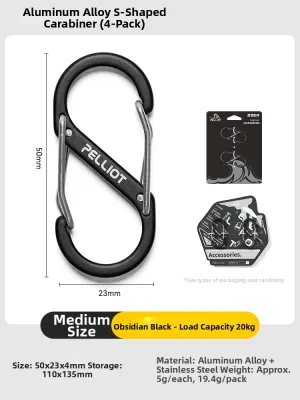
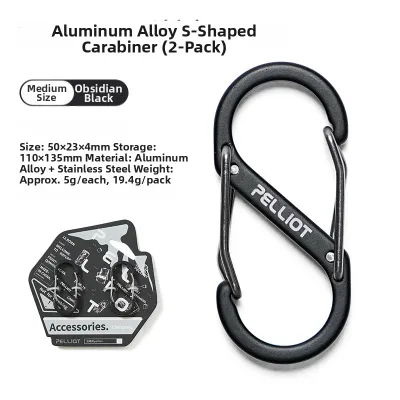

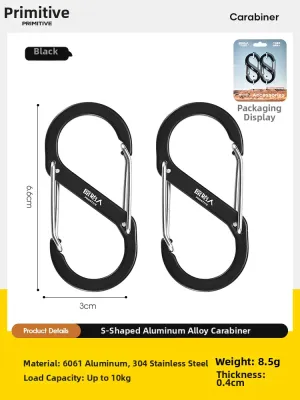
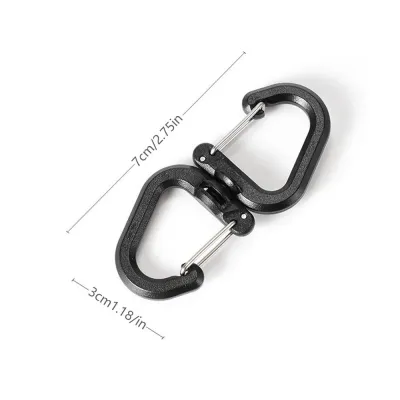
Prices are valid at publication and may change. Please refer to the product page for the latest price.
In a standard climbing carabiner, the load is designed to run along the solid spine, which is the strongest part of the metal frame. The single gate is positioned opposite the spine and remains closed to maintain a continuous, high-strength loop. When tension is applied to an S-shaped carabiner, the force is split across two curved hooks, pulling against both gates simultaneously. This split load path prevents the carabiner from aligning the force along a single, reinforced axis.
Under dynamic loads, the S-shape tends to twist and deform. This twisting action can cause the gates to fail or the metal to snap at a fraction of the force a standard climbing carabiner can handle. Furthermore, S-shaped carabiners typically feature simple wire gates without any locking sleeves. In climbing, locking gates are essential for critical connections to prevent ropes, slings, or harness loops from accidentally pushing the gate open. The dual-gate design of an S-carabiner doubles the risk of accidental opening, as either gate can be compromised by contact with rock, webbing, or the climber’s body.
How to Verify Load Ratings and Safety Markings
To ensure your safety on the rock, you must know how to verify the load ratings and safety markings on every piece of hardware in your kit. Certified climbing carabiners are stamped with their minimum breaking strength measured in kilonewtons (kN). One kilonewton is equivalent to approximately 100 kilograms of static force, meaning a carabiner rated at 20 kN can withstand roughly 2,000 kilograms of force before failing.

On a certified climbing carabiner, you will typically find three distinct ratings stamped directly onto the spine: the major axis rating (usually 20 kN or higher), the minor axis rating (usually 7 to 10 kN), and the open-gate rating (usually 7 to 9 kN). These markings are mandatory under international safety standards and must be clearly legible before you trust the gear with your life.
S-shaped utility clips, on the other hand, rarely feature kilonewton ratings. Instead, they are often marked with a Working Load Limit (WLL) or a simple weight limit in kilograms or pounds. This rating indicates the maximum static weight the clip can safely hold under normal, non-dynamic conditions. It is crucial to understand that WLL is not equivalent to breaking strength, and utility clips are never rated for the dynamic impact forces of a climbing fall, which can easily exceed several kilonewtons in a split second.
Always look for recognized safety certifications on your climbing gear. Legitimate climbing hardware must carry the CE mark (Conformité Européenne) followed by a four-digit code identifying the testing laboratory, or the UIAA (International Climbing and Mountaineering Federation) safety label. If a carabiner only lists a weight limit in pounds or kilograms, or if it lacks these official certification stamps, it is a utility tool and must never be integrated into your climbing safety system.
Recognizing Cross-Loading and Unclipping Risks
Dynamic climbing environments introduce complex forces that can easily compromise non-standard gear. One of the most common hazards is cross-loading, which occurs when a carabiner rotates so that the load pulls across the gate or the minor axis rather than along the spine. Standard climbing carabiners are designed to handle some minor-axis force, though their strength is significantly reduced when cross-loaded. In contrast, an S-shaped carabiner has no stable spine to guide the load, making cross-loading almost guaranteed under dynamic movement.
When a rope or sling shifts, it can easily slide into the curved ends of the S-shape, applying leverage directly to the gates. Because S-shaped carabiners have two open compartments with non-locking gates, any slack in the climbing system allows ropes, webbing, or harness loops to move freely. As the climber moves, a rope can easily wrap around the outer gate, and when tension is reapplied, the rope’s own weight can force the gate open, releasing the connection.
This risk is compounded by gate flutter, a phenomenon where rapid vibrations cause the wire gate to vibrate open. These vibrations can be caused by a rope running quickly through a carabiner or the metal body striking a rock face during a fall. If a fall occurs at the exact millisecond the gate flutters open, the structural integrity of the clip is severely compromised, leading to immediate failure. Standard climbing carabiners use precise spring tension and locking mechanisms to mitigate this risk, features that are entirely absent in utility S-biners.
When to Use S-Shaped vs. Standard Climbing Carabiners
Understanding when to use S-shaped carabiners versus standard climbing carabiners is a fundamental skill for gear management. S-shaped carabiners are excellent tools for non-safety-critical utility tasks. On the crag or at the gym, you can use them to clip lightweight accessories to your harness or backpack. They are perfect for carrying your chalk bag, securing a water bottle, organizing your keys, or clipping your climbing shoes together during an approach hike.
For all life-safety connections, certified climbing carabiners are non-negotiable. This includes belaying, rappelling, building anchors, clipping into protection bolts, and connecting your harness to a rope or personal anchor system. For these tasks, you must match the carabiner shape and gate type to the specific application.
Use pear-shaped (HMS) locking carabiners for belaying and rappelling, as their wide top allows ropes and belay devices to operate smoothly. Use offset D-shaped carabiners for quickdraws and anchors, as their shape naturally coaxes the rope toward the strong spine, maximizing safety. Always choose locking gates—whether screw-gate, twist-lock, or magnetic-lock—for any connection that is critical to your safety chain, and leave the S-shaped clips strictly for accessory organization.
How to Inspect and Retire Your Carabiners
Regular gear inspections are essential to ensure the ongoing safety of your climbing kit. You should perform a thorough visual and physical check of all your carabiners before and after every climbing session. Start by examining the metal body under bright light, looking for any signs of hairline cracks, deep grooves worn by ropes, sharp edges, or visible deformation. Even minor warping can alter how loads are distributed, significantly reducing the carabiner’s strength.
Next, test the gate action. The gate should open smoothly and snap shut completely and instantly when released. If the gate sticks, hesitates, or fails to align perfectly with the nose of the carabiner, it must be retired immediately. Do not attempt to fix a sticky gate with household lubricants, as these can attract dirt and worsen the mechanism over time; instead, use a dedicated dry-film lubricant or simply replace the unit.
Finally, evaluate the gear for environmental damage. Look for chemical corrosion, which often appears as white, powdery oxidation or pitting on the surface of the aluminum. Exposure to harsh chemicals, battery acid, or salt spray can weaken the metal without leaving obvious visual clues. If a carabiner has been exposed to extreme heat or shows significant wear from contact with steel bolts, it is time to retire it. When retiring a carabiner, destroy it or mark it clearly to ensure it is never accidentally used for climbing again.
Frequently Asked Questions (FAQ)
Can I use an S-shaped carabiner to build a climbing anchor?
No, you must never use an S-shaped carabiner to build a climbing anchor. Anchors are the foundation of your safety system and must be constructed using certified, high-strength locking carabiners. S-shaped carabiners lack the structural strength, locking gates, and safety certifications required to handle the multi-directional and dynamic forces that can occur at an anchor point.
What should I do if my carabiner drops from a significant height?
If a carabiner drops from a significant height onto a hard surface, you should inspect it closely for visible damage, cracks, or gate misalignment. While modern aluminum climbing gear is highly durable, severe impacts can cause micro-fractures that are invisible to the naked eye. To ensure your safety, follow the manufacturer’s specific guidelines regarding dropped gear, and when in doubt, retire the carabiner from life-safety use.

Community discussion
Share your experience or ask a question. Comments are reviewed before publication.