
Deciding to bring a JOMO foldable treadmill into an HDB flat requires more than just checking the product’s advertised footprint. Compact living spaces demand careful evaluation of active running clearance, folding mechanics, delivery routes, and daily storage logistics. This guide walks you through the exact measurements and spatial checks needed to determine if a specific JOMO model will comfortably and safely integrate into your home layout without compromising your living area.
Fitting fitness equipment into a typical home is a balancing act between personal wellness and spatial harmony. Because HDB flats feature optimized floor plans where every square meter counts, introducing a large motorized machine requires systematic planning. A foldable treadmill offers an excellent compromise, but its viability depends entirely on how well its physical specifications align with your specific room dimensions, storage configurations, and daily household traffic.
Verifying JOMO Treadmill Dimensions and Folding Specs
Before making a purchase, you must gather the exact physical specifications of the JOMO model you are eyeing. Do not rely on generic product photos, which can often make equipment look smaller than it is in reality. Instead, locate the official user manual, specification sheet, or authorized retailer listing to find the precise length, width, and height of the machine. These dimensions must be evaluated in two distinct states: the active running state and the folded storage state.
Products mentioned in this guide
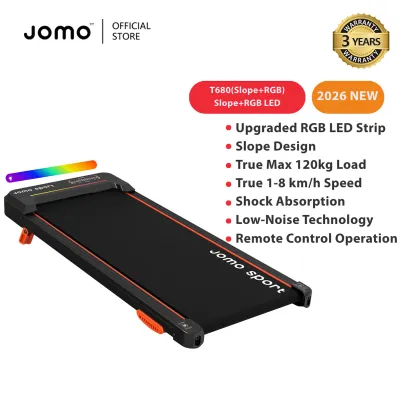
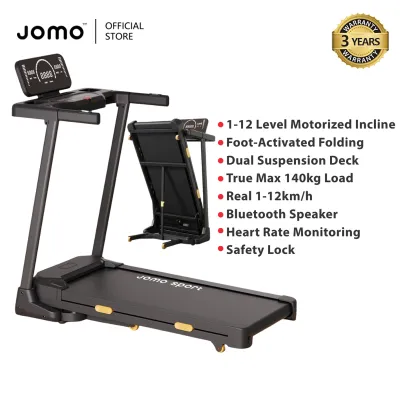
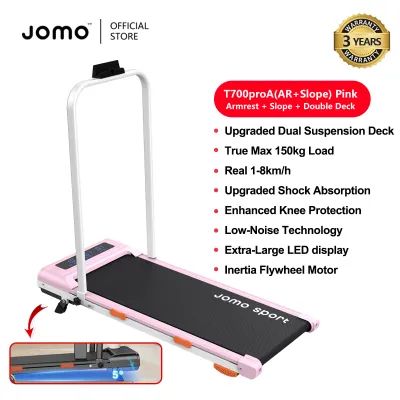
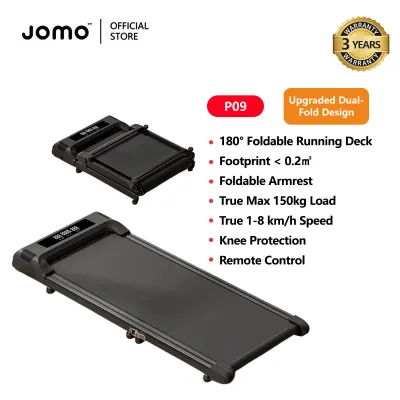
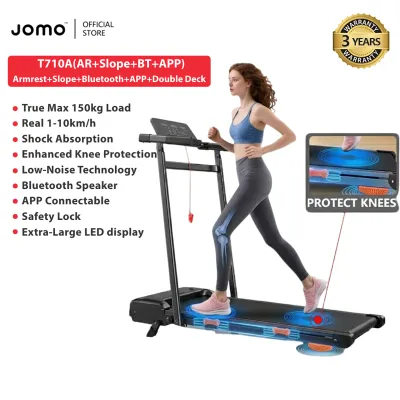
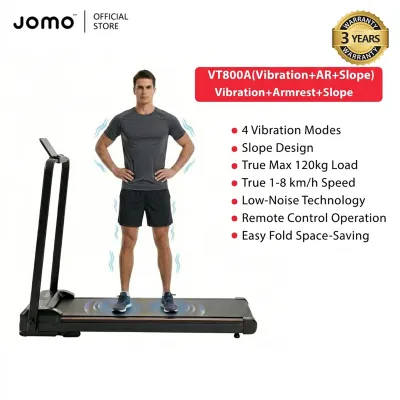
Prices are valid at publication and may change. Please refer to the product page for the latest price.
The active footprint represents the total floor area the treadmill occupies when it is fully unfolded and ready for a workout. The folded footprint, on the other hand, shows the dimensions when the deck is secured upright or collapsed flat. Depending on the specific JOMO model, the folding mechanism may vary. Some models utilize a vertical folding system where the deck locks upright at an angle, while others feature a flat-folding design that allows the machine to lie completely flat. You should also check if the model features a hydraulic assist system, which helps lower the heavy deck slowly and safely to the floor, or if it relies on a manual locking pin that requires physical lifting.
Unit weight is another critical specification that directly impacts usability in a compact flat. A heavy treadmill can be exceptionally difficult to maneuver, even if it is advertised as portable. Check the product specifications for the net weight of the machine. Ensure the model is equipped with high-quality transport wheels or casters. You will want to verify whether these wheels roll in multiple directions or only along a single axis, as multi-directional wheels make it significantly easier to guide the folded unit around tight corners, furniture legs, and narrow bedroom entryways.
Measuring Your HDB Room for Safe Active Use
Operating a treadmill safely in an HDB room requires significantly more space than the machine’s physical footprint alone. When you run, your body requires lateral space for arm swings and natural stride deviations. More importantly, you must account for emergency safety clearance. If you lose your footing or slip while running at high speeds, the moving belt will rapidly push you backward. If the rear of the treadmill is placed directly against a wall, wardrobe, or bed frame, you risk being trapped and severely injured by the spinning belt.

To prevent this, you must measure and maintain a strict safety zone around the machine during use. Refer to the manufacturer’s safety instructions for the exact clearance requirements. As a general safety standard for home cardio equipment, aim for at least 1.5 to 2 meters of completely unobstructed space directly behind the running deck. Additionally, ensure there is at least 0.5 meters of clear space on both sides of the treadmill. This lateral clearance allows you to step off the belt onto the side rails safely in an emergency and prevents your arms or shoulders from striking nearby walls or furniture.
Ceiling height is another frequently overlooked factor in HDB flats, where standard ceiling heights typically hover around 2.6 meters. To calculate your vertical clearance, add the step-up height of the treadmill deck (the distance from the floor to the running surface) to your own height. You must also add a buffer of at least 15 to 20 centimeters to account for your natural vertical bounce while running. Ensure this total height clears any low-hanging ceiling fans, light fixtures, or decorative beams in your room. Running under a spinning ceiling fan with inadequate clearance poses an immediate and severe safety hazard.
Finally, consider how the active treadmill affects the overall flow of the room. Map out the placement to ensure the unfolded machine does not block main bedroom doors, toilet doors, or wardrobe doors. In a compact layout, blocking a primary exit route even temporarily during a workout can create a safety hazard in the event of an emergency. If the treadmill must cross a high-traffic pathway, commit to folding it away immediately after every single session.
Evaluating Storage and Folding Clearance
Once you have confirmed that the treadmill can be operated safely, you must evaluate where and how it will be stored when not in use. If you plan to store a flat-folding JOMO model under a bed or sofa, use a measuring tape to verify the vertical clearance of the furniture frame. Do not forget to account for any protruding bolts, center support legs, or dust ruffles that might snag on the treadmill’s console or motor cover. If the clearance is too tight, forcing the machine underneath can scratch both the equipment and your furniture.
For models that fold vertically, measure the depth and width of your designated storage nook, such as the gap between a wardrobe and the wall, or a corner behind a living room partition. Ensure the folded unit can stand securely without the risk of tipping over. If the model is freestanding, verify that it is placed on a perfectly level surface away from household foot traffic, pets, and children. If the manufacturer specifies that the vertically folded unit must be anchored or strapped to a wall for safety, verify that your HDB walls can accommodate the necessary mounting hardware.
The physical act of folding and unfolding the treadmill also requires its own clearance radius. You must have enough room to stand comfortably at the rear or side of the machine to lift or lower the deck without twisting your back or bumping into nearby obstacles. Ensure that during the folding process, the handlebars or console do not swing into wall-mounted televisions, glass cabinet doors, or delicate home decor.
Protecting your HDB flooring is another essential consideration during storage transitions. The concentrated weight of a heavy treadmill resting on small transport wheels can easily dent vinyl flooring, scratch laminate, or crack ceramic tiles over time. To safeguard your floors, always place a high-density, non-slip equipment mat under the treadmill. When rolling the folded unit into its storage position, move slowly and deliberately to avoid dragging the frame across unprotected floor surfaces.
Navigating HDB Delivery Routes and Power Setup
Before your JOMO treadmill even arrives at your doorstep, you must ensure it can physically enter your home. Delivery boxes are substantially larger and bulkier than the assembled treadmill itself. Measure the width and height of your HDB flat’s main entrance, gate, and any internal room doors the delivery team must navigate. If your flat is located on an upper floor, measure the lift door opening and internal cabin dimensions to confirm the packaged unit can fit inside without requiring hazardous tilting.
If your building’s lift is too small or if you live in an older HDB estate with split-level lift access, you may need to coordinate with the delivery service beforehand. Carrying a heavy cardio machine up flights of stairs requires specialized handling and may incur additional fees or require professional disassembly. Clear the common corridor of shoe racks, potted plants, and bicycle racks prior to delivery day to provide a straight, unobstructed path for the delivery team.
Once inside, the treadmill’s electrical requirements must be carefully managed. Motorized treadmills draw a high amount of electrical current, especially when accelerating or operating under a heavy user load. Check the manufacturer’s specifications to confirm the power requirements. It is highly recommended to plug the treadmill directly into a dedicated, grounded wall outlet. Avoid using multi-way adapters, cheap extension cords, or daisy-chaining multiple power strips, as this can lead to voltage drops, overheating, and tripped circuit breakers in your home’s electrical distribution board.
Finalizing Space-Saving Setup and Safety Checks
Integrating a treadmill into an HDB flat successfully requires ongoing consideration for your living environment and your neighbors. Because HDB blocks share concrete floor slabs, the structural vibrations from running can easily telegraph downstairs, creating a disruptive low-frequency thudding noise for your neighbors. To maintain good neighborly relations, place a thick, high-density rubber anti-vibration mat beneath the entire footprint of the treadmill to absorb these impact shocks.
Establish a strict safety routine before every workout session. Inspect the folding hinges, locking pins, and safety latch to ensure they are fully engaged and undamaged. Never attempt to operate the treadmill if any part of the folding mechanism feels loose or fails to click securely into place. Always attach the safety key clip to your clothing before starting the belt; this key is designed to pull out and instantly stop the motor if you fall or drift too far back.
Before unfolding the deck for a run, perform a quick visual sweep of the surrounding area. Ensure that pets are secured in another room and that children are at a safe distance. Check that the floor space behind and around the treadmill is completely clear of loose items like shoes, toys, or power cables. By maintaining these strict spatial boundaries and safety habits, you can enjoy a highly effective cardio routine right in the comfort of your HDB flat without compromising your home’s safety or living space.

Community discussion
Share your experience or ask a question. Comments are reviewed before publication.