
Using a regular bag carabiner for climbing is an immediate and severe safety hazard. Under no circumstances should an everyday accessory clip, keychain carabiner, or bag attachment be used for any climbing activity that involves supporting human weight, arresting a fall, or securing safety ropes. These everyday items are designed solely for light utility tasks, such as securing a water bottle to a backpack or keeping keys organized.
Climbing gear, by contrast, is classified as Personal Protective Equipment (PPE). It must undergo rigorous engineering, manufacturing controls, and standardized testing to ensure it can withstand the extreme forces generated during a fall. If you are currently using a bag carabiner for any load-bearing climbing application, you must stop immediately and replace it with a certified climbing carabiner before your next climb.
Structural Differences: Why Everyday Clips Fail in Climbing
To understand why everyday clips fail on the climbing wall, one must look at how they are manufactured and the materials used. Certified climbing carabiners are typically constructed from high-grade, hot-forged aluminum alloys, such as 7075 aluminum. This forging process aligns the internal grain structure of the metal, maximizing its tensile strength while keeping the gear lightweight. In contrast, bag carabiners are often made from cheap, stamped sheet metals, cast zinc alloys, or low-grade plastics. These materials are prone to internal voids and brittle fractures when subjected to sudden tension.
Products mentioned in this guide
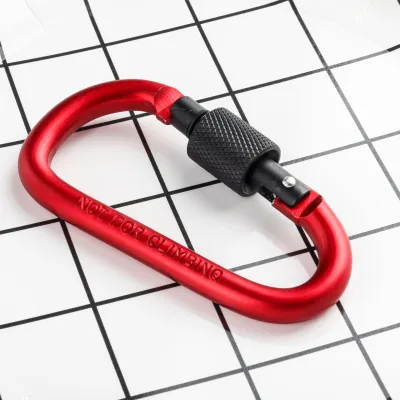
![[SG Stock] Carabiner Locking Screw Lock Biner Snap Keychain Bag Hook Aluminum Alloy Outdoor Camping Hiking](https://img.lazcdn.com/g/p/f7df1e5fcb0fd6af28660e14a5b7a86b.jpg_400x400q80.jpg_.webp)
Prices are valid at publication and may change. Please refer to the product page for the latest price.
The gate mechanism is another critical point of failure. Climbing carabiners feature robust, spring-loaded gates designed to snap shut securely and remain closed under load. Many climbing models incorporate locking sleeves—such as screw-gates, twist-locks, or magnetic locks—to prevent accidental opening. Bag clips, however, rely on weak wire springs or simple rivets that can easily slip open under minimal pressure or vibration.
Furthermore, the physical shape and load distribution of these two categories differ fundamentally. Climbing carabiners are engineered with specific geometries, such as the asymmetrical D-shape or pear shape, which naturally guide the rope or load along the strong, solid spine of the frame. Bag carabiners are often symmetrical, oval, or highly irregular, allowing the load to shift toward the gate or the minor axis. This shifting can cause the clip to fail at a fraction of its intended capacity.
Finally, the spine thickness and cross-sectional design of climbing gear are optimized to handle rope friction and heat dissipation. In Singapore’s humid tropical climate, sweat and moisture can accumulate on gear, making smooth, anodized surfaces essential to prevent corrosion and rope wear. Bag clips lack these specialized coatings and structural reinforcements, meaning a moving climbing rope can quickly cut through their thin frames.
How to Verify Your Carabiner is Certified for Climbing
Verifying that your gear is safe for climbing requires a close inspection of the carabiner’s body. Every legitimate climbing carabiner will have critical safety specifications and certifications permanently stamped, engraved, or laser-etched onto its spine. If you pick up a carabiner and the spine is completely blank, it is an accessory clip and must never be used for climbing.

The first markings to look for are the load ratings, which are measured in kilonewtons (kN). One kilonewton represents roughly 100 kilograms of static force. A certified climbing carabiner will display three distinct load ratings:
- Major Axis Rating: This symbol shows a vertical double-headed arrow along the spine, indicating the strength when the gate is closed and locked. This rating is typically 20 kN or higher.
- Minor Axis Rating: This symbol shows a horizontal double-headed arrow, indicating the strength when cross-loaded. This rating is significantly lower, often around 7 kN to 10 kN.
- Open Gate Rating: This symbol shows a carabiner with an open gate, indicating the strength if the gate accidentally flutters open during a fall. This is usually around 7 kN to 9 kN.
In addition to these ratings, look for recognized safety certification marks. The most common are the CE mark (Conformité Européenne) followed by a four-digit number (which identifies the independent testing laboratory) and the UIAA logo (International Climbing and Mountaineering Federation). These marks guarantee that the carabiner has passed standardized laboratory tests for strength, gate function, and durability.
If you encounter a carabiner where the safety markings have faded, become scratched beyond recognition, or are entirely missing, you must treat the gear as uncertified. Do not attempt to guess its strength or rely on memory. In the climbing community, the rule is simple: if you cannot verify the certification, the gear must be retired from life-support systems immediately.
Specific Risks of Using Non-Certified Carabiners on the Wall
Using a non-certified bag carabiner on a climbing wall introduces catastrophic risks due to the physics of climbing falls. When a climber falls, the force generated is not just their static body weight; it is a dynamic shock load. This dynamic force can easily reach several kilonewtons in a split second. A bag carabiner, designed to hold perhaps 5 to 10 kilograms of static weight, will deform, bend, or snap instantly under a dynamic load, leading to a complete failure of the safety system.
Another major hazard is gate flutter. When a rope moves rapidly through a carabiner or when the gear strikes a rock or wall during a fall, the metal vibrates. This vibration can cause the gate of a non-locking bag clip to swing open momentarily. If a load is applied at the exact microsecond the gate is open, the carabiner’s structural integrity is severely compromised, and it will fail at a much lower force than its rated capacity.
Multi-directional loading also poses a severe threat. In real-world climbing scenarios, ropes, harnesses, and anchors do not always pull in a perfect straight line. If a bag carabiner becomes cross-loaded—where the force pulls sideways against the gate rather than along the spine—it has virtually zero resistance.
The consequences of these failures are absolute. Whether you are climbing indoors at a local gym in Singapore or tackling outdoor routes at Dairy Farm Quarry, a failed carabiner in a belay system, anchor, or quickdraw means a ground fall. This can result in severe, life-altering injuries or fatalities.
When to Retire and Replace Your Certified Climbing Carabiners
Even when using certified climbing carabiners, gear does not last forever. Regular maintenance and inspection are vital to ensure your safety system remains intact. You should perform a quick visual and functional check of your carabiners before and after every climbing session.
There are several clear indicators that a climbing carabiner must be retired immediately:
- Deep Rope Grooves: Over time, the friction of running ropes wears down the aluminum. If you notice a groove deeper than 1 millimeter, or if the metal has worn down by more than 10% of its original thickness, the carabiner must be replaced.
- Gate and Lock Malfunctions: The gate must snap shut quickly and completely on its own. If the gate is sticky, sluggish, or fails to align with the nose, or if the locking sleeve does not spin smoothly, retire the gear.
- Chemical Exposure: Exposure to harsh chemicals, battery acid, or strong cleaning agents can cause invisible structural damage. In Singapore's high humidity, storing gear in damp, unventilated bags can also accelerate oxidation and corrosion.
- Severe Drops: If a carabiner is dropped from a significant height onto a hard surface, such as concrete or jagged rocks, it should be inspected closely. While modern aluminum is highly resilient, any visible denting, deep gouges, or cracks are grounds for immediate retirement.
When retiring a carabiner, do not simply throw it in the trash where someone else might find and use it. Permanently disable the gear. You can use a hacksaw to cut the frame, bend the gate with pliers so it cannot close, or clearly paint it red and label it “NOT FOR CLIMBING” to use strictly as a household keychain. Spending S$15 to S$30 on a certified replacement is a minor investment for absolute peace of mind.
Frequently Asked Questions (FAQ)
Can I use a bag carabiner to attach my climbing shoes or chalk bag to my harness?
Yes, you can use non-certified accessory clips or bag carabiners strictly for organizing non-life-support gear, such as hanging your chalk bag or carrying your climbing shoes. However, be aware of the practical risks. Cheap clips can easily bend, snag on your harness gear loops, or break, causing you to drop your expensive climbing shoes down the wall. Ensure these accessory clips are kept completely separate from your safety gear so there is no risk of accidentally grabbing one to clip into an anchor during a stressful moment on the climb.
What should I do if I bought a carabiner online without visible safety markings?
If you purchased a carabiner from an online marketplace or ecommerce platform and it lacks visible safety markings, stop using it for climbing immediately. Check the retailer’s return policy to see if you can secure a refund for unverified safety gear. You can also contact the seller or manufacturer directly to request official CE or UIAA certification documents. If they cannot provide verifiable proof of testing, do not risk your life. Relegate the carabiner to non-safety tasks around the house, and purchase your climbing gear from reputable, specialized outdoor retailers.

Community discussion
Share your experience or ask a question. Comments are reviewed before publication.