
Finding the right badminton racket as a beginner in Singapore involves matching the equipment to your current physical capabilities rather than chasing the high-end models used by professional players. In the humid climate of Singapore, where community games in ActiveSG sports halls and community clubs are fast-paced and frequent, a racket that offers high forgiveness, ease of swing, and comfortable handling is essential. The ideal beginner racket is typically lightweight, features an even-balanced or head-light distribution, possesses a flexible shaft, and is strung at a moderate tension. This combination allows you to develop proper hitting form, reduces the risk of early fatigue or strain, and ensures you do not spend excessively on advanced features that require highly developed wrist strength and precise timing to activate.
Understanding Key Racket Specifications
To make an informed decision, you must first learn how to read the technical specifications printed on the shaft or cone of almost every modern badminton racket. These markings dictate how the racket behaves in the air and how it transfers energy to the shuttlecock.
The weight of a badminton racket is universally categorized using the “U” classification system. A lower number before the “U” indicates a heavier racket, while a higher number indicates a lighter one. For example, a 3U racket typically weighs between 85 and 89 grams, a 4U racket weighs between 80 and 84 grams, and a 5U racket weighs between 75 and 79 grams. Heavier rackets provide more momentum and power behind your shots but demand greater physical strength and can lead to rapid arm fatigue during extended doubles sessions. Lighter rackets offer superior maneuverability and faster reaction times, making them highly suitable for beginners who are still building their shoulder and wrist conditioning.
Products mentioned in this guide
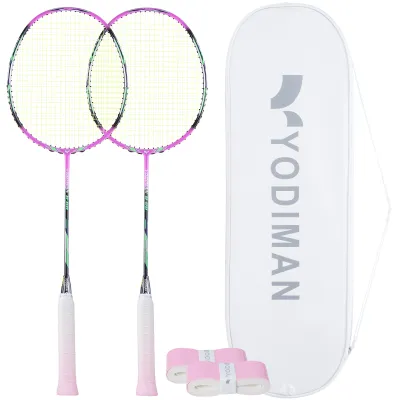
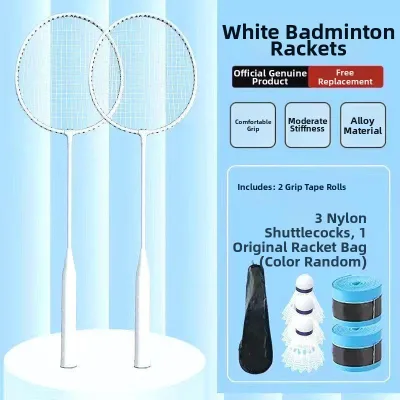

Prices are valid at publication and may change. Please refer to the product page for the latest price.
The balance point of a racket determines where the majority of its weight is concentrated, which significantly alters the feel of your swing. Rackets are classified into three main balance categories: head-heavy, even-balanced, and head-light. Head-heavy rackets concentrate weight toward the top of the frame, acting like a hammer to generate massive downward force for smashes, but they feel sluggish during quick defensive exchanges. Head-light rackets shift the weight toward the handle, allowing for rapid defensive blocks and quick net play, though they require more physical effort to generate deep clears. Even-balanced rackets distribute weight uniformly, offering a versatile middle ground that supports both defensive reactions and moderate power generation.
Shaft flexibility is another critical specification that dictates how much the racket bends during a swing. Rackets range from highly flexible to stiff. When you swing a racket, the shaft bends backward and then snaps forward, acting as a whip to propel the shuttlecock. A flexible shaft bends easily even with slower, less developed swing speeds, providing a natural whipping effect that helps beginners clear the shuttlecock from baseline to baseline. Conversely, a stiff shaft requires immense swing speed and precise timing to bend; if a beginner uses a stiff racket, the shaft will remain rigid, resulting in weak shots and transferring the harsh impact vibrations directly into the player’s wrist and elbow.
Matching Racket Features to Beginner Needs
Selecting the right combination of these specifications is about maximizing forgiveness on off-center hits and protecting your body from injury as you learn the game. Many beginners are tempted to buy stiff, head-heavy rackets because they associate them with powerful smashes, but this choice often hinders skill development.

Using a stiff, head-heavy racket without the necessary wrist strength and technique can quickly lead to physical strain. When your swing speed is insufficient to flex a stiff shaft, you end up compensating by using excessive shoulder and elbow force. Over time, this improper biomechanical strain can lead to common injuries such as tennis elbow or rotator cuff inflammation. Furthermore, the heavy head of such rackets slows down your defensive recovery, leaving you struggling to return fast drives during typical doubles matches on local courts.
For most beginners, the most reliable starting point is a 4U weight class combined with an even-balanced frame and a flexible or medium-flexible shaft. This configuration provides enough weight to feel the racket head during a swing without overloading your arm muscles. The even balance ensures you can transition smoothly between defensive blocks at the net and clears from the backcourt. If you have a naturally slower swing speed or prefer a highly maneuverable feel, opting for a lighter 5U racket with a flexible shaft will offer the necessary assistance to keep rallies going without exhausting your forearm.
The shape of the racket frame also plays a vital role in how forgiving the racket is during play. Modern badminton rackets generally feature either an isometric (square-shaped) frame or a conventional (oval-shaped) frame. Isometric frames have a larger sweet spot because the main and cross strings are of equal length across a wider area of the racket face. This design ensures that even if you misjudge the flight of the shuttlecock and strike it slightly off-center, the racket still delivers a relatively stable and powerful return. Oval frames have a more concentrated, smaller sweet spot that offers exceptional control for advanced players but is highly unforgiving for beginners, often resulting in weak, unstable shots when hit off-center.
String Tension and Grip Size Considerations
Once you have selected a racket frame with the appropriate weight, balance, and flexibility, you must configure the strings and grip to match your physical needs. These two elements are the direct contact points between your body, the racket, and the shuttlecock, making them crucial for comfort and control.
String tension is measured in pounds (lbs), and there is a common misconception that higher tension always equals better performance. In reality, high string tension creates a highly rigid string bed with a very small sweet spot, requiring perfect technique and high swing speeds to generate power. For beginners, a lower string tension ranging from 20 lbs to 24 lbs is highly recommended. Lower tension allows the string bed to stretch more upon impact, creating a deeper pocket that repels the shuttlecock with less physical effort. This lower tension also dampens harsh vibrations, protecting your arm from repetitive shock.
Grip size is another factor that directly influences your control and wrist mobility. Grip sizes are typically designated by the letter “G” followed by a number, where a higher number indicates a thinner handle (for example, G5 is thinner than G4). In Singapore, where high humidity leads to sweaty hands, choosing a slightly thinner grip size like G5 or G6 is highly advantageous. A thinner handle allows you to wrap an absorbent overgrip over the original factory grip without making the handle too bulky. To check if a grip size is correct, hold the racket in a standard forehand grip; there should be a gap about the width of your index finger between your fingertips and the palm of your hand.
Before having your racket strung, always verify the manufacturer’s maximum recommended tension limit, which is usually printed on the cone of the racket. Attempting to string a beginner-grade racket beyond its structural limit can warp or crack the frame under the immense pressure. Keeping your tension within the recommended boundaries ensures the longevity of your racket and preserves any warranty coverage provided by the manufacturer.
Buying and Verifying Your Racket in Singapore
When you are ready to make your purchase, navigating the local retail landscape carefully will help you secure an authentic product and receive proper assembly services. Singapore offers a variety of physical and digital retail options, each with distinct advantages.
Visiting established physical sports hubs, such as the specialized racket shops in Queensway Shopping Centre or Bras Basah Complex, allows you to physically hold different rackets before buying. This hands-on experience is invaluable for testing how the weight feels in your hand, assessing the grip size, and executing a few dry swings to gauge the balance. Physical stores also offer the benefit of professional in-store stringing services, where experienced stringers can recommend suitable string types and tension levels based on your profile. Conversely, official online brand stores and authorized e-commerce platforms offer convenience and easy price comparisons, but you must ensure you are purchasing from verified sellers to avoid counterfeit goods.
Counterfeit badminton rackets are highly prevalent in online marketplaces, often mimicking the aesthetics of high-end models at suspiciously low prices. To verify the authenticity of a racket, look for official holographic stickers on the cone, check for cleanly engraved serial numbers on the shaft and cone rather than cheaply printed ones, and register the serial number on the manufacturer’s official portal if available. Purchasing exclusively from authorized dealers listed on the official brand websites is the most reliable way to guarantee authenticity.
Before finalizing your purchase at any retailer, clarify the warranty terms and return policies. Most reputable brands offer warranties that cover manufacturing defects in the frame, but these warranties are often voided if the racket shows signs of accidental clashes with other rackets, ground scrapes, or if it was strung above the maximum recommended tension. Understanding these terms beforehand protects your investment and ensures you have recourse if a structural defect arises during your initial weeks of play.
Frequently Asked Questions (FAQ)
How often should a beginner restring their badminton racket?
A beginner should consider restringing their racket when they notice visible signs of wear or a significant drop in performance. Over time, strings lose their tension and elasticity, even if they do not snap. You can perform visual and tactile checks by looking for fraying fibers along the sweet spot or checking if the strings slide out of place easily after a hit. As a general guideline, if you play once a week, restringing your racket once or twice a year is usually sufficient to maintain a consistent feel. If you play multiple times a week in humid conditions, you may need to restring every few months to compensate for the natural tension loss caused by heat and moisture.
When is the right time to upgrade from a beginner to an advanced racket?
The right time to upgrade is when your physical technique and swing speed have developed to the point where your beginner racket feels like it is limiting your play. Indicators of readiness include the ability to consistently clear the shuttlecock from baseline to baseline with minimal effort, a desire for more precise control over power, and a defined playstyle preference, such as an aggressive attacking game or a fast-paced defensive style. Upgrading to a stiff or head-heavy racket too early can disrupt your natural skill progression, as you may struggle to control the racket, leading to inconsistent shots and an increased risk of wrist or shoulder strain.

Community discussion
Share your experience or ask a question. Comments are reviewed before publication.