
Selecting the right competition kettlebell in Singapore requires looking beyond marketing hype and focusing on strict international manufacturing standards, material durability, and local environmental suitability. Because Singapore’s high relative humidity accelerates rust and typical HDB floor structures demand careful weight management and impact protection, choosing a brand is less about finding a universal winner and more about verifying specific engineering tolerances. A true competition kettlebell must maintain identical external dimensions regardless of its weight, allowing athletes to preserve their lifting mechanics as they progress.
To make an informed purchase, fitness enthusiasts and competitive lifters must evaluate structural integrity, handle finishes, and local delivery logistics. This guide outlines the essential standards, evaluation criteria, and verification steps to ensure your investment supports safe, effective, and technically sound training. Remember that high-quality equipment is a tool to facilitate safe movement, but it cannot replace proper lifting technique and physical preparation.
Defining Official Competition Kettlebell Standards
Unlike traditional cast-iron kettlebells, which grow in physical size as they increase in weight, competition kettlebells maintain a uniform external dimension. This uniformity is the cornerstone of kettlebell sport, also known as Girevoy Sport. Whether you are lifting an 8 kg bell or a 32 kg bell, the height, diameter, and handle geometry remain identical. This consistency ensures that your technique, forearm contact point, and trajectory do not change when you transition to heavier weights, allowing your nervous system to build highly reliable muscle memory.
Products mentioned in this guide
Prices are valid at publication and may change. Please refer to the product page for the latest price.
The standardized dimensions typically feature a total height of 280 mm, a bell diameter of 210 mm, and a handle diameter of either 33 mm or 35 mm. The window—the open space between the handle and the bell body—is carefully designed to allow the hand to pass through comfortably. This specific clearance prevents unnecessary pressure on the wrist and forearm during overhead locks, snatches, and rack positions, reducing the risk of blunt-force bruising during high-repetition training.
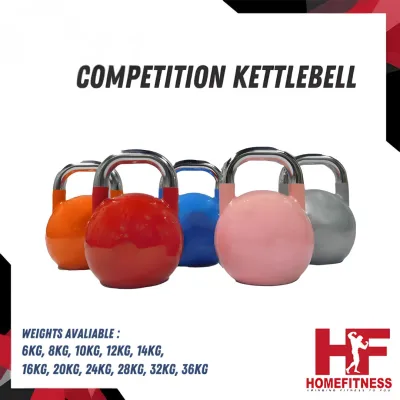
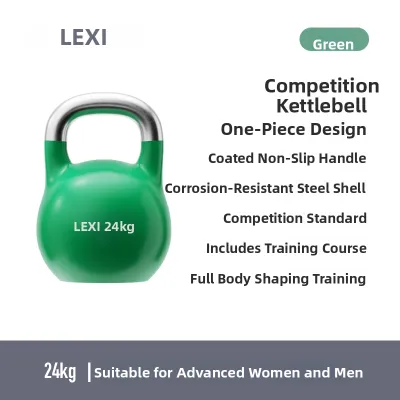
Color coding is another critical aspect of official standards, allowing lifters and judges to identify the weight instantly. The standard international color mapping includes pink for 8 kg, blue for 12 kg, yellow for 16 kg, purple for 20 kg, green for 24 kg, orange for 28 kg, and red for 32 kg. Brands that deviate from these colors or use non-standard weight increments fail to meet competition specifications and can disrupt your preparation if you plan to compete locally or internationally.
The handle design is highly specific and optimized for one-handed movements. Unlike the curved, wide handles of cast-iron bells designed for two-handed swings, competition handles are narrower, straighter, and feature a rectangular window. This shape is engineered for clean hand insertions, ensuring the bell sits securely on the lateral aspect of the forearm. This positioning distributes the load evenly across the skeletal structure rather than straining the soft tissues of the wrist.
Core Criteria for Evaluating Kettlebell Brands
When evaluating different brands available in the Singapore market, look past promotional slogans and focus on measurable manufacturing tolerances. High-quality brands adhere to a strict weight tolerance, often within +/- 100 grams of the nominal weight. A bell that deviates significantly from its labeled weight can disrupt training progression and compromise safety during high-repetition sets. Always check the manufacturer’s specification sheet to verify their guaranteed weight tolerance before purchasing.

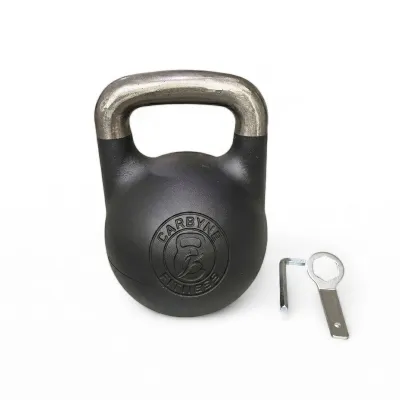
The handle finish is a critical touchpoint that directly impacts performance and skin safety. Competition kettlebell handles are typically unpainted, bare steel or lightly polished iron to allow for optimal chalk retention. A handle that is too smooth or chrome-plated will not hold chalk well, leading to slippage as sweat builds up in Singapore’s warm, humid climate. Conversely, a handle with rough casting seams or excessive porosity can cause friction blisters and skin tears during high-volume snatches. Look for brands that specify a precision-ground, smooth handle surface.
Base flatness is essential for safety, especially during floor-based exercises like renegade rows, push-ups, or handstands on the bells. A kettlebell with an uneven or warped base can wobble or tip over unexpectedly, risking wrist hyperextension or impact injuries. High-quality brands machine the bottom of the bell flat to ensure absolute stability on hard gym flooring or protective rubber mats. If a brand does not explicitly state that their bases are machined flat, treat it as a verification item upon delivery.
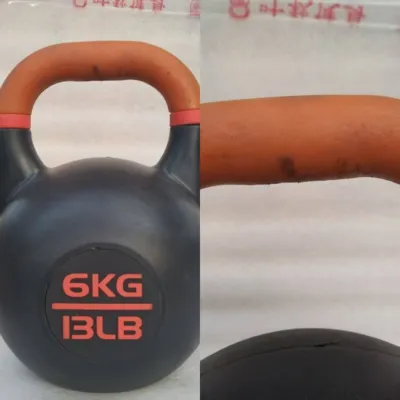
The durability of the outer color coating is another key evaluation metric. Because competition kettlebells are frequently subjected to high-velocity impacts during double-kettlebell exercises, the paint or powder coating must resist chipping and cracking. Standard liquid paint chips easily, exposing the underlying metal to moisture. Electrostatic powder coating or high-grade polyurethane finishes offer superior impact resistance and protect the steel core from the corrosive effects of sweat and high humidity.
Sourcing and Purchasing Channels in Singapore
Acquiring competition-grade kettlebells in Singapore involves balancing immediate availability against shipping costs. Local specialized fitness equipment retailers and authorized distributors are the most reliable starting point. Visiting a local showroom allows you to inspect the handle texture, check the base flatness, and verify the overall casting quality before committing to a purchase. Buying locally also simplifies transport, as many local distributors offer direct delivery to your home or gym, often with lower domestic shipping fees.
For brands that do not have a dedicated local distributor, cross-border e-commerce platforms and international fitness supply stores are viable alternatives. However, importing heavy iron or steel equipment requires careful financial planning. Shipping costs are calculated by weight, and because kettlebells are exceptionally dense, freight charges can sometimes equal or exceed the cost of the product itself. Additionally, you must factor in local import taxes, such as the Goods and Services Tax (GST) in Singapore, which applies to the total value of the imported goods including shipping fees.
Before finalizing an international order, review the seller’s warranty and return policies. Returning a defective or damaged 24 kg kettlebell to an overseas warehouse is often financially impractical due to return shipping costs. Therefore, prioritize sellers that offer robust packaging, such as reinforced wooden crates or heavy-duty molded foam, and clear policies regarding transit damage. For local purchases, verify if the warranty covers structural integrity, such as handle separation, and understand the process for exchanging a bell that fails your initial quality inspection.
Quality Verification and Inspection Upon Delivery
Once your competition kettlebell is delivered, conducting a thorough physical inspection is crucial before integrating it into your training routine. Start by measuring the key dimensions using a digital caliper or a precise measuring tape. Verify that the handle diameter matches the specified standard, typically 33 mm or 35 mm, and that the window clearance is uniform. Any deviation in handle thickness can alter your grip fatigue rate, which is particularly critical for high-repetition endurance sets.
Next, run your hands carefully over the entire surface of the handle and the horns, which are the vertical portions of the handle. Check for any sharp casting seams, burrs, or mold lines. Even minor imperfections can act like sandpaper under high-velocity movements, leading to painful hand tears. If you detect any rough spots, assess whether they can be easily polished down with fine-grit sandpaper or if they warrant a product exchange with the distributor.
Weight verification is the next step. Place the kettlebell on a calibrated digital scale on a flat, hard surface. Compare the reading to the nominal weight stamped on the bell. For competition-grade equipment, the variance should be minimal. If a 16 kg bell weighs significantly more or less than its target weight, it fails competition standards and should be flagged for replacement, as inaccurate weights can lead to muscular imbalances or training plateaus.
Finally, test the base flatness. Place the kettlebell on a perfectly level, hard floor, such as concrete or tile, rather than a soft rubber mat. Gently press on different sides of the handle to see if the bell rocks or tilts. A stable, flat base is non-negotiable for safety during floor-based exercises. If the bell wobbles, the base was not machined correctly, posing a safety risk during weight-bearing movements. Stop using the bell for floor exercises immediately if it fails this stability check.
Frequently Asked Questions (FAQ)
Can I use a competition kettlebell for general fitness training?
Yes, competition kettlebells are highly effective for general fitness training, though they have specific trade-offs. The primary benefit is the consistent size, which allows you to maintain identical lifting mechanics and forearm placement as you build strength. However, the narrower handle design is optimized for one-handed lifts. If your routine relies heavily on two-handed swings, you may find the handle window too cramped to accommodate both hands comfortably, unlike the wider handles of standard cast-iron bells. Additionally, competition steel bells generally carry a higher price tag than cast-iron alternatives, making them a larger initial investment for casual home workouts.
How do I maintain the color coating on a competition kettlebell?
Preserving the color coating requires regular cleaning and proper storage, especially in Singapore’s humid climate. After each workout, wipe down the painted surface with a damp microfiber cloth to remove sweat, which contains corrosive salts. Avoid using harsh chemical solvents or abrasive scrubbers that can degrade the paint or powder coating. Store your kettlebells indoors in a dry, well-ventilated area rather than on an open balcony where humidity and rain can accelerate rust. To minimize paint chipping, avoid dropping the bells directly onto concrete or clashing them together during double-kettlebell exercises; instead, perform your lifts over high-density rubber gym mats.
What is the difference between single-cast and two-piece competition kettlebells?
The difference lies in their manufacturing process and long-term structural integrity. Single-cast competition kettlebells are molded from a single piece of molten steel or iron, resulting in a seamless structure with no welded joints. This method eliminates the risk of the handle separating from the bell body under high stress. Two-piece kettlebells, on the other hand, feature a separate handle welded to a hollow body, which is sometimes filled with ballast, like lead or sand, to achieve the target weight. Over time, the internal ballast in two-piece bells can come loose, causing an annoying rattling sound and shifting the center of gravity, while the welded joints represent potential failure points under repeated impact.

Community discussion
Share your experience or ask a question. Comments are reviewed before publication.