
When comparing foldable yoga mats across popular brands, there is no single “best” thickness. The ideal choice depends entirely on how you weigh joint protection against carrying convenience. Thinner mats maximize portability for travel, while thicker options provide essential cushioning for sensitive joints. This guide breaks down the common thickness categories, explains how they impact your practice, and provides a decision framework to help you choose the right balance for your needs.
Foldable yoga mats generally range from ultra-thin travel profiles of 1 mm to 2 mm up to cushioned options of 4 mm to 6 mm. Popular brands design these mats with distinct folding lines or crease patterns to allow them to pack flat rather than roll. Choosing the right thickness requires balancing your personal need for joint cushioning against your daily portability requirements. While a thicker mat offers superior comfort on hard surfaces, it also increases the overall folded volume and weight, making it less convenient for commuting or travel.
Understanding Common Thickness Categories for Foldable Mats
To navigate the options offered by various brands, it helps to understand the three primary thickness categories available in the foldable yoga mat market. Each category serves a distinct purpose, catering to different styles of practice, travel habits, and comfort preferences.
Products mentioned in this guide
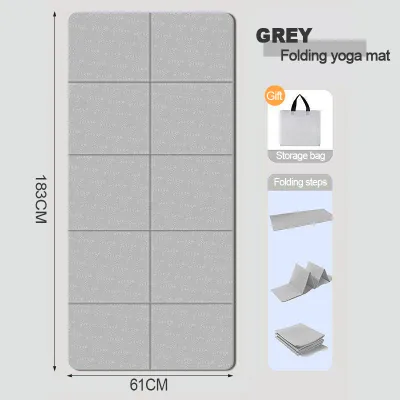
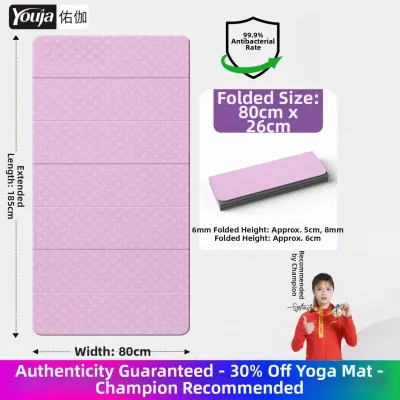
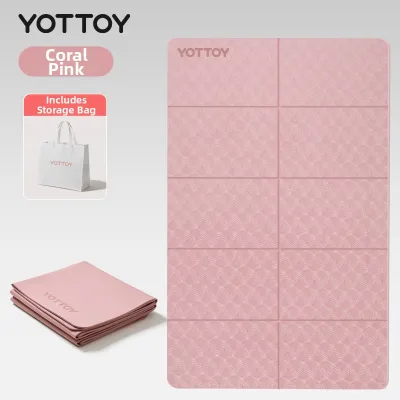
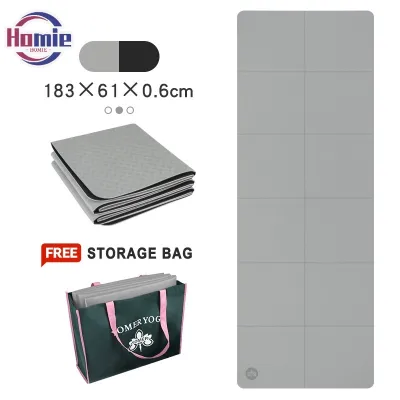
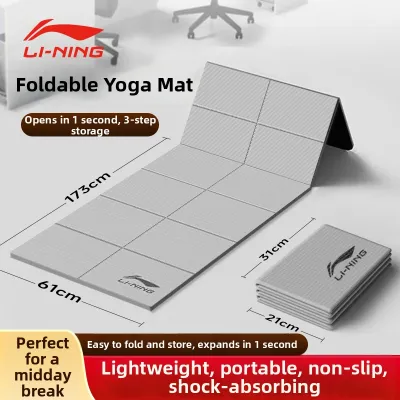
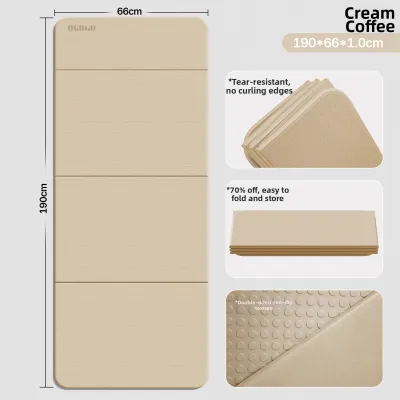
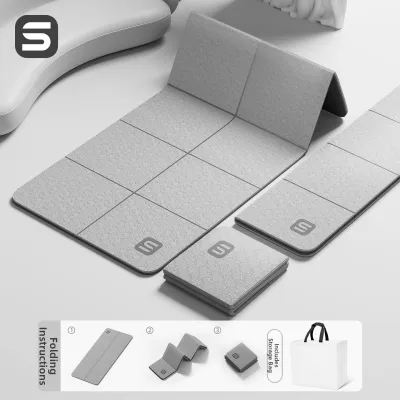
Prices are valid at publication and may change. Please refer to the product page for the latest price.
The ultra-thin and travel-focused category typically ranges from 1 mm to 2 mm in thickness. These mats are engineered specifically for maximum portability, allowing them to fold down to the size of a notebook or a small tablet. Because they use minimal material, they are exceptionally lightweight and can easily slip into a backpack, tote bag, or carry-on suitcase. However, this minimal profile offers virtually no cushioning, meaning you will feel the hardness of the floor directly beneath you. Many practitioners use these ultra-thin mats as a hygienic topper over a studio-provided mat rather than as a standalone surface, allowing them to enjoy the grip of their personal mat without sacrificing joint comfort.
The standard everyday category generally spans from 3 mm to 4 mm. This mid-range thickness represents a compromise, attempting to balance basic joint comfort with reasonable folded dimensions. A 3 mm or 4 mm foldable mat provides enough barrier to soften the impact on your knees and elbows during floor poses, yet it can still fold into a relatively compact square or rectangle. While it will not pack as flat as a 1 mm travel mat, it remains highly manageable for daily commutes to a local studio or gym. This category is highly popular among regular practitioners who want a single, versatile mat that can handle both active flows and restorative sessions.
The extra-cushioned category includes foldable mats that are 5 mm to 6 mm thick or more. These are the thickest foldable options available, designed for practitioners who require substantial joint support but still prefer a flat-folding design over a traditional roll-up mat. It is important to note that as thickness increases in this category, the folded bulk grows significantly. The extra material makes the folded mat much thicker and heavier, which can sometimes limit how tightly the folding mechanism compresses or make it too bulky for standard backpacks. These mats are best suited for home use or dedicated studio spaces where long-distance transport is not a primary concern.
Evaluating Cushioning and Joint Protection
When selecting a foldable yoga mat, understanding how thickness translates to physical comfort and joint protection is essential for a safe and sustainable practice. The primary function of mat cushioning is to absorb impact and distribute your body weight evenly across sensitive contact points.

During poses that place direct pressure on small areas—such as Cat-Cow, low lunges, or headstands—your knees, wrists, and spine bear a concentrated load. A mat that is too thin can cause discomfort or even joint strain, especially if you practice on hard surfaces. Thicker mats provide a deeper compression barrier, allowing these bony prominences to sink slightly into the material, which reduces localized pressure and helps prevent bruising or chronic soreness. This is particularly important for practitioners recovering from injuries or those with sensitive joints who require a reliable buffer.
The hardness of your primary practice surface plays a major role in determining how much thickness you actually need. If you primarily practice on carpeted floors at home, a thin 1.5 mm or 2 mm mat may be perfectly adequate because the underlying carpet and underlayment provide natural shock absorption. Conversely, if you practice on hardwood, laminate, polished concrete, or tile floors, you will likely require a standard 3 mm to 4 mm mat, or even an extra-cushioned 6 mm option, to counteract the unforgiving hardness of the subfloor. Outdoor surfaces like grass or sand can also provide natural cushioning, making thinner mats more viable in those settings.
However, there is an inherent trade-off between maximum cushioning and the stability required for standing and balancing poses. In poses like Tree Pose or Warrior III, a mat that is too thick or overly soft can create an unstable foundation. Your feet may sink too deeply, forcing the stabilizing muscles in your ankles and arches to work harder to maintain balance, which can lead to fatigue or loss of alignment. A thinner, firmer mat keeps your feet closer to the solid floor, providing a more responsive and stable surface for precise balancing and active standing sequences.
Assessing Portability, Weight, and Storage
Portability is the primary reason to choose a foldable yoga mat over a traditional roll-up model, but the thickness you select will directly dictate how easy the mat is to transport and store. Every millimeter of added thickness exponentially increases the overall volume of the mat when it is folded.
An ultra-thin mat folds down into a compact, flat shape that easily fits into standard luggage, a commuter backpack, or even a large handbag. This makes it an excellent option for business travelers, vacationers, or anyone who wants to squeeze a quick practice into a busy day on the go. It is also highly convenient for those who commute via public transit or bicycle, as it adds minimal bulk and weight to your daily carry. As you move up to standard and extra-cushioned thicknesses, the folded stack becomes progressively taller and wider, requiring more space in your bag.
A 5 mm or 6 mm foldable mat, when folded into its multi-panel configuration, can become quite bulky, often requiring a dedicated carrying strap or a spacious gear bag rather than fitting neatly inside a standard backpack. This added bulk can make commuting on crowded trains or buses more cumbersome. Therefore, if you plan to carry your mat over long distances or on daily commutes, you must carefully weigh the physical effort of transporting a thicker mat against the comfort it provides during your practice.
Storage considerations also extend to your home environment, gym lockers, or office space. If you live in a compact apartment or have limited storage options, a flat-folding mat can be slipped under a bed, stacked on a shelf, or tucked vertically into a narrow closet gap where a bulky rolled mat might not fit. However, you must ensure that the folded dimensions of your chosen thickness align with the physical space you have available. To avoid surprises, it is crucial to check the manufacturer’s official specifications for both the actual folded dimensions and the total weight, rather than relying solely on the unfolded thickness metric.
Material Density and Construction Checks
When comparing foldable yoga mats, focusing solely on the thickness measurement can be misleading. The density of the material and the quality of the structural construction are often more critical to real-world performance and durability than the physical thickness alone.
A thinner mat made of high-density material can offer similar, or even superior, joint support compared to a thicker, low-density alternative. For example, a dense 2 mm natural rubber mat can provide a firm, supportive barrier that prevents your joints from bottoming out against the floor, whereas a cheap, low-density 4 mm foam mat might compress completely under your weight, offering very little actual protection. High-density materials distribute pressure more effectively across the surface area, giving you the benefits of cushioning without the added bulk.
When shopping, always check the product labels and technical specifications for material composition and density indicators. Common materials include Polyvinyl Chloride (PVC), Thermoplastic Elastomer (TPE), natural rubber, and polyurethane (PU). Natural rubber and dense PU are heavier but offer exceptional grip and firm support even at thinner profiles. TPE is lighter and offers decent cushioning but may compress more easily under heavy loads. By understanding these material characteristics, you can make a more informed decision rather than assuming a thicker mat is automatically more comfortable.
Additionally, you should carefully inspect the specific folding mechanism of the mat. Foldable mats typically use a tri-fold, bi-fold, or accordion-style design with pre-molded crease lines. Because these creases are subjected to repeated bending and unfolding, they represent potential weak points. Verify that the design is structurally rated to handle the chosen thickness without cracking, tearing, or degrading over time. High-quality brands reinforce these fold lines to ensure the mat can withstand regular use without splitting along the seams, preserving both the structural integrity and the aesthetic appeal of the mat.
Decision Framework: Which Thickness Fits Your Needs?
To help you finalize your choice, use this condition-based decision framework to match your primary practice habits, travel frequency, and physical needs to the right foldable yoga mat thickness.
Choose the ultra-thin category (1 mm to 2 mm) if your absolute priority is frequent travel, outdoor hiking, or minimizing luggage space. This category is ideal if you frequently practice on forgiving surfaces like grass, sand, or carpeted hotel rooms, or if you plan to use the foldable mat as a clean, personal layer on top of a thicker studio mat. It is also the best choice for those who prioritize a lightweight commute and want a mat that can slide effortlessly into a standard work bag without adding noticeable bulk.
Choose the standard category (3 mm to 4 mm) if you seek a versatile, all-purpose balance for regular studio classes, gym sessions, or home use. This thickness provides a reasonable level of joint protection on hard floors while remaining compact enough to fold down into a manageable size. It is well-suited for practitioners who want a single mat that can transition smoothly from home practice to local classes without causing excessive carrying fatigue or requiring a specialized carrying bag.
Choose the extra-cushioned category (5 mm to 6 mm) if you require maximum joint support due to sensitive knees or wrists, practice primarily on hard tile or concrete floors, and do not need to carry your mat over long distances. This option is perfect for home-based practices where space-saving storage is desired, but portability is secondary to physical comfort. It is also highly suitable for slower, restorative styles of yoga where prolonged floor contact requires maximum cushioning.
Before purchasing any foldable mat, verify that the manufacturer’s warranty and care instructions cover your intended frequency of folding and unfolding. Some materials may require specific folding patterns to prevent permanent creasing or structural damage. Taking a moment to check these details ensures your mat remains a durable and reliable partner in your wellness routine, providing the perfect foundation for your practice wherever you choose to unfold it.
Frequently Asked Questions (FAQ)
Can I just fold a standard thick roll-up yoga mat myself?
No, you should not attempt to fold a standard roll-up yoga mat that is not specifically designed for folding. Standard roll-up mats are manufactured as a continuous, uniform sheet of material meant to be rolled into a cylinder. Forcing a standard mat to fold creates sharp creases that put extreme stress on the material fibers. This can lead to permanent structural damage, including deep cracks, tearing, or weak points along the crease lines that will eventually cause the mat to split. Purpose-built foldable mats feature engineered hinges, scored lines, or segmented panels designed specifically to bend repeatedly without degrading.
Does a thicker foldable mat always mean it is significantly heavier?
Not necessarily, as the total weight of a foldable yoga mat depends heavily on its material density rather than its thickness alone. For example, a thin 2 mm mat made of dense natural rubber can actually weigh more than a thicker 4 mm or 5 mm mat made of lightweight Thermoplastic Elastomer (TPE) or closed-cell foam. When comparing options, it is essential to check the exact product weight listed in the manufacturer’s specifications rather than assuming a thinner mat is always lighter or a thicker mat is always heavier.

Community discussion
Share your experience or ask a question. Comments are reviewed before publication.