
Fitting fitness equipment into a Singapore home requires careful planning, especially when dealing with the compact layouts of modern Housing & Development Board (HDB) flats. While a home treadmill offers the convenience of running in air-conditioned comfort, its physical size can easily overwhelm a bedroom or study room. To find a treadmill that works for a typical HDB flat, you must balance a compact physical footprint with a running deck that safely accommodates your stride, while ensuring the machine can fold away and operate quietly enough for high-density living. Typically, this means looking for a folding treadmill with a footprint of under 160 cm in length and 70 cm in width, paired with a high-density shock-absorption mat to protect your floors and maintain neighborly peace.
Measuring Your HDB Space and Clearance Requirements
Before browsing online marketplaces, map out the exact zone where the treadmill will sit. Use a measuring tape to outline the proposed footprint in your chosen room, keeping in mind the swing radius of wardrobe doors, study chairs, and entryways. A common mistake is measuring only the static machine size without accounting for the space you need to get on and off the equipment safely.
Safety clearances are non-negotiable when operating a moving belt in a tight space. Maintain at least 1 to 1.5 meters of clear, unobstructed space behind the rear of the treadmill. This safety zone ensures that if you slip, you are thrown onto a clear floor rather than into a concrete wall or sharp furniture. Additionally, leave at least 0.5 meters of clearance on both sides of the machine for natural arm swings and easy mounting.
Products mentioned in this guide
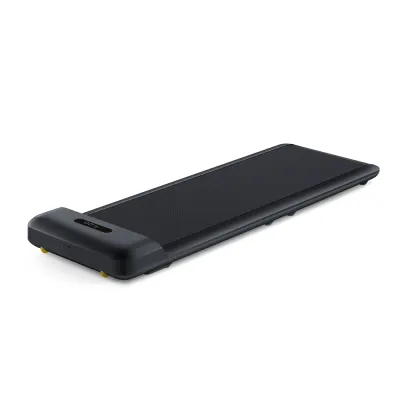
Prices are valid at publication and may change. Please refer to the product page for the latest price.
Vertical clearance is another critical factor. HDB ceilings typically average around 2.6 meters in height. To calculate your required ceiling clearance, add the height of the treadmill’s running deck (usually 15 to 25 cm) to the height of the tallest user, and then add another 15 to 20 cm to account for head bounce. If the treadmill features an incline function, add the maximum height of the fully inclined deck to prevent head strikes against light fixtures or ceiling fans.
Finally, consider the logistics of getting the machine into your home. Measure the width of your HDB main door, bedroom door frames, and hallway turns. Many heavy-duty treadmills are delivered in large, heavy boxes that cannot easily navigate narrow corridors or standard passenger lifts. Verifying these entry dimensions beforehand prevents delivery issues.
Balancing Machine Footprint and Running Belt Size
When shopping for a compact treadmill, you will constantly face a trade-off between the machine’s overall exterior footprint and the actual usable size of the running belt. The exterior frame, motor cover, and console pillars always add significant length and width to the machine’s total physical dimensions. It is crucial to look at both sets of measurements rather than relying on a single “compact” label.

The ideal running belt size depends heavily on your height, stride length, and intended workout intensity. If you plan to use the machine primarily for walking or light jogging, a belt width of 40 cm and a length of 120 cm is generally sufficient for most users. However, if you intend to run at higher speeds, your stride naturally lengthens and sways. For safe running, look for a belt that is at least 45 to 50 cm wide and 130 to 140 cm long to prevent your feet from accidentally stepping onto the side rails.
While ultra-compact, flat-folding treadmills are highly appealing for small rooms, they often come with stability trade-offs. To achieve a slim profile, these models typically use smaller motors and lighter frames. During high-impact running, a lightweight frame may shake, slide, or feel unstable underfoot. If you are a dedicated runner, a slightly heavier folding model with a sturdier frame is necessary to ensure a safe and smooth workout experience.
To verify if a compact frame can handle your workouts, always check the manufacturer’s specified maximum user weight capacity. A higher weight rating indicates a more robust motor and a more rigid frame construction. For safety and longevity, choose a machine with a weight capacity that exceeds your actual body weight by at least 15 to 20 kilograms, ensuring the motor does not overheat during extended use.
Key Space-Saving and Noise-Reduction Features
Modern cardio equipment designed for urban living incorporates several features to minimize its physical and acoustic impact on your home. Folding mechanisms are the most common space-saving solution. Look for hydraulic soft-drop systems that allow the heavy deck to fold upward easily and lower to the ground slowly and safely without manual lifting. Alternatively, some flat-folding models allow the console to fold completely flat against the deck, enabling you to store the unit vertically against a wall or horizontally under a bed.
Portability is equally important if you do not plan to leave the treadmill in the middle of the room. Check for integrated transport wheels, preferably multi-directional wheels that allow you to roll the machine sideways into a corner or closet. Always measure your storage space—such as the gap under your bed frame or the depth of your utility closet—against the folded dimensions of the treadmill before making a purchase.
Acoustic management is vital in high-density HDB blocks where sound and vibrations travel easily through concrete floors. Look for treadmills equipped with brushless DC motors, which operate much more quietly and have a longer lifespan than traditional brushed motors. Additionally, pay close attention to the deck’s cushioning system. High-quality rubber dampers, air springs, or elastomer cushions absorb the impact of your footfalls, significantly reducing the low-frequency thuds that can disturb your downstairs neighbors.
Console design also plays a role in the overall bulk of the machine. Streamlined, minimalist consoles with LED touch panels or integrated tablet holders keep the upper frame slim and unobtrusive. Avoid bulky, commercial-style consoles with massive plastic cup holders and protruding handles, as these add unnecessary visual weight and make the machine much harder to fold and store compactly.
Evaluating Treadmills Against Compact Alternatives Like Exercise Bikes
If your HDB bedroom or study room simply cannot accommodate a treadmill’s footprint and safety clearance, it is worth exploring compact cardio alternatives. An upright or folding exercise bike, such as an irunning bike, offers an exceptionally space-efficient solution. These bikes typically occupy less than half the floor area of a standard folding treadmill and do not require extensive safety clearance zones behind them.
From a spatial perspective, an exercise bike has a much lower visual profile, helping your room feel open and less cluttered. Because you remain seated while exercising, there is no need to worry about ceiling height limitations or head clearance near ceiling fans. This makes bikes highly suitable for rooms with low ceilings or those already packed with tall furniture like wardrobes and bookshelves.
The physical impact of your workout is another key differentiator. Running is a high-impact, weight-bearing exercise that burns calories quickly but puts significant stress on your joints. In contrast, cycling on an exercise bike provides a low-impact cardiovascular workout that is highly gentle on the knees and ankles, making it an excellent choice for recovery or joint-friendly conditioning.
In terms of portability, a lightweight compact bike is far easier to relocate, store, or hide away than a heavy folding treadmill. Many folding bikes can be collapsed and rolled into a wardrobe or behind a door in seconds. If you live in a cozy three-room HDB flat where every square meter counts, or if you prefer a quiet workout option that generates virtually zero floor vibration, downsizing to a compact exercise bike is often the most practical and neighbor-friendly decision.
Frequently Asked Questions (FAQ)
Do I need to reinforce my HDB floor to support a treadmill?
Standard HDB floor slabs are engineered to support typical residential live loads of up to 1.5 kN/m², which translates to roughly 150 kg per square meter. A standard home treadmill weighing between 60 kg and 100 kg, combined with a user, is well within these structural limits. However, the dynamic load—the concentrated force exerted when your feet strike the deck—can put localized stress on your flooring. To distribute this weight evenly and protect your floor tiles or vinyl planks from scratches and indentations, always place a wide, high-density equipment mat under the machine. If you are considering an exceptionally heavy, commercial-grade treadmill exceeding 150 kg, consult your town council or a qualified structural engineer first.
How can I reduce treadmill noise and vibration for downstairs neighbors?
To minimize structure-borne noise in an HDB flat, place a thick, high-density rubber or foam anti-vibration mat directly under the treadmill to absorb impact energy. Position the machine away from shared structural walls, and avoid placing it directly over a neighbor’s bedroom; a living room or study corner is usually a better choice. Regularly maintain your treadmill by checking the belt alignment and lubricating the deck according to the manufacturer’s instructions. This reduces mechanical friction, squeaks, and motor strain, keeping the decibel levels low during early morning or late-night workouts.

Community discussion
Share your experience or ask a question. Comments are reviewed before publication.