
Investing in your first tennis ball machine is a significant step toward accelerating your skill development. For beginners, the primary value of a machine lies in its ability to deliver consistent, predictable balls, allowing you to focus entirely on your stroke mechanics, footwork, and contact point. Instead of scrambling to react to erratic hits from a practice partner, you can repeat the same swing path hundreds of times until the motion becomes second nature.
However, navigating the market can be overwhelming, with options ranging from basic battery-powered units to advanced, programmable robots used by touring professionals. It is easy to fall into the trap of overpaying for high-tech features that do not actually contribute to early-stage learning. By focusing on a few essential specifications and understanding which premium add-ons to avoid, you can find a reliable training partner that fits your budget and practice environment.
In tropical climates like Singapore, where outdoor court bookings are highly competitive and weather conditions can change rapidly, portability and setup efficiency are just as important as technical specifications. A machine that is too heavy to transport or too complicated to set up will likely end up gathering dust in a closet. This guide will help you prioritize the features that matter most for building a solid foundation on the court.
Products mentioned in this guide
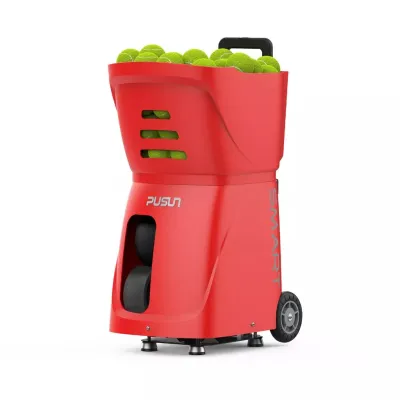
![SG [In Stock]PUSUN PT-Smart Tennis Ball Machine Tennis Training Automatic Tennis Ball Machine](https://img.lazcdn.com/g/p/b2b0605406eaea1e93f16ffa7337aed5.jpg_400x400q80.jpg_.webp)
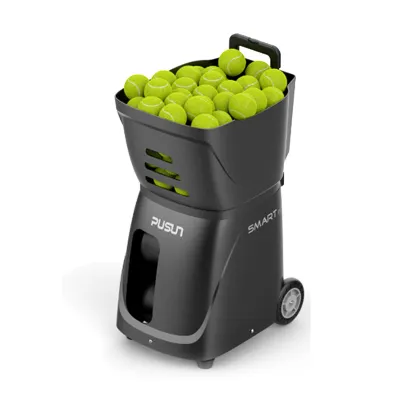
![SG [In Stock]PUSUN PT-Smart Tennis Ball Machine - 100% Genuine Automatic Launcher with 3-Year Warranty & Lifelong Maintenance Portable for Tennis Training & Games](https://img.lazcdn.com/g/p/2ec99476661dd32c9412c8f267272116.jpg_400x400q80.jpg_.webp)
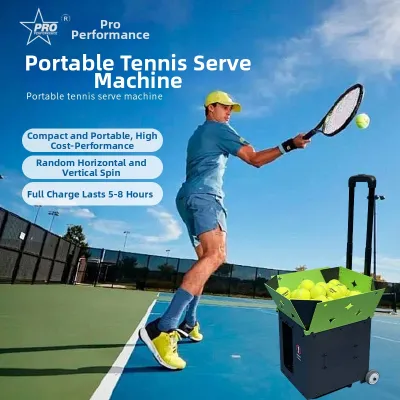
Prices are valid at publication and may change. Please refer to the product page for the latest price.
Core Features to Prioritize for Beginner Practice
To build a consistent swing, you need a machine that can adapt to your current physical limits while providing room to grow. The most critical feature to evaluate is the machine’s feed rate, which is the time interval between each ball delivery. As a beginner, you need ample time to recover your court positioning, reset your racket preparation, and execute a clean split-step before the next ball arrives. Look for a machine that offers an adjustable feed rate starting at a slow interval, such as six to ten seconds, allowing you to practice without feeling rushed or fatigued.
Ball capacity is another key specification that directly impacts your practice rhythm. A hopper capacity of 70 to 120 balls is generally the sweet spot for entry-level players. This range provides enough continuous hitting time—roughly five to ten minutes of active drilling per round—to build muscle memory without causing excessive physical exhaustion. It also keeps the overall weight of the machine manageable when fully loaded and transported.
While basic repetition is essential, you will eventually need to practice moving to the ball. This is where horizontal oscillation becomes invaluable. Horizontal oscillation sweeps the machine’s nozzle side-to-side, distributing balls across the width of the court. For a beginner, a basic random horizontal sweep is perfect for teaching lateral movement, recovery steps, and positioning. You do not need complex, programmable patterns; a simple, continuous left-to-right sweep is more than sufficient to transition your practice from stationary hitting to active footwork drills.
Vertical oscillation, which changes the depth of the ball from short court to deep baseline, is less critical in the initial stages but can be useful as you progress. If your budget allows, a machine with manual vertical angle adjustment lets you set the height of the feed to practice different types of shots, such as high-bouncing groundstrokes or low volleys.
Finally, pay close attention to the speed and spin capabilities. Beginners do not need extreme ball speeds. A machine that delivers balls between 20 and 70 kilometers per hour is ideal for learning. This range covers everything from soft, slow feeds for close-range volley practice to faster baseline groundstrokes. Additionally, look for basic spin controls. While you will mostly practice hitting flat balls initially, having the option to introduce light topspin or backspin will help you learn how to control your racket face against different ball rotations as your skills improve.
Advanced Functions You Can Safely Skip
When shopping for tennis ball machines, manufacturers often highlight high-tech connectivity and smart features to justify premium price tags. For a beginner, many of these features are unnecessary distractions that add complexity and potential points of failure. Smartphone app integration and advanced wireless remotes, for example, are often marketed as essential conveniences. In reality, simple manual dials or a basic, single-button physical remote are often more practical on the court. Adjusting dials directly on the machine takes only a few seconds, and physical buttons are much easier to operate with sweaty hands under the bright sun than a touchscreen interface.

Programmable drill sequences are another expensive feature that entry-level players can safely bypass. These systems allow users to program highly specific ball locations, speeds, and spins to simulate real match play. While beneficial for advanced players training for competitive tournaments, beginners derive far more value from simple, repetitive feeds. Trying to cope with unpredictable, multi-location drills before mastering basic stroke mechanics can lead to poor form, frustration, and even injury. Your primary goal is to hit the same shot repeatedly until your technique is stable.
You should also avoid paying extra for extreme speed capabilities and massive ball hoppers. Some commercial-grade machines can launch balls at speeds exceeding 130 kilometers per hour and hold over 250 balls. For a beginner, these specifications are not only unnecessary but can also be counterproductive. High-speed feeds are dangerous if you have not yet developed quick reaction times and proper defensive footwork. Furthermore, a massive hopper significantly increases the physical size and weight of the machine, making it incredibly difficult to lift into a car boot or transport to local public courts.
Portability, Power, and Court Setup
The physical logistics of using a tennis ball machine are often overlooked during the buying process, yet they are critical to how often you will actually use the equipment. In Singapore, where most recreational play occurs on public outdoor courts managed by ActiveSG or private condo courts, access to electrical outlets is rarely guaranteed. Therefore, a battery-powered machine is almost always the best choice. Look for a machine equipped with a high-quality lithium-ion or sealed lead-acid battery that offers at least two to three hours of continuous runtime. This ensures you can complete a full hitting session without worrying about the machine dying mid-drill.
Charging convenience is another factor to consider. Some machines feature removable battery packs, allowing you to leave the heavy machine in your car or storage locker while bringing only the battery indoors to charge. This is a massive advantage if you live in a high-rise apartment or have limited storage space. If the battery is internal, ensure you have a dedicated, well-ventilated charging area near an outlet at home.
Portability is heavily influenced by the machine’s physical design. Look for models that weigh under 20 kilograms when empty. The machine should feature a sturdy, ergonomic handle—ideally a folding or telescopic design similar to luggage—and large, heavy-duty wheels. Small, plastic wheels can struggle on rough asphalt paths, grass, or court thresholds, whereas larger rubber wheels roll smoothly over various surfaces.
Environmental factors also play a significant role in the longevity of your machine. Singapore’s high humidity, intense sun, and sudden rain showers can quickly degrade electronic components and rubber feeding wheels. Always check the manufacturer’s guidelines regarding weather resistance. While no consumer ball machine is completely waterproof, some models feature sealed control panels and protective housings. Regardless of the machine’s design, you should never operate it in the rain, and you must store it in a cool, dry, indoor environment when not in use to prevent rust and battery degradation.
Building Your Shortlist: Budget and Verification
Establishing a clear financial boundary is the first step in narrowing down your options. For a reliable, entry-level tennis ball machine, a realistic budget allocation ranges from S$1,200 to S$2,500. While you may find cheaper options online, these often sacrifice build quality, battery life, and motor reliability. Conversely, spending more than S$3,000 as a beginner usually means paying for advanced programming features that you will not use. Investing in a mid-range machine from a reputable brand ensures you get durable internal components, a reliable battery, and consistent performance.
Before making a purchase, it is crucial to verify the manufacturer’s warranty and the availability of local customer support. Because tennis ball machines contain moving parts, motors, and batteries that wear out over time, having access to local servicing is incredibly valuable. Check if the brand has an authorized distributor or service center in Singapore. Shipping a 20-kilogram machine back to an overseas manufacturer for repairs can cost hundreds of dollars in freight fees, quickly wiping out any initial savings from buying from an unauthorized online seller. Look for a warranty that covers the motor and electronics for at least one to two years, and the battery for at least six months.
Finally, verify ball compatibility by carefully reading the product manual. Tennis ball machines rely on internal spinning wheels to propel the balls forward. Standard pressurized tennis balls lose their bounce and pressure quickly when subjected to the constant squeezing of a machine’s throwing wheels. For the best results, you should plan to use pressureless tennis balls. These balls are designed with a thicker rubber core and do not rely on internal gas pressure for their bounce, making them highly durable and consistent over hundreds of hours of machine use. Ensure the machine you choose is explicitly compatible with pressureless balls, and avoid using wet or heavily worn balls, which can cause internal jams and damage the motor.
Frequently Asked Questions (FAQ)
How many balls should a beginner tennis ball machine hold?
For beginner practice, a machine with a capacity of 70 to 120 balls is ideal. This capacity allows you to hit continuously for several minutes, which is sufficient to establish a practice rhythm and build muscle memory without causing physical overexertion. Hoppers with larger capacities, such as 150 to 200 balls, make the machine significantly heavier and bulkier, making transport to and from the court much more difficult.
Can I use regular tennis balls in any ball machine?
While you can technically use standard pressurized tennis balls, they are not recommended for long-term use in ball machines. Pressurized balls lose their bounce rapidly under the mechanical pressure of the machine’s launching wheels, leading to inconsistent feeds. Instead, use pressureless tennis balls, which maintain their bounce indefinitely and are highly durable. Always avoid using wet, dirty, or severely worn balls, as they can slip on the throwing wheels, cause frequent jams, and strain the internal motors.
Is it worth buying a used tennis ball machine as a beginner?
Buying a used machine can offer significant cost savings, but it comes with notable risks. If you choose to buy second-hand, carefully inspect the battery health, as rechargeable batteries degrade over time and can be expensive to replace. Test the machine to ensure the launching wheels spin smoothly without excessive noise, and check the metal components for signs of rust or corrosion. Keep in mind that used machines rarely come with a warranty, so you must weigh the upfront savings against potential repair costs and the lack of local technical support.

Community discussion
Share your experience or ask a question. Comments are reviewed before publication.