
No, the HeroClip Small is absolutely not safe for climbing, belaying, anchoring, or supporting human body weight in any capacity. While its carabiner-like silhouette and metallic construction might suggest rugged durability, it is designed strictly as a lifestyle and utility accessory. It is engineered to hang gear statically, not to arrest falls or secure life-safety systems in vertical environments.
Using a utility clip in place of certified climbing hardware introduces extreme, life-threatening risk. Climbing requires equipment that can withstand massive dynamic forces generated during a fall. The HeroClip Small is not built, tested, or certified to meet these life-safety standards. Any attempt to use it in a load-bearing climbing scenario could result in immediate equipment failure and catastrophic consequences.
Utility Design vs. Climbing Gear Standards
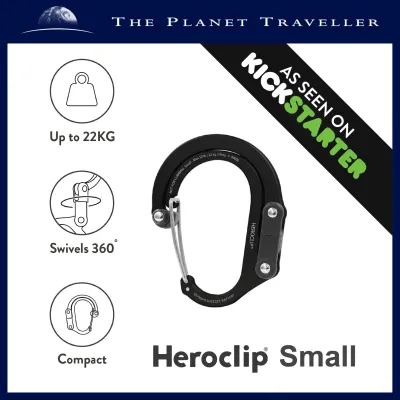
To understand why the HeroClip Small cannot be used for climbing, you must examine its design and material composition. The HeroClip is a highly versatile, hybrid gear hanger. It features a dual-jointed, folding hook that rotates 360 degrees, folds around the main body, and has a grippy rubber tip on the end. This design is exceptionally convenient for everyday carry, camping, and organizing gear, allowing you to hang backpacks, water bottles, and accessories from tables, branches, or fences.
Products mentioned in this guide
Prices are valid at publication and may change. Please refer to the product page for the latest price.
However, this multi-jointed articulation is a major structural vulnerability under high loads. True climbing carabiners are solid, rigid loops designed to distribute forces along a continuous metal spine. The pivoting joints, swivel pins, and folding mechanisms of a utility clip introduce multiple failure points that cannot handle multi-directional or high-impact forces.
Furthermore, the weight ratings of these two categories of gear are fundamentally different. The HeroClip Small has a maximum static load limit of 50 pounds (approximately 22 kilograms). This rating is strictly for static loads, meaning the weight must be applied slowly, evenly, and remain completely still. You must always verify the exact load limit printed on your specific product packaging or the manufacturer’s official documentation before hanging any gear, as overloading can cause the frame or the swivel joint to deform.
In contrast, climbing gear is rated in kilonewtons (kN), a unit of force rather than static mass. One kilonewton is equivalent to approximately 100 kilograms (220 pounds) of static force under gravity. A standard climbing carabiner certified under international standards must have a minimum breaking strength of 20 kN (about 2,000 kilograms or 4,400 pounds) along its major axis with the gate closed. This massive difference highlights the gulf between utility organization and life-safety engineering.
Why Utility Clips Fail Under Climbing Forces
The primary reason utility clips fail catastrophically in climbing scenarios is the physics of dynamic loading. In a static scenario, a 70-kilogram climber hanging from a rope exerts exactly 70 kilograms of force (about 0.7 kN) on the anchor. However, climbing is rarely static. If that same climber slips and falls just one meter before the rope catches them, the sudden deceleration generates a dynamic shock load.

This shock load multiplies the force exponentially. Depending on the rope’s elasticity and the fall factor, a short fall can easily generate forces between 4 kN and 8 kN (400 to 800 kilograms of force) on the top anchor. The HeroClip Small, with its static limit of 22 kilograms (0.22 kN), would instantly shear, snap, or bend under a fraction of this force.
The materials used in utility clips are also not selected for high-impact resilience. While high-quality utility clips may use aircraft-grade aluminum, they are often manufactured using casting or simple extrusion processes rather than the hot-forging techniques used for climbing gear. Hot forging aligns the crystalline structure of the metal, making it incredibly tough and resistant to micro-fractures. Utility clips, conversely, may contain internal voids or brittle alloys that shatter under sudden shock.
Additionally, safety mechanisms are entirely absent in utility designs. Climbing carabiners feature robust gate-locking mechanisms—such as screwgates, twist-locks, or magnetic locks—to prevent the gate from opening accidentally. A carabiner with an open gate loses up to 70% of its strength. The HeroClip Small utilizes a simple wire gate without any locking mechanism. Under the vibration, rope movement, or contact with rock typical of a climb, this gate can easily flutter or force open, leading to immediate failure.
The “looks like a carabiner” trap is a well-documented hazard in the outdoor community. Because utility clips share a similar aesthetic with climbing hardware, beginners or casual recreationists may mistakenly assume they are interchangeable. This visual similarity is purely functional for hanging items and does not translate to structural integrity.
Safe and Intended Uses at the Crag or Basecamp
While the HeroClip Small must be kept far away from any life-safety systems, it remains an incredibly useful tool for organization around the crag, basecamp, or indoor climbing gym. In Singapore’s humid tropical climate, keeping gear off the damp ground is crucial to prevent mold, dirt accumulation, and premature wear on fabrics.
Safe applications for the HeroClip Small include:
- Hanging your chalk bag from a tree branch or a gym railing to keep it upright and prevent spills.
- Suspending your climbing shoes between climbs to allow them to air out and dry.
- Hanging a water bottle, headlamp, or Bluetooth speaker from your gear pack or tent loop.
- Keeping your backpack suspended off muddy ground at outdoor sites like Dairy Farm Quarry.
To ensure safety, you must practice the strict rule of isolation. The utility clip must never be attached to, or even placed near, the active climbing chain. This includes ropes, harnesses, quickdraws, slings, anchors, or belay devices. It should be kept in a separate compartment of your pack or clearly color-coded so it is never grabbed in a high-stress moment on the wall.
Before clipping any item with a HeroClip, run through this quick mental checklist:
- Consequence Check: If this clip fails and the item falls, will anyone be injured?
- System Check: Is this clip connected to any rope, harness, or anchor that supports a human?
- Dynamic Check: Will this item experience sudden jerks, swings, or drops?
If you answer “yes” to any of these questions, remove the utility clip immediately and replace it with a certified climbing carabiner or appropriate rigging.
How to Identify Certified Load-Bearing Climbing Hardware
For actual climbing, rigging, or load-bearing tasks, you must only use hardware that is explicitly certified for life safety. Identifying genuine climbing gear is straightforward once you know what markings to look for.
First, inspect the spine of the carabiner for permanent, stamped or laser-etched certification markings. True climbing hardware must comply with strict international standards, most notably those set by the UIAA (International Climbing and Mountaineering Federation) and the European Committee for Standardization (CE/EN). Look for markings such as “CE” followed by a four-digit number (identifying the notified body that certified the gear) and “EN 12275” (the European standard for mountaineering connectors).
Second, check the rated breaking strengths, which are always expressed in kilonewtons (kN). A certified carabiner will display three distinct force ratings:
- Major Axis Strength: Typically 20 kN to 30 kN, representing the strength when loaded end-to-end with the gate closed.
- Minor Axis Strength: Typically 7 kN to 10 kN, representing the strength when cross-loaded sideways.
- Open Gate Strength: Typically 7 kN to 10 kN, representing the strength if the gate accidentally opens during a load event.
Third, select the appropriate gate mechanism for your specific task. Locking carabiners (screwgate or auto-locking) are mandatory for critical connections like belaying, building anchors, or attaching yourself to a safety line. Non-locking carabiners (solid or wire gates) are suitable for quickdraws or racking gear on your harness, where quick clipping is required but the system has built-in redundancy.
If you find any hardware in your gear bag that lacks these permanent, stamped safety certifications and kN ratings, you must immediately segregate it. Mark it clearly as “NON-CLIMBING” or retire it entirely to prevent accidental use during a climb.
Frequently Asked Questions (FAQ)
Can I use a HeroClip to hang my climbing rope or harness at the crag?
Yes, you can use the HeroClip Small for static, low-weight storage of your climbing rope or harness when they are not in use. For instance, hanging a coiled rope or your harness from a tree branch to keep them out of the dirt at the base of a route is a perfectly acceptable use. However, you must ensure that the total weight of the gear remains well within the clip’s labeled static limit of 50 pounds (22 kg). Most importantly, the clip must be completely removed from the gear before anyone ties into the rope or puts on the harness for active climbing.
What happens if a utility clip breaks during a climb?
If a utility clip is mistakenly integrated into a life-safety system and fails during a climb, the consequences are almost always catastrophic. Because these clips lack the elasticity, material strength, and locking gates of certified climbing gear, they will snap or deform instantly under dynamic loads. This can result in a complete system failure, leading to severe, life-threatening falls. Unlike certified climbing gear, utility clips do not undergo rigorous batch testing, drop testing, or quality control to detect micro-fractures, making their failure point highly unpredictable when subjected to forces beyond their static rating.

Community discussion
Share your experience or ask a question. Comments are reviewed before publication.