
S-Biners are highly convenient tools for organizing your gear, but they are strictly prohibited for any load-bearing or life-support climbing tasks. Using them for critical safety connections can lead to catastrophic equipment failure. While these double-gated utility clips excel at keeping your accessories organized, they lack the structural engineering, material strength, and safety certifications required to withstand the dynamic forces of a climbing fall.
Whether you are training at an indoor climbing gym in Singapore or preparing for an outdoor lead climb at Dairy Farm Quarry, understanding the limits of your gear is a fundamental safety skill. Mistaking a utility clip for a load-bearing connector is a dangerous error that can easily be avoided. By learning how to read load ratings, recognizing the structural differences between utility clips and certified carabiners, and establishing clear boundaries for your gear, you can keep your climbing setups safe and secure.
Many beginners fall into the psychological trap of assuming that because a clip is made of metal, it must be strong enough to hold human weight. This misconception is highly dangerous on the rock. Aluminum and steel utility clips are widely available in hardware stores and outdoor shops, but their physical appearance does not equate to structural safety in a high-risk sport.
Products mentioned in this guide
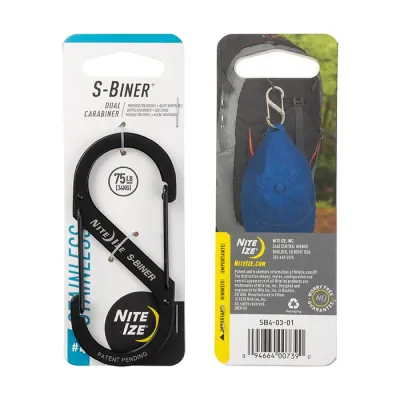
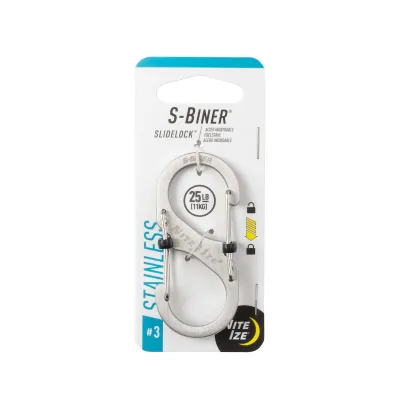
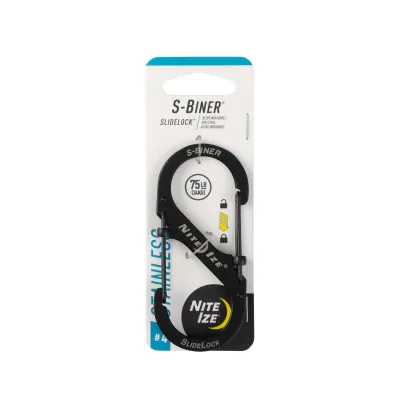
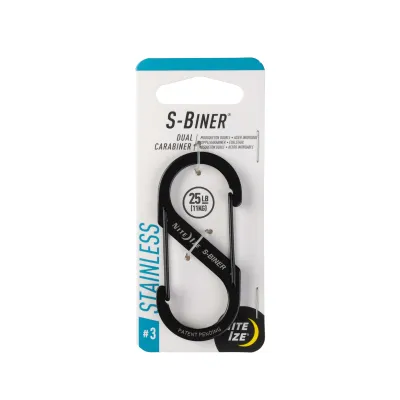
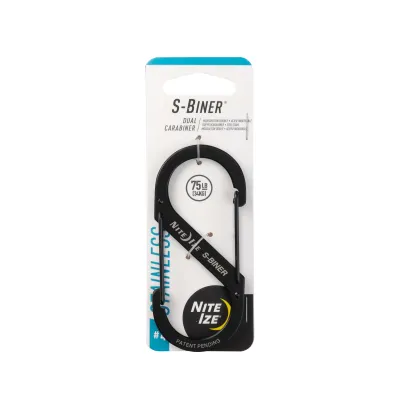
![[SG Stock] S-Biner Aluminum Alloy Dual Carabiner Hook Outdoor Camping Hiking](https://img.lazcdn.com/g/p/d574f43883e26950ef1c22d18b30eda1.jpg_400x400q80.jpg_.webp)
Prices are valid at publication and may change. Please refer to the product page for the latest price.
Understanding S-Biner Load Ratings and Climbing Standards
To understand why an S-Biner is unsuitable for climbing safety systems, you must look at how load ratings are calculated and certified. Utility clips are designed for static loads, meaning they are rated to hold a constant, non-moving weight. These ratings are typically printed on the packaging in kilograms or pounds, indicating the maximum weight the clip can support under ideal, stationary conditions. However, these figures do not account for the sudden, violent forces generated during a climbing fall.
Climbing hardware is rated using kilonewtons (kN), which measure force rather than simple static mass. One kilonewton is equivalent to approximately 100 kilograms of static force, but in a dynamic fall, the force exerted on an anchor or carabiner multiplies rapidly due to gravity and acceleration. A falling climber can easily generate forces exceeding 5 to 8 kN, even on a short fall. To provide a safe margin of error, certified climbing carabiners are engineered to withstand major-axis forces of at least 20 kN.
Furthermore, life-support climbing equipment must carry recognized safety certifications. Look for the CE (Conformité Européenne) mark or the UIAA (Union Internationale des Associations d’Alpinisme) logo stamped directly onto the metal spine. These certifications guarantee that the gear has undergone rigorous laboratory testing, including drop tests and gate-strength evaluations, to ensure it can survive real-world climbing impacts.
Always verify the manufacturer’s specifications on the product packaging or the spine of the clip itself. If a connector does not feature a laser-etched or stamped kN rating alongside a CE or UIAA certification mark, it is not climbing gear. Never assume a metal clip is safe for climbing simply because it is made of aluminum or feels heavy in your hand.
Safe vs. Unsafe Uses for S-Biners in Climbing
While S-Biners must never be used in your safety chain, they remain incredibly useful for non-critical gear management at the crag. Approved uses include organizing your gear loops, clipping your chalk bag to your harness, securing water bottles, or hanging your approach shoes from your backpack. In these scenarios, the clip is only subjected to minor static loads, and a mechanical failure would result in nothing more than a dropped accessory.

Conversely, life-critical applications are strictly off-limits for any utility clip. You must never use an S-Biner for belaying, building anchors, connecting a personal tether, or clipping into a climbing rope. These tasks require absolute structural reliability, which utility clips cannot provide.
The mechanical design of an S-Biner introduces specific risks when subjected to climbing forces. Because they feature two independent wire gates on opposite sides of a central spine, they are highly susceptible to accidental opening. If the clip rubs against a rock face, a bolt hanger, or another piece of gear, one of the gates can easily be pushed open, allowing your rope or sling to slip out.
Additionally, utility clips are highly vulnerable to cross-loading and structural deformation. If a force is applied sideways across the gates (the minor axis) rather than along the spine (the major axis), the thin metal frame can bend or snap instantly. Certified climbing carabiners are specifically designed to resist cross-loading and feature locking gates to prevent accidental opening, features that standard utility clips completely lack.
How to Verify Gear Safety Before You Climb
Developing a strict pre-climb inspection routine is the best way to ensure that non-rated utility clips never accidentally enter your life-support system. Before you leave the ground, perform a thorough visual and physical check of your harness, belay device, and anchor connections. This partner check is a standard safety practice that should never be skipped, regardless of your experience level.
During your inspection, verify that every connector in your safety chain is a certified climbing carabiner. Check your belay loop to ensure your belay device is secured with a locking carabiner, and inspect your personal anchor system to confirm that all attachment points are fully rated and locked. S-Biners should only be visible on your gear loops holding non-critical accessories.
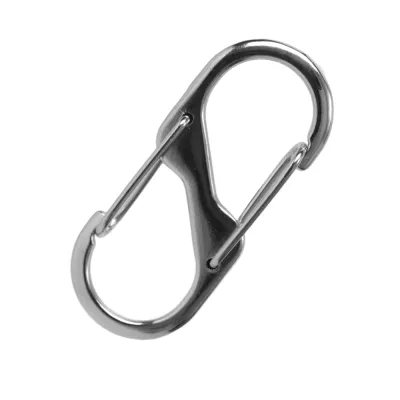
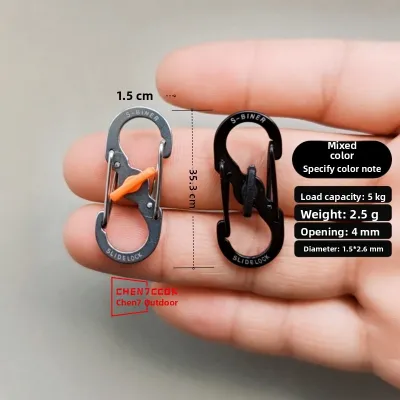
You can easily identify the differences between utility clips and climbing hardware by looking at their physical construction. Climbing carabiners feature a thick, robust spine, a single gate with a dedicated locking sleeve (such as a screw-gate or auto-locking collar), and clear certification markings. S-Biners typically have a symmetrical “S” shape, thin wire gates, and a much thinner profile overall.
Establish a strict rule for your climbing sessions: if you cannot verify the rating, origin, or intended use of a clip, remove it from your setup immediately. It is always better to pause your climb and consult a qualified climbing instructor or the manufacturer’s documentation than to risk your safety on an unverified piece of hardware. Investing S$12 to S$25 in a certified locking carabiner is a small price to pay for peace of mind on the wall.
When to Retire or Replace Your S-Biners
Even when used exclusively for non-critical gear organization, S-Biners will eventually wear out and require replacement. In Singapore’s humid tropical climate, gear stored in damp gear bags or exposed to outdoor moisture can degrade more quickly. Regularly inspecting your utility clips ensures they do not fail and cause you to lose valuable gear during a climb.
Begin your inspection by checking the gate spring tension. The wire gates should snap shut instantly and align perfectly with the nose of the clip. If you notice gate spring fatigue, sticking mechanisms, or a complete loss of tension that leaves a gate partially open, the clip must be retired immediately. A loose gate can easily snag on your harness or allow your gear to fall.
Next, examine the metal body for physical damage. Look for deep grooves caused by rope friction, sharp burrs, or visible bending. Sharp edges on a worn utility clip are particularly dangerous because they can easily snag and fray your harness webbing, climbing slings, or ropes during transport.
When you decide to retire an S-Biner, make sure to discard it properly so it cannot be accidentally reused. Use a pair of pliers to bend the frame or cut the wire gates before throwing it in the recycling bin. This simple step ensures that a beginner climber or a well-meaning partner does not mistake the damaged clip for a functional tool and put it back into service.
Frequently Asked Questions (FAQ)
Can I use an S-Biner to attach my climbing shoes to my harness?
Yes, attaching your climbing shoes to your harness or backpack is a safe and highly practical use for an S-Biner. Because this is a non-critical, low-load task, a utility clip is perfectly adequate. However, always make sure the wire gates are fully closed and clear of any rock contact during your climb to prevent your shoes from accidentally unclipping and falling on climbers below.
What is the difference between an S-Biner and a climbing carabiner?
The primary difference lies in their engineering, load capacity, and safety certifications. A climbing carabiner is a certified life-safety device designed to withstand dynamic forces of 20 kN or more, featuring a robust spine and a secure locking gate. An S-Biner is a dual-gated utility clip designed solely for lightweight, static gear organization and lacks the structural strength, locking mechanisms, and safety certifications required to support human weight.

Community discussion
Share your experience or ask a question. Comments are reviewed before publication.