
Selecting the right RSL shuttlecock model depends on matching your playing frequency, skill level, and budget to the specific materials and speed ratings of the shuttlecock. Beginners and recreational players benefit most from durable synthetic nylon options or entry-level training feathers that tolerate frequent mishits. Intermediate club players require a balance of flight consistency and cost, making mid-tier duck or goose feather models with composite cork bases the ideal choice. Advanced and competitive players demand maximum flight precision and structural integrity, which only premium goose feather models with natural cork bases can deliver.
Understanding RSL Shuttlecock Materials and Grading
Nylon shuttlecocks feature a synthetic skirt molded to mimic the shape of natural feathers. They offer exceptional durability because the plastic skirt resists tearing and bending when struck off-center. However, synthetic skirts do not collapse and flare in the same manner as natural feathers during flight. This difference results in a more linear trajectory and a heavier impact feel on the racket strings, which can limit the development of delicate net play and precise drop shots.
Natural feather shuttlecocks, crafted from either duck or goose feathers, provide the classic badminton experience. They offer superior flight stability, a crisp impact sound, and a natural deceleration curve that allows for advanced tactical play. Goose feathers are generally stronger and have thicker vanes than duck feathers, leading to better structural integrity and more consistent flight paths over multiple rallies. Duck feathers are more economical but tend to wear out faster under high-intensity play.
Products mentioned in this guide
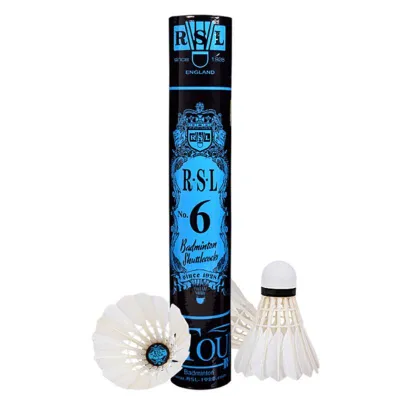
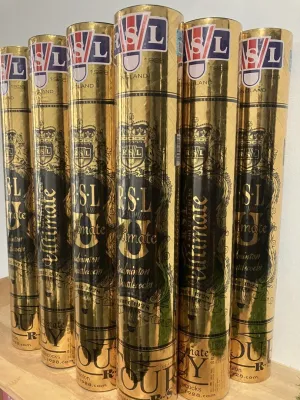
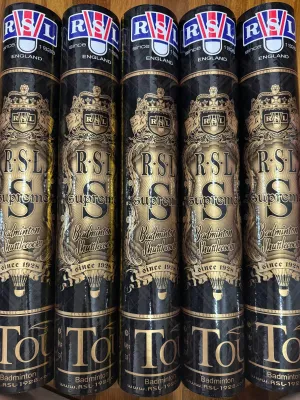
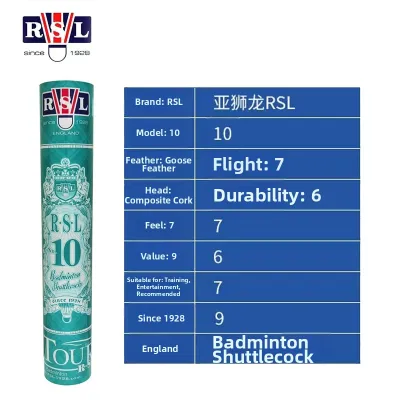
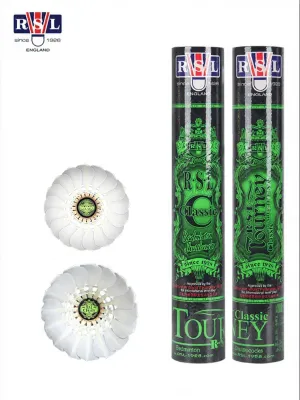
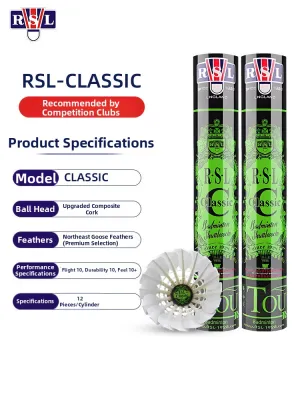
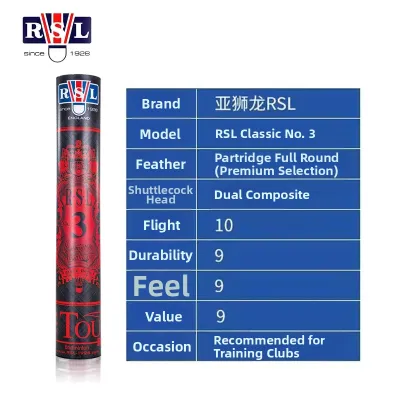
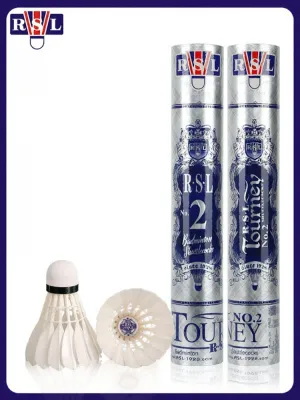
Prices are valid at publication and may change. Please refer to the product page for the latest price.
RSL classifies its product lines into distinct tiers, typically labeled on the tube as training, club, or tournament grades. Training-grade options focus on affordability and basic durability, often utilizing duck feathers and composite cork bases to withstand repetitive drills. Club-grade models step up the quality with selected duck or lower-grade goose feathers, offering a reliable flight path for regular social matches. Tournament-grade models represent the premium tier, utilizing top-grade goose feathers and natural cork to meet strict standards for international and domestic competitions.
The speed rating of a shuttlecock, usually indicated by numbers like 76, 77, or 78 on the tube cap, determines how fast and far the shuttlecock travels under specific environmental conditions. Higher temperatures and higher altitudes reduce air density, causing shuttlecocks to fly faster and farther. Conversely, cold air and sea-level altitudes increase air resistance, slowing the shuttlecock down. Choosing the correct speed rating ensures that players do not have to alter their stroke mechanics to compensate for an unnaturally fast or slow flight.
Matching RSL Shuttlecocks to Your Skill Level
A player’s physical power and technical precision dictate the physical demands placed on a shuttlecock. Beginners often struggle with clean contact, frequently striking the feather skirt instead of the cork base, which quickly destroys natural feathers. As players progress, their smash power increases, but so does their control, allowing them to transition to higher-quality shuttlecocks that reward precise racket-face contact.

The transition from synthetic nylon to natural feather shuttlecocks is a significant milestone in a player’s development. While nylon is excellent for learning basic swing mechanics, it cannot replicate the spin, slice, and rapid deceleration required for advanced net play and deceptive drops. Upgrading to feather models becomes essential when a player begins focusing on tactical placement and stroke variation rather than simply keeping the shuttlecock in play.
Beginners and Casual Players: Prioritizing Durability
For those starting their badminton journey or playing occasionally for fitness, durability and cost-effectiveness are the primary concerns. Synthetic nylon shuttlecocks are the practical standard for these scenarios, especially when playing in non-ideal environments like outdoor parks, community center backyards, or school physical education halls. The robust construction of a nylon skirt ensures that a single shuttlecock can survive multiple sessions without losing its basic flight shape.
When purchasing synthetic options, players should examine the packaging for details regarding skirt stiffness and base material. A stiffer nylon skirt helps maintain a more stable flight path in light breezes, while a synthetic or composite cork base provides a forgiving feel that reduces the risk of wrist fatigue during off-center hits. These models are designed to offer a predictable, albeit simplified, flight trajectory that allows beginners to focus on timing and footwork.
Typical use cases for these durable models include family recreational games, school sports sessions, and outdoor fitness hitting. Because these environments often lack the controlled conditions of indoor sports halls, natural feathers would degrade almost instantly. Using synthetic alternatives keeps the game accessible, affordable, and fun, allowing players to build their stamina and coordination before investing in premium gear.
Intermediate Club Players: Balancing Feel and Cost
Intermediate players who participate in regular club sessions or social leagues require a shuttlecock that supports technical improvement without becoming a financial burden. This is the stage where transitioning to entry-level or mid-tier natural feather shuttlecocks is highly recommended. These models typically feature duck feathers or standard-grade goose feathers, providing the authentic flight dynamics and crisp impact feel necessary for mastering advanced strokes.
Using duck feather shuttlecocks allows intermediate players to practice precise net drops, tight slices, and deep clears with realistic feedback. The trade-off lies in durability; while these shuttlecocks fly beautifully, their feathers are more brittle than premium goose feathers. A single mistimed smash that contacts the skirt can bend or break a feather, immediately compromising the shuttlecock’s flight stability and requiring a replacement.
To manage costs during long social sessions, players can implement a practical rotation strategy. Use slightly worn or older shuttlecocks for warm-ups and high-intensity smash drills where damage is most likely to occur. Save fresh, new shuttlecocks from the tube for active match play where flight precision directly impacts the game’s outcome. This approach extends the lifespan of each tube and ensures that players get the most value out of their purchase.
Advanced and Tournament Players: Demanding Precision
Advanced players and competitive tournament competitors cannot compromise on flight consistency, speed accuracy, or structural integrity. At this level, even a minor wobble in the air can ruin a delicate net shot or cause a smash to land out of bounds. Consequently, these players require premium goose feather shuttlecocks equipped with natural or high-grade composite cork bases that deliver absolute predictability.
Premium goose feathers are selected for their uniform thickness, straight shafts, and strong vanes, which allow the shuttlecock to spin consistently and slow down predictably at the end of its trajectory. The base, often made of solid natural cork, provides a clean, solid transfer of energy from the racket face, allowing for maximum smash speed and precise control over deceptive shots. These materials ensure that the shuttlecock behaves exactly as the player intends, stroke after stroke.
When preparing for official competitions, players must verify that the shuttlecocks carry the Badminton World Federation (BWF) approval label on the tube. This certification guarantees that the model has passed rigorous testing for flight trajectory, speed consistency, and structural standards. Additionally, players should perform a quick visual inspection upon opening a new tube, checking for uniform feather alignment, even glue distribution along the bands, and a smooth, unblemished cork face to ensure peak performance.
What to Check on the Tube Before You Buy
Before purchasing a tube of RSL shuttlecocks, either from a local pro shop or an online marketplace, players should carefully verify several key specifications to ensure they are getting the right product for their playing environment. The first and most critical detail to check is the speed number printed on the tube’s cap. In Singapore, where the climate is consistently hot and humid and courts are at sea level, speed 77 is generally the standard choice for balanced flight. Speed 76 may be preferred during exceptionally hot periods or on faster courts, while speed 78 is typically reserved for cooler, air-conditioned halls where the denser air slows the shuttlecock down.
Next, perform a visual inspection of the shuttlecocks if the packaging or store display allows. Look through the transparent tube window or ask to examine a sample to assess the quality of the cork base and the uniformity of the feathers. A high-quality composite or natural cork base should feel firm and show no signs of crumbling or unevenness. The feathers should be perfectly aligned, with no gaps, bent tips, or thin, fragile-looking vanes, as these defects will immediately cause the shuttlecock to wobble in flight.
Finally, always verify that you are purchasing from authorized retail channels or official brand stores. Because RSL is a highly popular brand, counterfeit products are common on various ecommerce platforms. Counterfeit shuttlecocks often use low-grade feathers and cheap adhesives, leading to terrible flight paths and rapid structural failure within just a few hits. Checking for official security labels, holographic stickers, or verification codes on the tube packaging is an essential step to guarantee product authenticity and ensure a high-quality playing experience.
How to Maintain and Extend Feather Shuttlecock Lifespan
Feather shuttlecocks are a significant investment, but players can dramatically extend their lifespan through proper care and maintenance. One of the most effective, reversible methods to prevent feathers from becoming brittle is humidification or steaming. In Singapore, many badminton halls are heavily air-conditioned, which dries out the air and makes natural feathers dry and prone to snapping upon impact. Steaming the shuttlecocks before a session restores moisture to the feathers, making them more flexible and resilient.
To steam your shuttlecocks safely, open both caps of the tube and expose the interior to gentle water vapor, such as from a handheld garment steamer or a cup of hot water, for about 30 seconds to a minute. Be careful not to let direct moisture or water droplets saturate the cork base, as this can alter its weight and ruin the flight balance. Once the vapor has passed through the tube, close the caps immediately to trap the moisture inside, allowing the feathers to absorb the humidity for at least a few hours before your game.
Proper storage is also crucial for maintaining the structural integrity of your gear. Always store shuttlecock tubes vertically with the corks pointing downward to prevent the feathers from warping under their own weight. Keep the tubes in a cool, dry place away from direct sunlight, car trunks, or extreme heat, which can dry out the natural oils in the feathers and degrade the adhesive holding them together.
Recognizing when to retire a damaged shuttlecock is essential for maintaining good playing habits and preventing physical strain. When feathers become broken, bent, or heavily frayed, the shuttlecock will lose its spin and begin to wobble or slow down prematurely. Continuing to play with a damaged shuttlecock forces players to swing harder to achieve the same depth, which can lead to poor stroke mechanics, wrist fatigue, or shoulder strain. Retire worn shuttlecocks to the training bin for low-intensity drills and open a fresh one to keep your game sharp and safe.
Frequently Asked Questions (FAQ)
How long does a typical feather shuttlecock last during a match?
The lifespan of a feather shuttlecock during active play depends heavily on the players’ skill levels, smash intensity, and the frequency of clean hits. In a high-intensity match involving advanced players who hit clean smashes and precise drops, a single high-quality shuttlecock can last for one to two games before the feathers begin to fray and affect flight consistency. However, if players frequently mishit the shuttlecock—striking the feather skirt instead of the cork—the feathers can break within a few rallies, requiring immediate replacement. For casual training or social play, a shuttlecock can often be used for several games, provided the flight path remains reasonably stable and predictable.
Can I use indoor feather shuttlecocks for outdoor badminton?
Using standard indoor feather shuttlecocks for outdoor play is highly impractical and not recommended. Outdoor environments present unpredictable wind currents, dust, and varying humidity levels that immediately disrupt the delicate flight path of natural feathers. Furthermore, rough outdoor surfaces like concrete or asphalt will rapidly destroy the feathers and the cork base upon landing. For outdoor badminton, synthetic nylon shuttlecocks or specialized outdoor shuttlecocks are the only cost-effective and practical choice, as they are designed to withstand wind resistance and survive impacts with hard ground surfaces.

Community discussion
Share your experience or ask a question. Comments are reviewed before publication.