
Quick Answer: Matching Yesoul Equipment to Your HDB Layout
Deciding on home cardio equipment for a Singapore HDB flat requires balancing floor footprint, ceiling clearance, and storage needs. Yesoul offers both treadmills and ellipticals, but their spatial demands differ significantly. Treadmills typically require a longer, linear floor footprint during use but often feature folding mechanisms to save space when idle. Ellipticals generally maintain a fixed footprint with higher vertical clearance demands due to the user’s elevated pedaling path. To make the right choice, you must verify the exact dimensions of your preferred model against your flat’s layout, ensuring you have adequate safety margins on all sides.
How to Measure Your HDB Space for Cardio Equipment
Before purchasing any heavy fitness equipment, you must map out a dedicated workout zone. Start by measuring the physical floor area where the machine will sit, but do not stop at the machine’s static dimensions. Safety guidelines require a clear zone around the equipment: aim for at least 0.5 meters of open space on both sides and at least 1 to 1.5 meters of clear space behind a treadmill to prevent injuries during an emergency dismount or fall.

Next, trace the delivery path from your HDB flat’s main entrance to the final room. Measure the clear width of your main door, hallway turns, and bedroom door frames. Large cardio machines, even when boxed or partially disassembled, require significant clearance to maneuver around tight corners typical of modern Build-To-Order (BTO) layouts.
Products mentioned in this guide
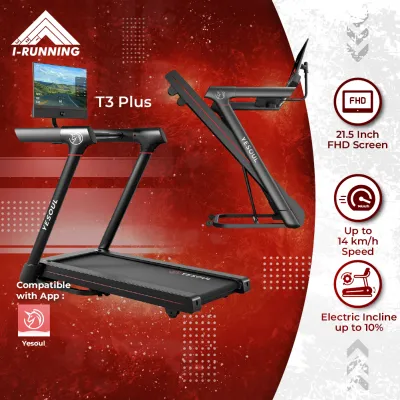
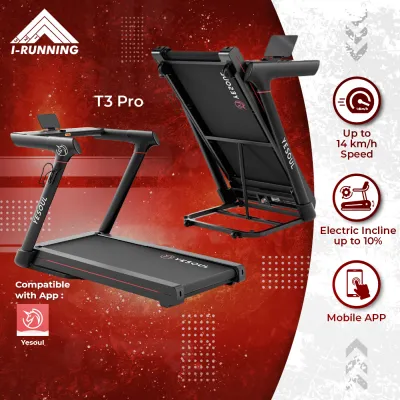
Prices are valid at publication and may change. Please refer to the product page for the latest price.
Vertical clearance is another critical factor, particularly for ellipticals. To calculate your ceiling safety margin, add your own height to the maximum pedal step-up height of the machine, then add a safety buffer of at least 30 centimeters. Ensure this total height does not conflict with ceiling fans, light fixtures, or low-hanging structural beams common in older flats.
Finally, identify the location of your nearest wall power outlet. High-draw motorized treadmills should be plugged directly into a dedicated wall socket rather than an extension cord or multi-way adapter to prevent electrical overloads and tripping hazards. Ensure the power cord can reach the outlet without stretching across high-traffic walkways where it could become a tripping hazard.
Evaluating Yesoul Treadmills vs. Ellipticals for Compact Flats
Choosing between a Yesoul treadmill and an elliptical involves comparing how each machine occupies your living space both during a workout and while stored. While both options provide excellent cardiovascular workouts, their structural designs dictate different room arrangements. A structured comparison of their footprint, storage capabilities, and movement clearance will help you determine which machine aligns with your specific HDB room layout.
Footprint, Foldability, and Storage Checks
Treadmills are highly favored in compact apartments because many models feature folding decks. When evaluating a Yesoul treadmill, check the user manual to verify the folding mechanism’s operation, the locked upright footprint, and the stability of the locking pins. Some models fold completely flat to slide under a bed or stand against a wall, while others fold at an angle, which still requires dedicated floor space.
Ellipticals, by contrast, usually feature a rigid, non-folding frame to maintain structural stability during high-intensity workouts. This means the machine’s footprint remains constant whether you are exercising or not. You must ensure your room can permanently accommodate this static footprint without blocking walkways or access to built-in wardrobes.
Never assume that all models within a brand’s lineup share the same folding capabilities or dimensions. Always check the exact model label, net weight, and folded dimensions on the manufacturer’s official specification sheet before finalizing your purchase. Heavy machines also require built-in transport wheels if you plan to roll them out of sight after every session.
Ceiling Height and Movement Clearance
Vertical clearance is a safety priority that is easily overlooked until the machine is assembled. For ellipticals, the user’s body moves along an elliptical path that raises their head significantly higher than their standing height. Use the standard formula: Required Ceiling Height = User Height + Maximum Pedal Elevation + 30 cm Safety Buffer. If your ceiling height is standard (around 2.6 meters in most HDB flats), a tall user on a high-step elliptical may find themselves uncomfortably close to the ceiling.
Treadmills also require vertical consideration, especially if the model features an incline function. Raising the treadmill deck increases the height of the running platform at the front of the machine. You must calculate your head clearance based on the maximum incline setting to ensure you do not collide with overhead fixtures during a run.
Scan your ceiling for potential hazards before deciding on placement. Avoid positioning any cardio machine directly underneath a ceiling fan or low-hanging light fixture. A sudden movement or a high-intensity sprint could lead to severe injury if your hands or head come into contact with a spinning fan blade.
Placement, Safety, and Neighbor Considerations
Living in a high-density HDB flat means your workouts can affect your neighbors. Treadmills generate significant impact noise from footstrikes, which travels through the concrete floor slab as structural vibration. To minimize this, place a high-density, shock-absorbing equipment mat beneath your machine to dampen the vibration and protect your flooring from scratches.
Proper placement also extends to the machine’s mechanical health. Ensure there is adequate ventilation around the motor housing, keeping it away from enclosed corners, heavy drapes, or direct sunlight. Restricting airflow can cause the motor to overheat, reducing the lifespan of the internal electronics.
To maintain good neighbor relations, avoid placing your cardio equipment directly above or adjacent to shared bedroom walls. Schedule your workouts during reasonable daytime or early evening hours, and avoid high-impact running late at night or early in the morning. Regularly lubricate the treadmill belt or elliptical joints as specified in the Yesoul user manual to prevent squeaking and mechanical friction noise.
Always consult the official Yesoul user manual for specific environmental, power, and maintenance requirements. Following the manufacturer’s guidelines ensures your machine operates safely, remains within warranty terms, and performs reliably over its lifespan.
Frequently Asked Questions (FAQ)
Can I keep a Yesoul treadmill or elliptical in the HDB corridor or household shelter?
HDB common corridors must remain clear of obstructions to ensure safe passage for residents and emergency personnel during evacuations. Placing fitness equipment in shared corridors violates local fire safety regulations and can result in fines or removal requests.
Household shelters, while private, are not ideal environments for electronic cardio equipment. These spaces often lack adequate ventilation and can accumulate moisture, which can damage sensitive electronic consoles and cause rust on steel frames. To protect your equipment and comply with safety guidelines, keep your treadmill or elliptical strictly within your flat’s private living areas.
Will using a treadmill in an HDB flat cause noise complaints from neighbors?
Using a treadmill can lead to noise complaints if the impact of your running steps transfers directly into the building’s concrete structure. The primary sources of noise are the motor hum, the belt sliding over the deck, and the physical impact of your feet.
To prevent complaints, use a thick, specialized anti-vibration rubber mat under the treadmill to absorb the impact energy. Additionally, place the machine on a solid floor area away from shared partition walls, keep the running belt properly lubricated according to the manual, and choose low-impact walking or moderate jogging during quiet hours.

Community discussion
Share your experience or ask a question. Comments are reviewed before publication.